This article is for health education purposes only and is intended for informational reference; it does not constitute medical advice. If you have any health concerns, please consult a professional physician.
"I'm Fat but Healthy"? A 13-Year Follow-Up of 150,000 People: This Claim No Longer Holds Up
Your checkup report comes back all normal—blood pressure isn't high, blood sugar is normal, blood lipids are within the reference range—only the number on the scale is over the limit. Many people therefore feel perfectly at ease: "I'm one of those healthy obese people." In medicine, this concept is called "metabolically healthy obesity" (MHO), referring to people with obesity who do not have high blood pressure, diabetes, or abnormal blood lipids. They account for about one-third of all people with obesity—possibly as many as 300 million worldwide. But is it really as "safe" as the name sounds? In August 2026, Kausik Ray's team at Imperial College London published a large-scale cohort study based on the UK Biobank in the
American Journal of Preventive Cardiology: 157,159 people, median follow-up of 12.9 years. The conclusion was direct and unequivocal—
Obesity without metabolic abnormalities is not benign.
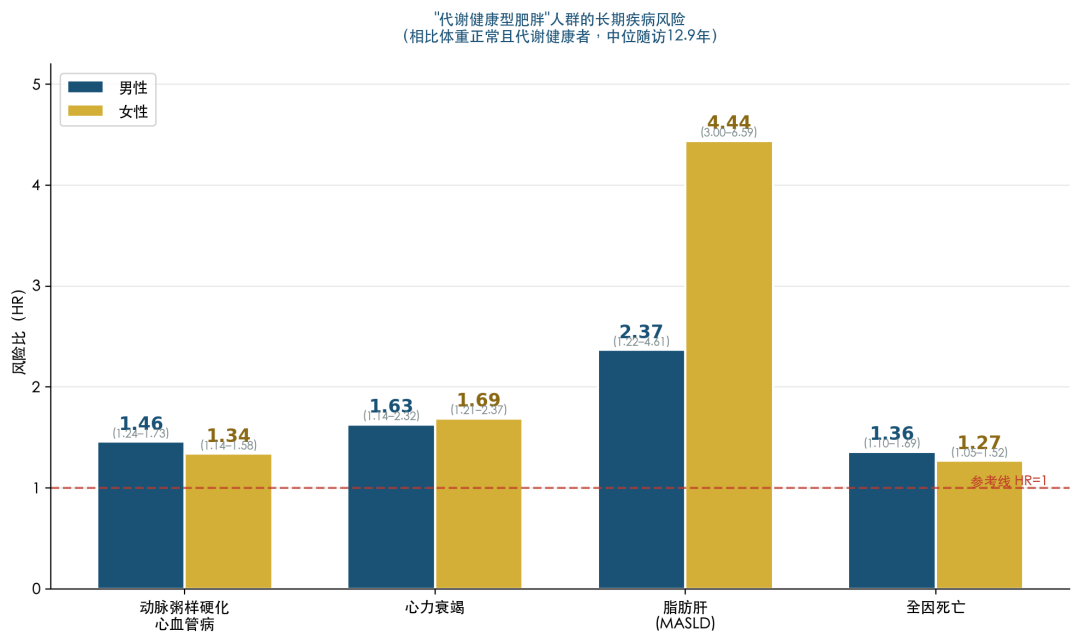
1. How Much Higher Is the Risk for "Healthy Obese" People, Really?
Using people with normal weight and no metabolic abnormalities as the reference group, and after adjusting for confounding factors such as age, smoking, and physical activity, the study found that even when blood pressure, blood sugar, and blood lipids were all normal, obese men still had a 46% higher risk of atherosclerotic cardiovascular disease, a 63% higher risk of heart failure, a 137% higher risk of fatty liver disease (MASLD), and a 36% higher risk of all-cause death. The data for women are equally concerning: heart failure risk was 69% higher, fatty liver risk soared by 344%, and all-cause death was 27% higher. The study authors, Ananda et al., pointed out that obesity itself—not merely through metabolic abnormalities—continuously damages the cardiovascular system.
2. What's More Dangerous: Metabolic Abnormalities Will Arrive Sooner or Later
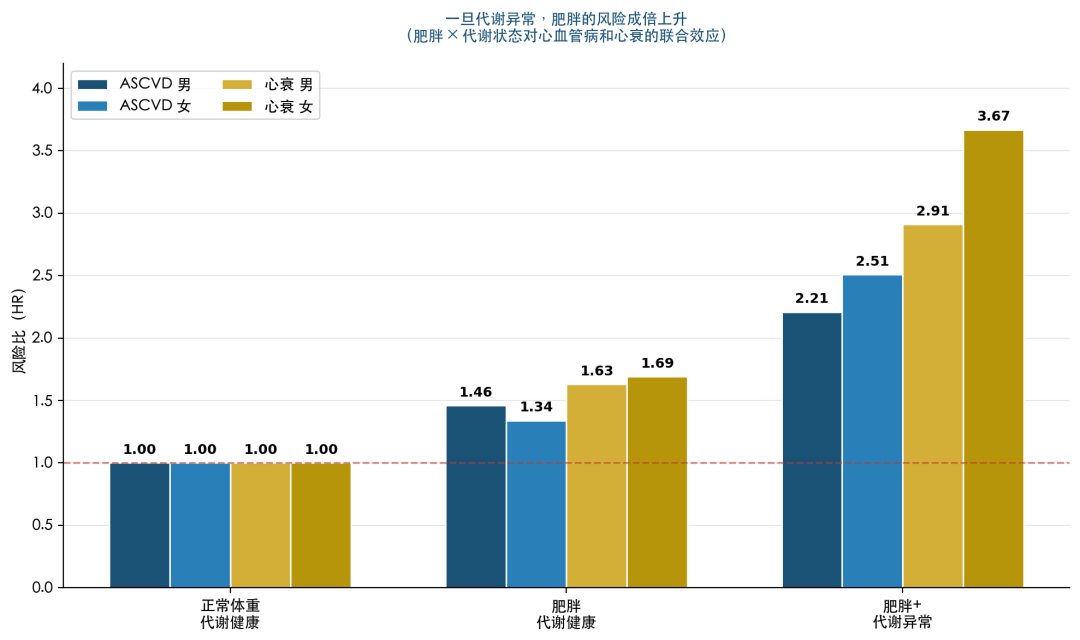
MHO is not a stable "safe haven." As people age and obesity persists, a considerable proportion of "healthy obese" individuals will gradually develop high blood pressure, abnormal blood sugar, or lipid disorders. And once metabolic abnormalities appear, the risk escalates sharply:
- In obese men with metabolic abnormalities, cardiovascular disease risk rose to 2.21 times, heart failure to 2.91 times, fatty liver to 6.84 times, and end-stage renal disease to 5.42 times;
- More pronounced in women: cardiovascular disease 2.51 times, heart failure 3.67 times, fatty liver 8.17 times, end-stage renal disease 7.96 times.
Simply put: the shift from "healthy obesity" to "unhealthy obesity" is not a question of whether, but when.
III. Why Does This Happen?
In a 2018 review in
The Lancet Diabetes & Endocrinology, Stefan et al. proposed that adipose tissue in MHO individuals often develops functional abnormalities earlier—visceral fat accumulation, adipocyte hypertrophy, chronic low-grade inflammation—and these changes precede the deterioration of traditional indicators such as blood glucose and blood pressure. In other words, "metabolically normal" on a routine health check is a relatively crude judgment. By the time you see the arrows on your report, your cardiovascular system may already have endured years of extra burden.
IV. Actionable Advice for Readers
Don't comfort yourself with "metabolically normal": a BMI ≥ 28 or an elevated waist circumference (≥ 90 cm for men, ≥ 85 cm for women) is itself a signal that intervention is needed—normal lab results are no reason to neglect weight management. Measure your waist, not just your weight: central obesity (a large belly) is more closely associated with cardiovascular risk than BMI, and studies confirm that abdominal obesity significantly amplifies risk. Get regular follow-ups—don't assume "one normal result means you're fine": for people with obesity, it is advisable to check blood pressure, fasting blood glucose, HbA1c, and blood lipids at least once a year, and where feasible, add liver ultrasound or fatty liver-related markers. Act before metabolic abnormalities appear: a sensible diet, regular exercise, and gradual weight loss—intervening before blood pressure and blood glucose raise red flags yields the greatest benefit. More than 1 billion people worldwide are affected by obesity (Lancet NCD-RisC, 2024), and about one-third of them are temporarily "metabolically normal." This study reminds us that the "healthy obese" label is more of a temporary window than a long-term get-out-of-jail-free card. While the window is still open, take charge of your weight and waist circumference—this may be the most cost-effective health investment you can make. Consider sharing this with that family member or friend who always says, "I'm fat but I'm fine."References: Ananda RA, Solomon B, Nicholls SJ, Ray KK. Obesity, metabolic health status, and adverse outcomes in men and women.Am J Prev Cardiol. 2026;28:101556. PMID: 42395093. DOI: 10.1016/j.ajpc.2026.101556.Stefan N, Häring HU, Hu FB, Schulze MB. Metabolically healthy obesity: the low-hanging fruit in obesity treatment?Lancet Diabetes Endocrinol. 2018;6(3):249-258. PMID: 28919065. DOI: 10.1016/S2213-8587(17)30292-9.NCD Risk Factor Collaboration (NCD-RisC). Worldwide trends in underweight and obesity from 1990 to 2022: a pooled analysis of 3663 population-representative studies with 222 million children, adolescents, and adults.Lancet. 2024;403(10431):1027-1050. PMID: 38432237. DOI: 10.1016/S0140-6736(23)02750-2.Disclaimer: This article is based on publicly published scientific literature and is intended for health education purposes only. It does not constitute any diagnostic or treatment advice or medication guidance. Please consult a qualified healthcare professional for personal health concerns.Conflict of interest statement: The author of this article and Sunsheng Hua (Beijing) Medical Technology Co., Ltd. have no conflicts of interest with the above-mentioned studies.© 2026 Sunsheng Hua (Beijing) Medical Technology Co., Ltd.