Snoring Isn't Proof of Good Sleep: 940 Million People Are Starved of Oxygen Every Night
This article is for health education purposes only and is intended for informational reference. It does not constitute medical advice; if you have health concerns, please consult a professional doctor.
You've just drifted off when the person next to you nudges you: stop snoring.
Most people explain it away—snoring means you're sleeping soundly.
The truth is a bit counterintuitive: during those loud minutes, air actually isn't getting in.
First, Look at How Big This Number Is
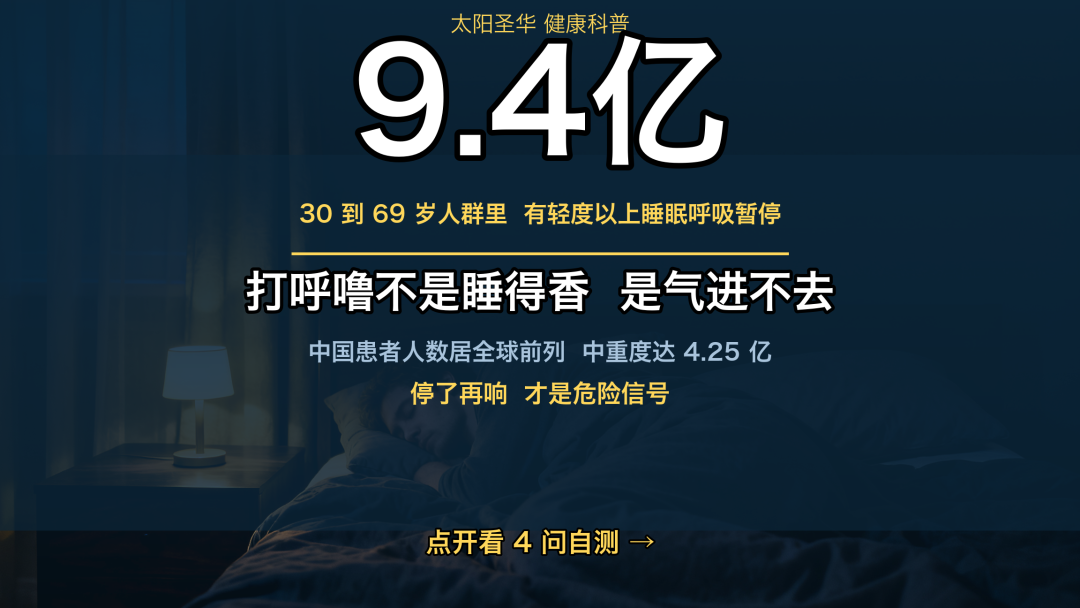
In 2019, The Lancet Respiratory Medicine offered an estimate: among people aged 30 to 69 worldwide, 936 million have mild to severe obstructive sleep apnea, of whom 425 million have reached moderate or worse. The report named China among the countries with the highest numbers[1].
This figure comes from projections based on 17 studies using objective monitoring, not self-reported questionnaires, so it reflects "how much actually exists," not "how many people think they have it."
Put in plain terms: after you fall asleep, the upper airway repeatedly collapses, breathing stops for seconds to tens of seconds, blood oxygen drops, and the brain has no choice but to drag you back into light sleep. Dozens or hundreds of times a night. The next day you only remember "not getting enough sleep"—when in fact you were woken up many times during the night and simply don't remember.
At What Point Does Snoring Become a Disease
Severity is measured by one index: AHI, the number of times per hour that breathing stops or becomes markedly shallow. Under 5 is normal, above 15 is moderate, above 30 is severe. Routine physical exams don't test for this; it requires an overnight sleep study.
The body's warning signs are usually these:
-
Daytime sleepiness: you nod off in meetings, watching TV, or driving—this is why many people actually come to see a doctor
-
Feeling awful in the morning: waking with a headache, dry mouth, tight throat
-
More nighttime urination: two or three times a night—it may not be a prostate issue
-
Worse memory and temper: family members often notice before the person does
There's one more sign only a bed partner or roommate can see: the snoring suddenly stops for a few seconds, followed by a loud gasp. Constant noise and stop-then-restart are two different things—the latter means the airway has closed completely.
Who's more likely to be affected? A higher body mass index, a thicker neck circumference, a small or receding chin, and being a postmenopausal woman all raise the risk. Before menopause, women have hormonal protection, and their symptoms are often not "loud" but insomnia, morning headaches, and constant fatigue—so they're more easily attributed to stress.
That's exactly why many people go years without a diagnosis: first treated as rhinitis, then as insomnia, and eventually chalked up to "getting older." A routine physical's complete blood count and liver/kidney function panels don't include AHI—if the machine doesn't beep, the problem just hangs there.
It's Connected to More Than One Organ
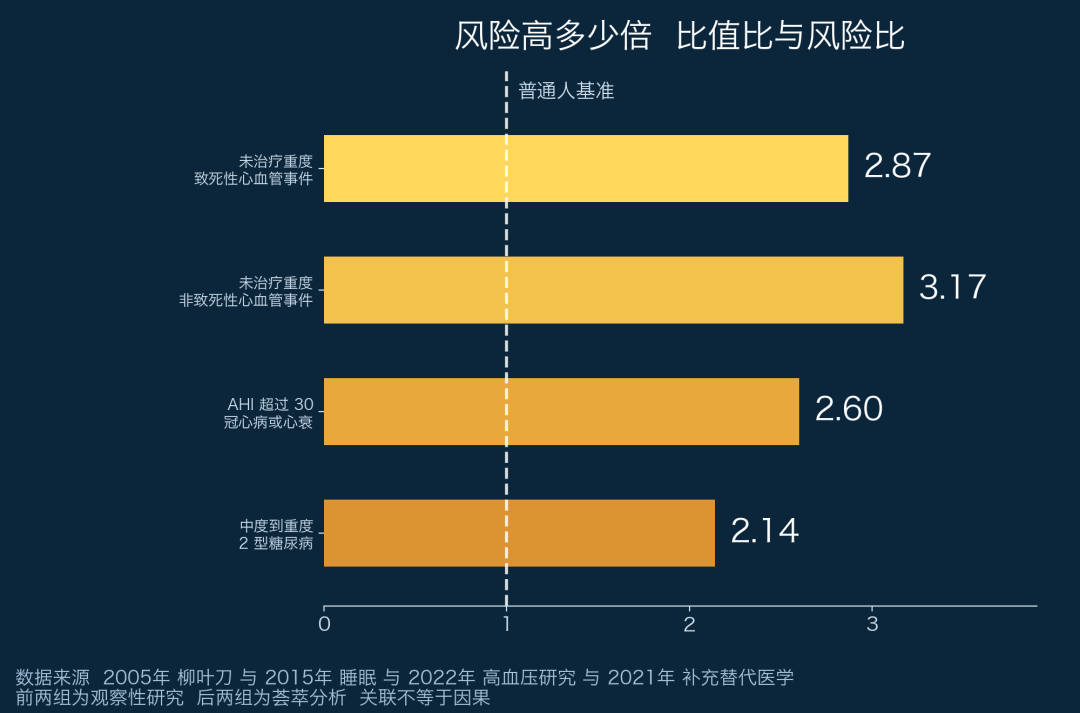
First, look at a chart—the numbers are fairly direct.
-
Heart and blood vessels: in an observational study with 10.1 years of follow-up, untreated severe patients had an odds ratio of 2.87 for fatal cardiovascular events and 3.17 for non-fatal events[2]
-
Coronary heart disease and heart failure: in the US Wisconsin cohort of 1,131 people followed for 24 years, those with AHI above 30 had 2.6 times the risk of coronary heart disease or heart failure compared with normal breathers[3]
-
Blood pressure: a meta-analysis of 19 randomized controlled trials with 1,904 people showed that after treatment with a breathing machine, 24-hour systolic pressure dropped by an average of 5.01 mmHg and diastolic by 3.30[4]
-
Blood sugar: in a dose-response meta-analysis, moderate to severe patients had an odds ratio of 2.14 for developing type 2 diabetes[5]
Two layers need to be distinguished here: the first two groups are observational studies, which describe "association" and cannot be read directly as "snoring causes heart disease"; the blood pressure item comes from randomized controlled trials, where the drop in blood pressure is brought about by the treatment itself—that's causal evidence. Looking at both layers together, the direction is consistent.
Why Weight Loss Helps at the Root
What accumulates around the upper airway is fat: in the neck, beside the pharynx, at the base of the tongue, in the viscera. As weight goes up, the lumen is squeezed narrower, and once the muscles relax during sleep, it collapses.
A randomized controlled study of 81 patients with mild disease applied a 1-year diet-plus-exercise intervention, then followed up for another two years: the intervention group lost an average of 7.3 kg, and after two years the odds ratio for developing sleep apnea was 0.35—meaning risk dropped to about one-third[6].
In another 12-month intensive intervention study, those who lost 8.2% of body weight saw their visceral fat index fall by 19.4, with sleep apnea severity improving in parallel[7]. In yet another randomized trial of a 6-month Mediterranean diet intervention, the intervention group's BMI fell by 0.75, nightly machine use rose from 5.4 hours to 6.1 hours, and systolic pressure dropped by 5.5 mmHg[8].
Magnitude and pace matter more: losing 5% to 10% of body weight is already meaningful—there's no need to chase speed. Rapid weight loss and prolonged fasting leave you more tired and cost you muscle.
Some people have normal weight yet still stop breathing: a receding jaw, enlarged tonsils, a deviated nasal septum, chronic nasal congestion—these structural problems can't be solved by weight loss. So don't treat weight loss as the whole answer—it addresses the fat layer; the structural layer still needs a doctor's evaluation.
What You Can Do Tonight, and When to See a Doctor
Four small things, at almost zero cost:
-
Sleep on your side: on your back, the base of the tongue sags back severely; side sleeping eases it
-
No alcohol for 3 hours before bed: alcohol relaxes the throat muscles further, worsening both snoring and breathing pauses
-
Clear the nose first: for people with chronic rhinitis or nasal congestion, treat the nose first
-
Don't treat anti-snoring strips or pillows as treatment: at most they reduce the noise; they can't improve oxygen deprivation
There's also a crude but very useful trick: have a family member record two audio clips of you sleeping on their phone and bring them to the doctor—far more useful than your verbal description of "snoring really loud."
When should you get tested? The STOP Four Questions commonly used by doctors can be used directly for self-assessment: Do you snore loudly? Are you tired during the day? Has anyone seen you stop breathing? Do you have high blood pressure? If two or more of these four apply, along with a high body mass index, a thick neck circumference, being male, and being older, it's time to get a sleep study. In the original research, the sensitivity of the four questions alone was 65.6% to 79.5%; when body mass index, age, neck circumference, and sex were included, sensitivity increased to 83.6% to 100%[9].

Consider forwarding this to the snorer in your family: Snoring is not evidence of sleeping well—it means air can't get through. If any one of these three applies—feeling sleepy during the day, morning headaches, or someone seeing you stop breathing—it's worth getting tested once.
If this has been helpful to you, give it a like or a "Wow," and feel free to leave a comment telling us what topics you'd like to see.
Snoring is a sound; oxygen deprivation is the disease.
✦
References
[1] Benjafield AV, Ayas NT, Eastwood PR, et al. Estimation of the global prevalence and burden of obstructive sleep apnoea: a literature-based analysis. Lancet Respir Med. 2019;7(8):687-698. PMID: 31300334
[2] Marin JM, Carrizo SJ, Vicente E, Agusti AG. Long-term cardiovascular outcomes in men with obstructive sleep apnoea-hypopnoea with or without treatment with continuous positive airway pressure: an observational study. Lancet. 2005;365(9464):1046-1053. PMID: 15781100
[3] Hla KM, Young T, Hagen EW, et al. Coronary heart disease incidence in sleep disordered breathing: the Wisconsin Sleep Cohort Study. Sleep. 2015;38(5):677-684. PMID: 25515104
[4] Shang W, Zhang Y, Liu L, et al. Benefits of continuous positive airway pressure on blood pressure in patients with hypertension and obstructive sleep apnea: a meta-analysis. Hypertens Res. 2022;45(11):1802-1813. PMID: 35701490
[5] Yu Z, Cheng JX, Zhang D, Yi F, Ji Q. Association between obstructive sleep apnea and type 2 diabetes mellitus: a dose-response meta-analysis. Evid Based Complement Alternat Med. 2021;2021:1337118. PMID: 34630603
[6] Tuomilehto H, Gylling H, Peltonen M, et al. Sustained improvement in mild obstructive sleep apnea after a diet- and physical activity-based lifestyle intervention: postinterventional follow-up. Am J Clin Nutr. 2010;92(4):688-696. PMID: 20702607
[7] Miralles-Llumà L, Vilarrasa N, Monasterio C, et al. Effects of a one-year intensified weight loss program on body composition parameters in patients with severe obesity and obstructive sleep apnea: a randomized controlled trial. Nutrients. 2024;16(24):4255. PMID: 39770877
[8] Bouloukaki I, Daskalaki E, Mavroudi E, et al. A dietary and lifestyle intervention improves treatment adherence and clinical outcomes in overweight and obese patients with obstructive sleep apnea: a randomized, controlled trial. Life (Basel). 2023;13(8):1755. PMID: 37629612
[9] Chung F, Yegneswaran B, Liao P, et al. STOP questionnaire: a tool to screen patients for obstructive sleep apnea. Anesthesiology. 2008;108(5):812-821. PMID: 18431116
Disclaimer: This article is for health education purposes only and is intended for informational reference. It does not constitute medical advice. The data cited are from publicly published medical literature. Please consult a professional physician for your individual circumstances.
Declaration of Interests: This article does not involve any recommendation of drugs or devices, and has no conflict of interest with the research institutions mentioned in the text.
© 2026 Sunshenghua (Beijing) Medical Technology Co., Ltd.