This article is for health education purposes only and is intended for informational reference; it does not constitute medical advice. If you have any health concerns, please consult a professional physician.
✦ ✦ ✦
In the middle of the night, the snoring is loud—then suddenly it goes quiet for a few seconds, followed by a big gasp. Many people think this means "sleeping deeply." It is exactly the opposite: those few seconds are when the airway has collapsed and the person is not breathing.
Snoring is so common that almost no one takes it seriously. But when the snoring is punctuated by "pauses," it may no longer be just snoring—it may be sleep apnea.
First, some numbers. An estimation study based on global data showed that among adults aged 30 to 69, approximately 936 million have mild to severe sleep apnea, of whom 425 million have moderate to severe disease; China has the largest number of affected people [1]. It may be a chronic condition that is substantially underdiagnosed.
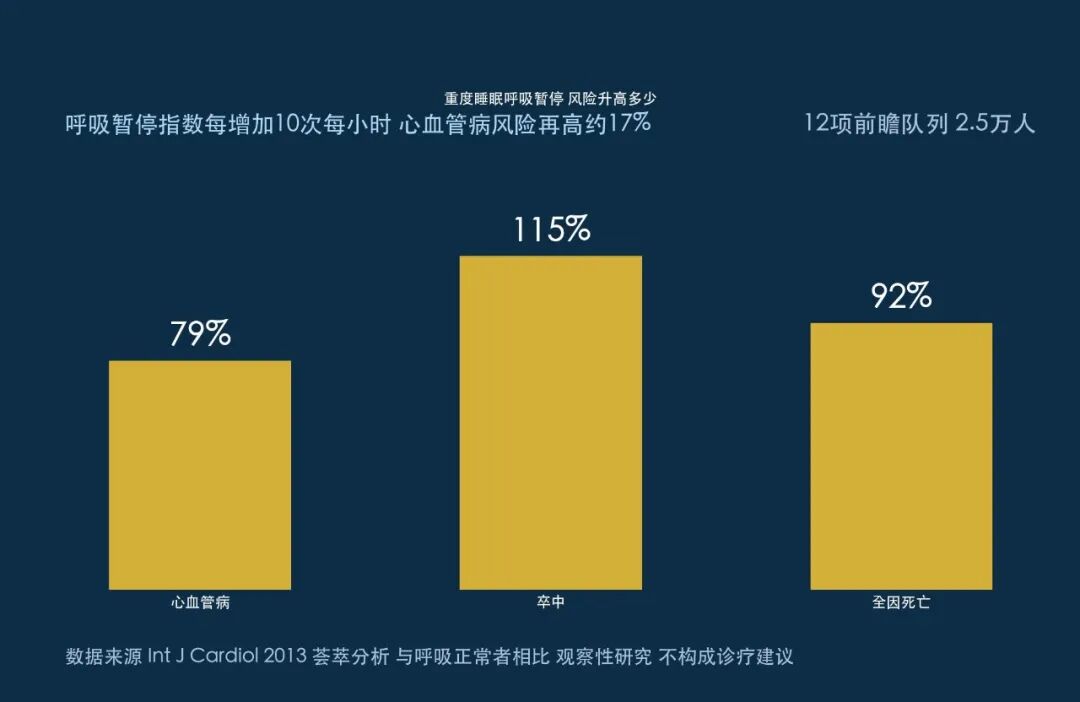
One figure shows the magnitude of the risk at a glance:
The card below explains in one go "which signals warrant vigilance and what to do after diagnosis":
1. What is the difference between "snoring" and "holding your breath"?
After falling asleep, the muscles of the throat relax. In most people, the airway simply narrows, and airflow vibrates the soft tissues, producing snoring. But if the airway collapses completely and airflow stops, blood oxygen drops in repeated episodes; the brain detects this and "wakes" the body—this is apnea.
It may occur dozens of times a night, and the person often has no memory of it. The next day they only feel they "slept quite deeply," when in fact their sleep was being interrupted all night.
2. The more severe the apnea, the higher the risk
The U.S. Wisconsin Sleep Cohort, followed for 4 years (709 people), provided a very intuitive dose-response relationship: with 0 apneas per hour as the reference, those with 5 to 15 per hour had an odds ratio of 2.03 for new-onset hypertension after 4 years; those with more than 15 per hour had an odds ratio of 2.89 [2]. This association was independent of age, neck circumference, waist circumference, alcohol consumption, and smoking.
The risk is not limited to blood pressure. A meta-analysis including 12 prospective cohorts and 25,000 people showed that, compared with those with normal breathing, people with severe sleep apnea had a 79% higher risk of cardiovascular disease, a 115% higher risk of stroke, and a 92% higher risk of all-cause death; for every 10-event-per-hour increase in the apnea index, the risk of cardiovascular disease rose by about another 17% [3].
Regarding arrhythmias, a Mayo Clinic cohort of 3,542 people found that people with sleep apnea had a hazard ratio of 2.18 for new-onset atrial fibrillation; further analysis showed that what was independently associated with atrial fibrillation was the magnitude of nocturnal oxygen desaturation—that is, "hypoxia" itself [5].
3. If there is only snoring and no breath-holding, does it matter?
It counts as a reminder, but there is no need to scare yourself. A meta-analysis including 8 prospective studies and 65,000 people found that habitual snorers had a 15% higher risk of coronary heart disease and a 26% higher risk of stroke, with men having a 54% higher risk of stroke; however, snoring was not significantly associated with all-cause death [4].
In other words, simple snoring is more like a signal to "not ignore"; what truly raises the risk markedly is apnea and nocturnal hypoxia.
4. An honest addition: obesity is the shared soil
Do not put all the blame on snoring. The Sleep Heart Health Study (2,470 people, 5-year follow-up) found that after adjusting for body mass index, the association between the apnea index and future hypertension was markedly attenuated and no longer significant [7]. This suggests that obesity both makes the airway more prone to collapse and itself raises blood pressure—the two share the same soil.
The good news is that one action can benefit both ends: lose a little weight, and snoring and blood pressure often improve together.
5. After diagnosis, treatment has data behind it
For diagnosed sleep apnea, continuous positive airway pressure (commonly known as a sleep apnea machine) is one of the first-line treatments. A meta-analysis including 19 randomized trials and 1,904 patients with hypertension and sleep apnea showed that the treatment group had 24-hour ambulatory systolic blood pressure about 5.0 mmHg lower on average and diastolic blood pressure about 3.3 mmHg lower [6]. It cannot replace antihypertensive medication, but it can help control blood pressure better.
6. If these situations occur, consider getting tested once
- Snoring that alternates between loud and soft, with pauses followed by a big gasp;
- Waking up at night gasping for breath, increased nocturia, dry mouth or headache upon waking;
- Feeling sleepy even while sitting during the day, decreased concentration, easily dozing off while driving;
- Elevated blood pressure that remains poorly controlled despite medication, or accompanied by atrial fibrillation.
In hospitals, "sleep monitoring" is usually used to confirm the diagnosis, and the test itself is not complicated. Many people only discover after the test that they have been experiencing hypoxia all night.
Small things you can do today:
- Sleep on your side. When lying on your back, the base of the tongue is more likely to fall backward; sleeping on your side can often reduce snoring;
- Lose a little weight. This is one thing that is effective for both snoring and blood pressure;
- Drink less alcohol before bed and use sedative-hypnotic drugs with caution, as they make the throat muscles more relaxed;
- If you have pauses, wake up gasping, or feel sleepy during the day, add "sleep monitoring" to your health checkup list.
Snoring is not a certificate of sound sleep; it is more like a letter the body sends at night—except that this letter is often interrupted by ourselves.
If you find this helpful, give it a like or a "Wow," and feel free to leave a comment telling us what topics you'd like to see.
✦ ✦ ✦
References
[1] Benjafield AV, Ayas NT, Eastwood PR, et al. Estimation of the global prevalence and burden of obstructive sleep apnoea: a literature-based analysis. Lancet Respir Med. 2019;7(8):687-698. PMID: 31300334
[2] Peppard PE, Young T, Palta M, Skatrud J. Prospective study of the association between sleep-disordered breathing and hypertension. N Engl J Med. 2000;342(19):1378-1384. PMID: 10805822
[3] Wang X, Ouyang Y, Wang Z, Zhao G, Liu L, Bi Y. Obstructive sleep apnea and risk of cardiovascular disease and all-cause mortality: a meta-analysis of prospective cohort studies. Int J Cardiol. 2013;169(3):207-214. PMID: 24161531
[4] Li D, Liu D, Wang X, He D. Self-reported habitual snoring and risk of cardiovascular disease and all-cause mortality. Atherosclerosis. 2014;235(1):189-195. PMID: 24854629
[5] Gami AS, Hodge DO, Herges RM, et al. Obstructive sleep apnea, obesity, and the risk of incident atrial fibrillation. J Am Coll Cardiol. 2007;49(5):565-571. PMID: 17276180
[6] Shang W, Zhang Y, Liu L, Chen F, Wang G, Han D. Benefits of continuous positive airway pressure on blood pressure in patients with hypertension and obstructive sleep apnea: a meta-analysis. Hypertens Res. 2022;45(11):1802-1813. PMID: 35701490
[7] O'Connor GT, Caffo B, Newman AB, et al. Prospective study of sleep-disordered breathing and hypertension: the Sleep Heart Health Study. Am J Respir Crit Care Med. 2009;179(12):1159-1164. PMID: 19264976
✦ ✦ ✦
Disclaimer: This article is for health education purposes only and is intended as general information; it does not constitute medical advice. If you have any health concerns, please consult a qualified physician.
Declaration of interests: This article does not recommend any medication and has no financial relationship with the research institutions mentioned herein.
© 2026 Sun Sheng Hua (Beijing) Medical Technology Co., Ltd.