This article is for health education purposes only and is intended for informational reference; it does not constitute medical advice. If you have any health concerns, please consult a professional doctor.
✦ ✦ ✦
Can't twist open a bottle cap, have to switch hands halfway through carrying two bags of groceries—many people just say "my hands have gotten weak lately," and few treat it as a health warning.
But over the past decade, grip strength has taken on a new identity in medical research: an easily obtained "longevity indicator."
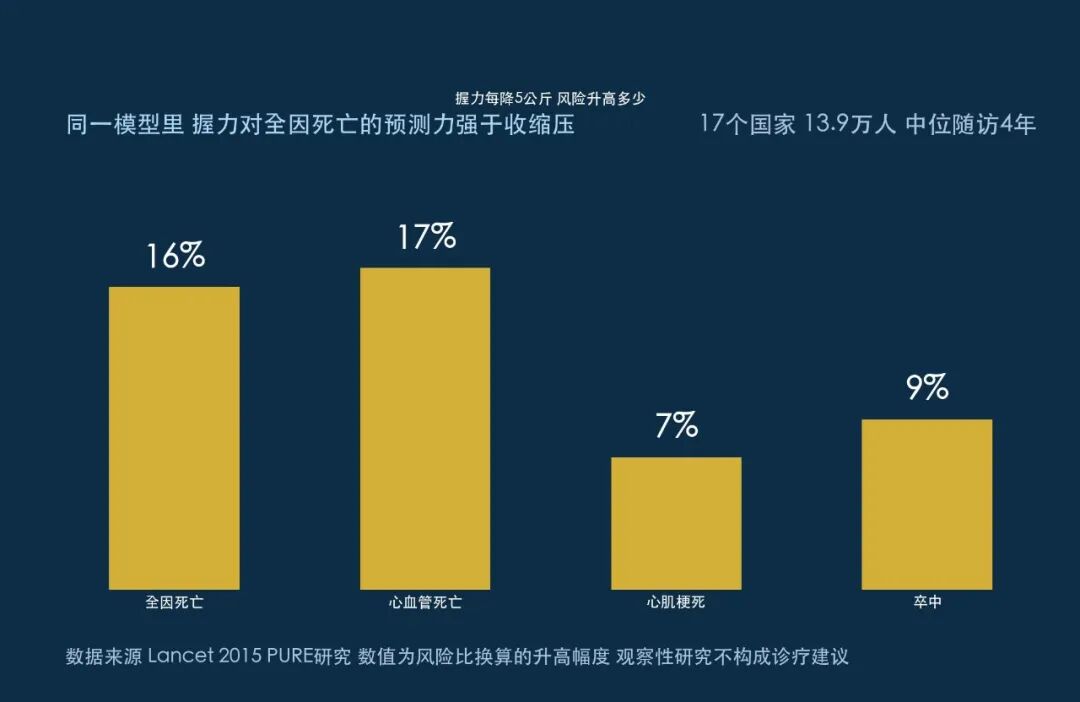
First, the data. A large cohort study (PURE) covering 139,000 people in 17 countries, with a median follow-up of 4 years, measured each person's hand strength with a dynamometer. The results showed that for every 5 kg decrease in grip strength, the risk of all-cause mortality was 16% higher and the risk of cardiovascular death was 17% higher; moreover, within the same statistical model, grip strength was a stronger predictor of all-cause and cardiovascular mortality than systolic blood pressure[1].
One chart shows which risks grip strength is associated with:
Another large UK cohort that tracked 502,000 people for an average of 7.1 years gave an answer in the same direction: for every 5 kg lower grip strength, the risk of all-cause mortality was 20% higher in women and 16% higher in men; the risk of death from respiratory disease was 31% and 24% higher, respectively[2].
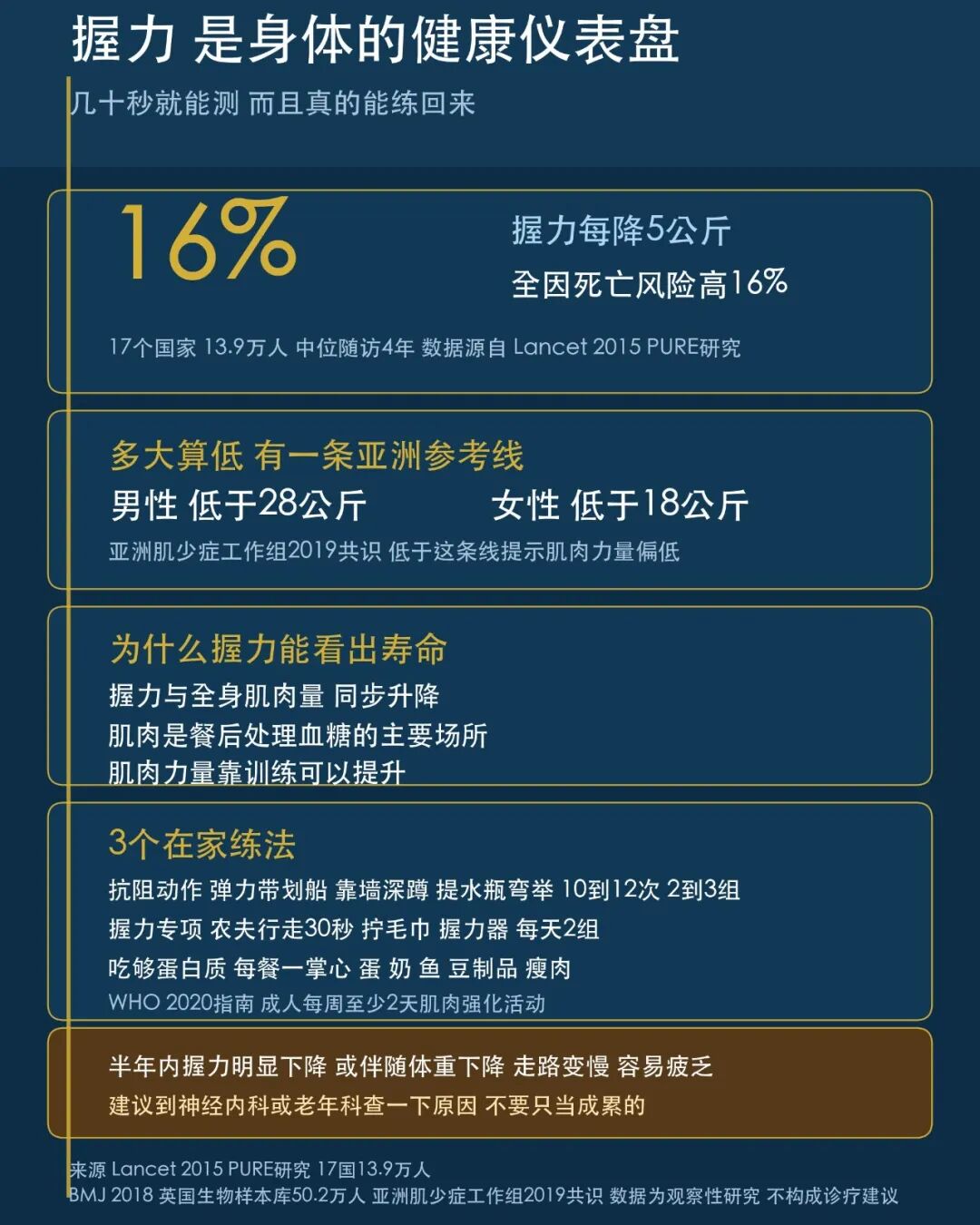
The card below explains in one go "how to assess it and how to train it back."
1. Grip strength is not just "hand strength"—it is a window into whole-body muscle
Grip strength is one of the easily measured aspects of whole-body muscle strength, and it rises and falls roughly in sync with limb muscle mass and overall muscle strength. And muscle is not just about having strength: it is both an important protein reserve for the body and the main site for processing blood sugar after meals.
After age 30, muscle mass decreases year by year, and the loss accelerates after age 60[4]. So "weaker hands" is often not an isolated phenomenon but a signal of whole-body muscle status.
2. How low counts as low? There is an Asian reference line
The cutoff given by the 2019 consensus of the Asian Working Group for Sarcopenia is: men with grip strength below 28 kg and women below 18 kg are considered to have low muscle strength[3]. The European consensus is slightly more lenient (27 kg for men, 16 kg for women)[4].
How to estimate at home? A dynamometer is more accurate; without equipment, you can use two alternative methods: first, wringing a towel is noticeably more strenuous than for peers; second, the five-times sit-to-stand test—sit in a chair with arms crossed over the chest and stand up and sit down 5 times in a row; taking more than 12 seconds suggests a decline in physical function[3].
3. What is more worth mentioning: grip strength can be trained back
The WHO 2020 physical activity guidelines clearly recommend that all adults should do muscle-strengthening activities at least 2 days a week[6]. At home, you can do this:
- Resistance exercises: resistance band rows, wall squats, water-bottle bicep curls, 10 to 12 reps per exercise, 2 to 3 sets;
- Grip-specific work: farmer's walks (carry heavy objects in both hands and walk for 30 seconds), towel wringing, grip trainers, 2 sets a day;
- Eat enough protein: about one palm-sized portion of high-quality protein at each meal (eggs, milk, fish, soy products, lean meat).
4. A reminder for two groups of people
- If you are over 40 and do not exercise much, it is recommended to measure your grip strength once during this year's health checkup and record the value, then watch the trend later—don't look only at a single measurement;
- If your grip strength has clearly declined within six months, or is accompanied by weight loss, slower walking, or easy fatigue, it is recommended to see a neurologist or geriatrician to find out the cause—don't just dismiss it as "being tired."
Grip strength is a warning letter sent by the body, and it is also one of the lowest-cost and relatively easy-to-change health check indicators—start today by carrying two water bottles and walking for 30 seconds.
If this has been helpful to you, give it a like or a "Wow," and feel free to leave a comment telling us what topics you'd like to see.
✦ ✦ ✦
References
[1] Leong DP, Teo KK, Rangarajan S, et al. Prognostic value of grip strength: findings from the Prospective Urban Rural Epidemiology (PURE) study. Lancet. 2015;386(9990):266-273. PMID: 25982160
[2] Celis-Morales CA, Welsh P, Lyall DM, et al. Associations of grip strength with cardiovascular, respiratory, and cancer outcomes and all cause mortality: prospective cohort study of half a million UK Biobank participants. BMJ. 2018;361:k1651. PMID: 29739772
[3] Chen LK, Woo J, Assantachai P, et al. Asian Working Group for Sarcopenia: 2019 Consensus Update on Sarcopenia Diagnosis and Treatment. J Am Med Dir Assoc. 2020;21(3):300-307.e2. PMID: 32033882
[4] Cruz-Jentoft AJ, Bahat G, Bauer J, et al. Sarcopenia: revised European consensus on definition and diagnosis. Age Ageing. 2019;48(1):16-31. PMID: 30312372
[5] Cooper R, Kuh D, Hardy R, et al. Objectively measured physical capability levels and mortality: systematic review and meta-analysis. BMJ. 2010;341:c4467. PMID: 20829298
[6] Bull FC, Al-Ansari SS, Biddle S, et al. World Health Organization 2020 guidelines on physical activity and sedentary behaviour. Br J Sports Med. 2020;54(24):1451-1462. PMID: 33239350
✦ ✦ ✦
Disclaimer: This article is for health education purposes only and is intended for informational reference; it does not constitute medical advice. If you have any health concerns, please consult a qualified physician.
Declaration of Interests: This article does not involve any drug recommendations and has no conflicts of interest with the research institutions mentioned herein.
© 2026 Sun Shenghua (Beijing) Medical Technology Co., Ltd.