Eat Enough Protein at Breakfast, Snack Less at Night
This article is for general health education and informational purposes only. It does not constitute medical advice. If you have health concerns, please consult a professional doctor.
Heading out the door after just a bowl of congee and a steamed bun? You might be setting yourself up for nighttime "sneaky snacking." A crossover controlled study offers a counterintuitive answer: the protein content of your breakfast can affect your appetite all day long—even your after-dinner snacks.
✦ ✦ ✦
1. The Study: Same 350-Calorie Breakfast, 3x the Protein, Very Different Results
A research team led by Leidy at the University of Missouri conducted a randomized crossover controlled study: 20 overweight/obese young women who typically skipped breakfast were assigned to three different regimens:
-
High-protein breakfast (350 kcal, containing 35g protein: eggs + beef);
-
Normal-protein breakfast (350 kcal, only 13g protein: cereal-based);
-
Continued breakfast skipping (control group).
Each regimen lasted 6 consecutive days, with full-day monitoring on the 7th day. Results[[1]]:
-
Only the high-protein breakfast significantly reduced ghrelin (the hunger hormone) and increased PYY (the satiety hormone) throughout the day;
-
Only the high-protein breakfast reduced the intake of high-fat snacks after dinner;
-
Both breakfasts suppressed overactivation of the brain's "food reward regions" (amygdala, hippocampus), but the high-protein effect was more pronounced.
In one sentence: Eat enough protein at breakfast, and your hands will be much "better behaved" at night.
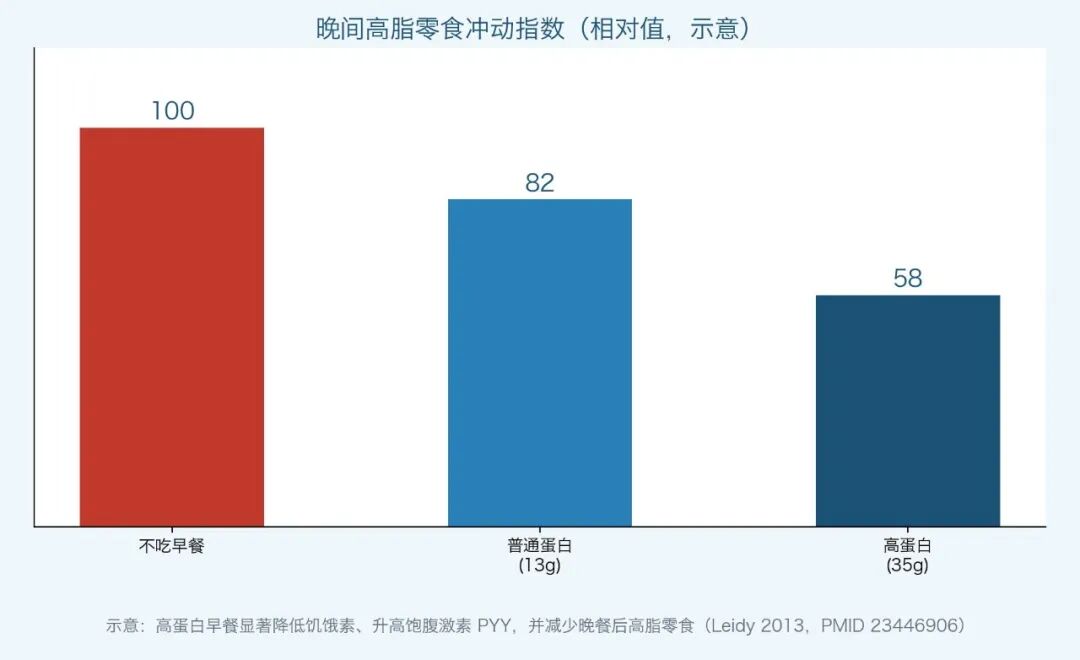
2. Why Can a Protein Breakfast Keep You in Check All Day?
-
Hormonal level: Protein is the most satiating macronutrient. It brings "hunger hormones" down and "satiety signals" up, and this effect can last into the afternoon and evening[[1]];
-
Brain level: A high-protein breakfast reduces the brain's "excitement" in response to high-calorie food cues—you feel less tempted when you see snacks. This was directly observed through neuroimaging (fMRI)[[1]];
-
Behavioral level: Better hunger resistance during the day → fewer snacks → reduced after-dinner snacking urges, making total daily calorie intake naturally more manageable.
3. Clearing Up Misconceptions
-
❌ "Just eat a little breakfast to save calories" → ✅ You save on breakfast but make up for it with nighttime snacks—not worth it;
-
❌ "Milk + cereal is high-protein" → ✅ Cereal is mostly carbs, and protein is usually insufficient. Check the nutrition label;
-
❌ "The more protein the better" → ✅ This study compared a 35g high-protein breakfast vs. a 13g normal breakfast; for most people, 20-30g of protein at breakfast is sufficient—no need to go to extremes;
-
❌ "Only skipping breakfast helps you lose weight" → ✅ For people who already skip breakfast, regularly eating a high-protein breakfast provides better appetite control[[1]].
4. Actionable Advice: 5 Practical Ways to Add Protein to Breakfast
-
Eggs are the best value: 1-2 boiled/fried eggs, about 12g protein;
-
Milk/soy milk to fill the gap: A glass of milk (about 8g) or unsweetened soy milk is far better than sugary drinks;
-
A small amount of meat/fish: A few bites of leftover chicken breast, shrimp, or beef easily adds +10g;
-
Swap out "plain congee + pickles": Replace congee with multigrain congee/oats, paired with eggs and milk—satiety doubles;
-
Remember this number: 20-30g of protein at breakfast is a reasonable starting point (roughly 2 eggs + 1 glass of milk).
✦ ✦ ✦
A decent high-protein breakfast is a "willpower reserve fund" you write for your future self tonight. Tomorrow morning, try adding some protein to your breakfast first.
If you found this helpful, feel free to hit "Like" or "Wow," and leave a comment telling us what topics you'd like to see.
✦ ✦ ✦
References:
-
Leidy HJ, et al. Beneficial effects of a higher-protein breakfast on the appetitive, hormonal, and neural signals controlling energy intake regulation in overweight/obese, "breakfast-skipping," late-adolescent girls. Am J Clin Nutr. 2013;97(4):677-688. PMID: 23446906.
-
Chinese Nutrition Society. Dietary Guidelines for Chinese Residents (2022). Beijing: People's Medical Publishing House, 2022.
Disclaimer: This article is for general health education and informational purposes only. It does not constitute medical advice. If you have health concerns, please consult a professional doctor.
Conflict of interest statement: The author has no financial relationship with any products or organizations mentioned in this article.
© 2026 Sun Saint Hua (Beijing) Medical Technology Co., Ltd.