People Who Don't Get Enough Sun Have Worse Mood and Sleep
This article is for health education purposes only and is intended for informational reference. It does not constitute medical advice; please consult a professional doctor if you have any health concerns.
After autumn begins, it gets dark before five o'clock. You stay in the office building from morning till night, and the total outdoor light you see in a day adds up to less than half an hour.
Many people attribute the irritability, drowsiness, and restless sleep of this season to work, overlooking a very simple variable: light.
1. Light Isn't Just for Illumination—It Sets Your Body's Clock
Sufficiently strong light during the day is the main time-setting signal for the biological clock. When the eyes receive light, the signal is sent to the rhythm center in the brain, which determines when to be awake and when to secrete melatonin.
As daylight grows shorter in autumn and winter—gray skies when you leave in the morning and darkness when you get home at night—the body receives increasingly weak signals that "it's daytime now." The rhythm gets delayed, and daytime drowsiness and nighttime sleeplessness follow.
2. Number One: Among 500,000 People, the Median Time Outdoors During the Day Was 2.5 Hours
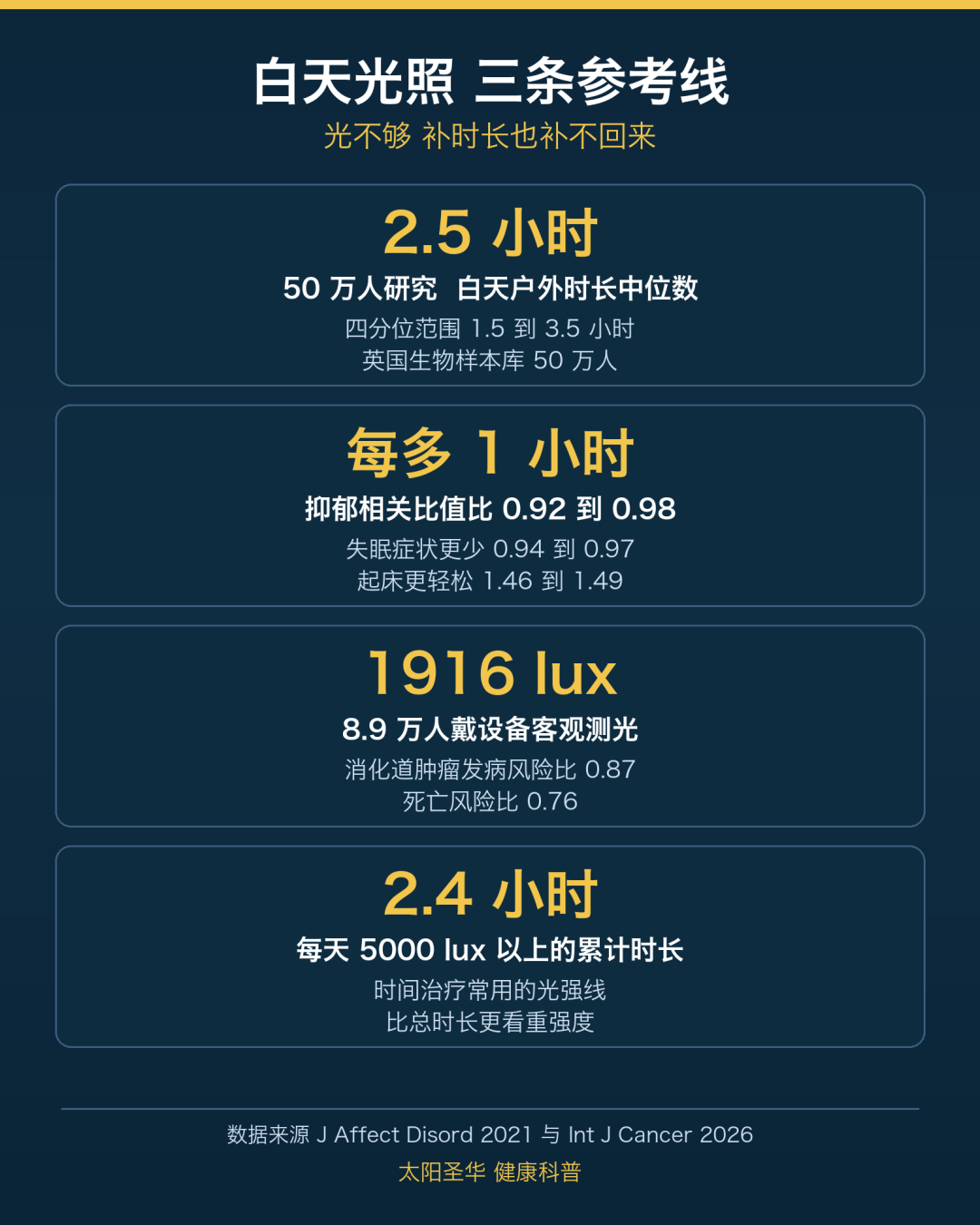
In a study of 500,000 participants from the UK Biobank, the median time spent outdoors during daylight hours was 2.5 hours per day, with an interquartile range of 1.5 to 3.5 hours[1].
Researchers compared this duration against mood and sleep item by item. For every additional hour of daytime outdoor light, the odds ratio for lifetime major depression and antidepressant use was between 0.92 and 0.98, and for low mood items 0.87 to 0.90; meanwhile, the odds ratio for "easier to get up" was 1.46 to 1.49, and for fewer insomnia symptoms 0.94 to 0.97[1].
In plain terms: The longer you spend outdoors during the day, the better your mood and sleep indicators look. This is an observational study and cannot establish causality in reverse, but the direction is consistent with light therapy trials.
3. Number Two: 89,000 People Wore Devices to Measure Light—1916 lux Is the Line
A 2026 prospective cohort study did not rely on recall questionnaires but instead had 89,000 people wear devices to objectively record daytime light intensity, with a median follow-up of 8.8 years[2].
Among those whose average daytime light intensity reached 1916 lux or above, the incidence risk ratio for gastrointestinal tumors was 0.87 and the mortality risk ratio was 0.76; among those who accumulated 2.4 hours per day at 5000 lux or above, pancreatic-related risks were lower[2].
To be clear: this is a correlation and does not equal "more sun exposure prevents cancer." But it at least shows that the intensity of daytime light is not a trivial detail—if the intensity is insufficient, duration cannot make up for it.
4. Number Three: 30 Minutes at Noon Is Enough to Synthesize a Day's Worth
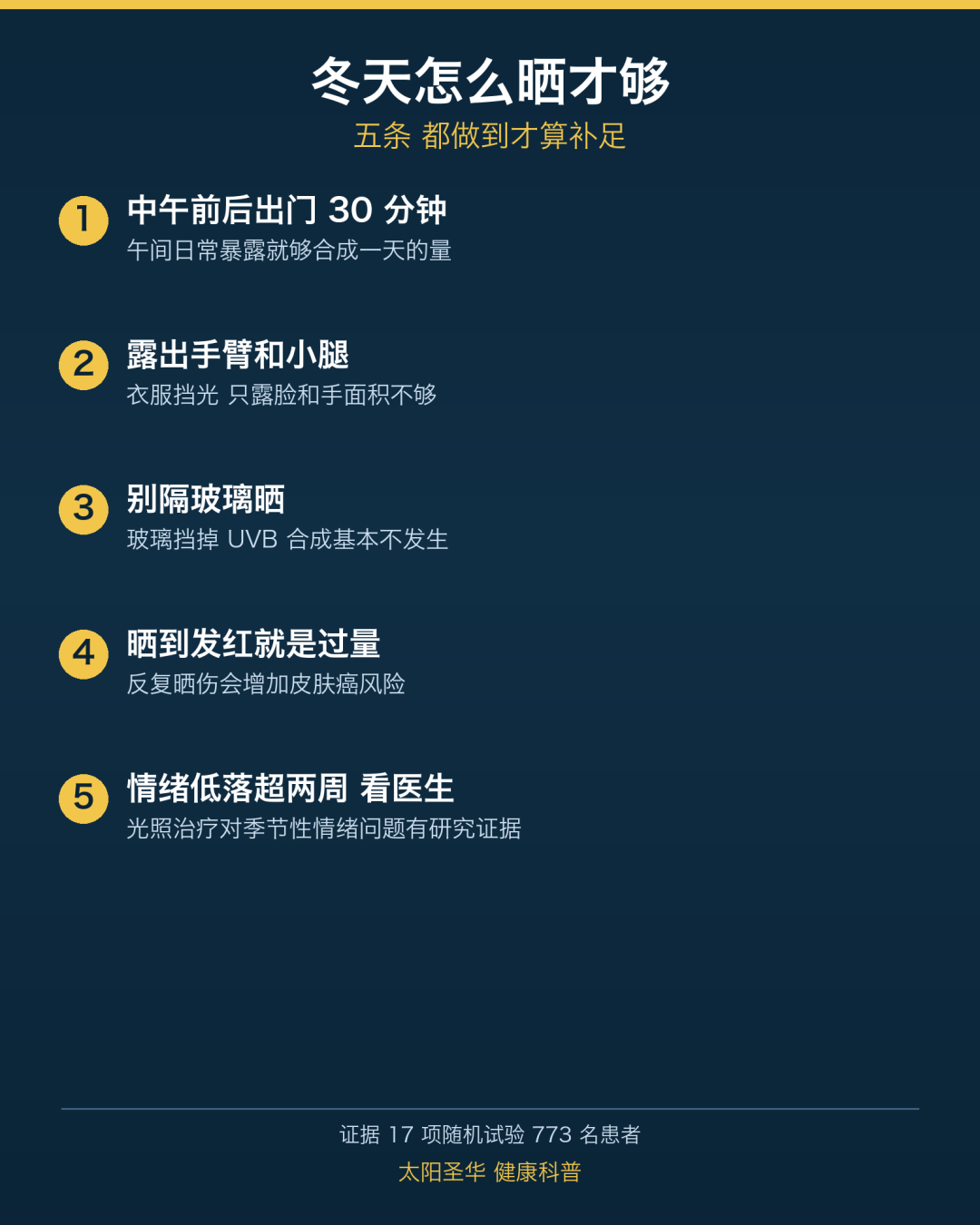
Sun exposure has another task: enabling the skin to synthesize vitamin D. UV exposure models have calculated that routine outdoor exposure around midday is sufficient to reach the level of 400 international units per day without reddening the skin[3].
Three prerequisites: expose your arms and lower legs, don't sit behind glass, and don't slather on sunscreen before sunbathing.
When you sunbathe through glass, most of the UVB in ultraviolet radiation is blocked outside the window, and the synthesis step essentially doesn't happen. Sitting by a window all afternoon in winter may feel warm, but it won't replenish vitamin D.
5. Sunburn Is Overexposure
Benefits and risks come in the same beam of light. Skin redness, heat, and peeling are signals of overexposure, and repeated sunburns over time increase the risk of skin cancer[3]. So all the durations above are premised on "not getting sunburned"; in periods and regions with strong ultraviolet radiation, the duration should be reduced.
If you have been feeling low for two consecutive weeks, have lost interest in everything, and are also experiencing changes in sleep and appetite, this is beyond what "getting more sun" can solve. Light therapy has clear research support for seasonal mood problems: in a network meta-analysis of 17 randomized trials involving 773 patients, white light showed more prominent improvement among several light colors[4]. How exactly to use it should be left to a psychiatrist's judgment.
6. Three Things You Can Do Today
-
Take a 30-minute walk around midday—don't just stand downstairs for two minutes and head back to your desk.
-
Roll up your sleeves before going out; exposing only your face and hands isn't enough surface area.
-
Moving your desk by the window doesn't count—glass blocks UVB, so you need to actually go outdoors.
The good thing about light exposure is this: it costs nothing, requires no equipment, and doesn't take long to maintain. Replenish your daily light in autumn and winter, and your mood and sleep will usually give you feedback first.
If you have an elder at home who feels low every winter and goes to bed early and wakes up early, forward this to them for a look.
If this was helpful to you, give it a like or a "reading" click, and feel free to leave a comment telling us what topics you'd like to see.
Disclaimer: This article is for health education purposes only and is intended for informational reference. It does not constitute medical advice; please consult a professional doctor if you have any health concerns.
Conflict of Interest Statement: This article does not involve any product promotion or commercial collaboration, and has no interest relationship with the research institutions mentioned in the text.
© 2026 Taiyang Shenghua (Beijing) Medical Technology Co., Ltd.
References
-
Time spent in outdoor light is associated with mood, sleep, and circadian rhythm-related outcomes: a cross-sectional and longitudinal study in over 400,000 UK Biobank participants. Journal of Affective Disorders. 2021;295:347-352. PMID:34488088
-
Higher Daytime Light Exposure Predicts Lower Risk of Gastrointestinal Cancer Incidence and Mortality. International Journal of Cancer. 2026;159(6):1401-1410. PMID:42071269
-
Ultraviolet Exposure Scenarios: Balancing Risks of Erythema and Benefits of Cutaneous Vitamin D Synthesis. Advances in Experimental Medicine and Biology. 2020;1265:1-25. PMID:32918230
-
Effectiveness of visible light for seasonal affective disorder: A systematic review and network meta-analysis. Medicine. 2025. PMID:40629637