This article is for health education and informational purposes only and does not constitute medical advice. If you have any health concerns, please consult a professional doctor.
Morning Run or Evening Run? Data from 625 People: Evening Exercise May Be Better for Glucose and Blood Pressure Control
Are you a morning runner or an evening runner? "The day's plan starts in the morning" and "morning exercise is the most healthful"—this is almost the default answer. But two meta-analyses published in 2026 have reached a different conclusion: for glucose and blood pressure control, afternoon and evening exercise may be the better choice.
✦ ✦ ✦
First, the Data: Evening Exercise Excels at Both Glucose and Blood Pressure Control
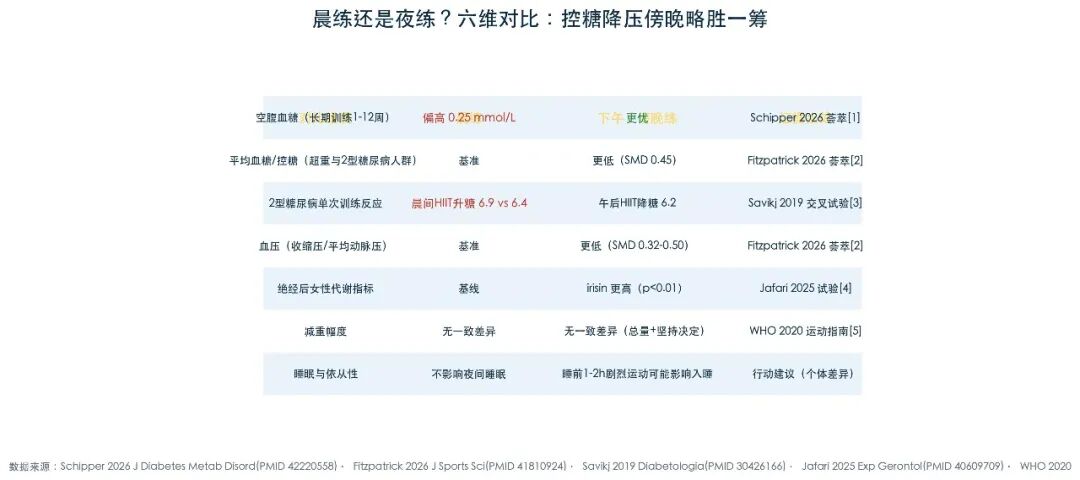
Study 1: A meta-analysis by a team from Ulster University in the UK, published in the Journal of Sports Science, pooling 625 participants—including healthy individuals, overweight and obese individuals, people with type 2 diabetes, and people with hypertension. The results found that after long-term training, afternoon/evening exercisers had lower blood glucose (SMD 0.45, 95% CI 0.06-0.83), and significantly lower systolic blood pressure and mean arterial pressure (SMD 0.32-0.50) [[2]].
Study 2: A meta-analysis by a team from the University of Amsterdam in the Netherlands, published in the J Diabetes Metab Disord, including 20 studies and 680 adults—after 1-12 weeks of training, morning exercisers had fasting blood glucose on average 0.25 mmol/L higher than afternoon/evening exercisers (95% CI 0.02-0.47) [[1]].
✦ ✦ ✦
Six-Dimension Comparison: How to Choose Between Morning and Evening?
✦ ✦ ✦
Three Key Points to Help You Decide
1. For glucose control: afternoon/evening training is more stable. In addition to the two meta-analyses above, a 2019 randomized crossover trial from Karolinska Institute in Sweden was even more direct: in 11 men with type 2 diabetes, morning high-intensity interval training (HIIT) actually raised blood glucose from 6.4 to 6.9 mmol/L, while afternoon HIIT lowered blood glucose to 6.2 mmol/L [[3]]. For people who are overweight, have prediabetes, or type 2 diabetes, scheduling moderate-to-high-intensity training in the afternoon is more favorable.
2. For blood pressure control: evening exercise offers more obvious benefits. The meta-analysis showed that evening exercise produced greater improvements in systolic blood pressure and mean arterial pressure (SMD 0.32-0.50) [[2]]. People with hypertension can schedule training in the afternoon to evening hours. Additionally, a trial involving 52 overweight postmenopausal women found that regardless of morning or evening, a single session of HIIT improved metabolic markers, but irisin (an exercise hormone related to fat metabolism) levels were higher after evening training [[4]].
3. For weight loss: don't obsess over timing—total volume and consistency determine the outcome. These two meta-analyses focused on blood glucose and blood pressure; there is no evidence showing that "a certain time period burns more fat." The core of weight loss is always burning more than you consume, plus being able to stick with it long-term—the WHO recommends 150-300 minutes of moderate-intensity aerobic exercise per week, plus strength training twice a week [[5]].
✦ ✦ ✦
Morning Exercisers, Don't Panic—Remember These Three Points
-
Hydrate first, then warm up: In the morning, body temperature is lower and joints are "stiff." Do 5-10 minutes of dynamic warm-up first to prevent strains;
-
Don't train hard on an empty stomach: Eat a small portion of easily digestible carbohydrates before morning exercise (such as half a banana) to prevent low blood sugar;
-
Note for type 2 diabetes: Morning high-intensity exercise may raise blood glucose, so remember to monitor after training [[3]].
For evening exercisers: For some people, vigorous exercise 1-2 hours before bedtime may affect falling asleep. If you can't sleep after training, move your workout earlier or reduce intensity—individual differences vary, so there's no need for a one-size-fits-all approach.
✦ ✦ ✦
One-Sentence Action Advice
Don't agonize over morning vs. evening: first pick a fixed time slot you can stick with and start training; if you want to prioritize glucose and blood pressure control, schedule moderate-to-high-intensity training between 4-6 PM; warm up before training, monitor after training, and consult a doctor first if your blood glucose or blood pressure is unstable.
The exercise time that truly suits you is the time you can actually stick with—and 4 to 6 PM may be a "hidden bonus" for glucose and blood pressure control. Feel free to share this with friends who are still debating morning runs vs. evening runs, and save this comparison table—just follow it and train.
If this content has been helpful to you, feel free to hit "Like" or "Wow," and leave a comment telling us what topics you'd like to see.
✦ ✦ ✦
References
-
Schipper SBJ, et al. The effect of timing of physical exercise on glycemia: a systematic review and meta-analysis of human intervention studies. J Diabetes Metab Disord. 2026;25(1):150. PMID: 42220558.
-
Fitzpatrick R, et al. Optimising exercise time-of-day for cardiometabolic health: insights from a systematic review and meta-analysis in varied adult cohorts. J Sports Sci. 2026;44(9):1158-1188. PMID: 41810924.
-
Savikj M, et al. Afternoon exercise is more efficacious than morning exercise at improving blood glucose levels in individuals with type 2 diabetes: a randomised crossover trial. Diabetologia. 2019;62(2):233-237. PMID: 30426166.
-
Jafari A, Kazemi F. The impact of acute morning versus evening high-intensity interval training on circulating irisin levels and metabolic parameters in overweight postmenopausal women. Exp Gerontol. 2025;208:112821. PMID: 40609709.
-
World Health Organization. WHO guidelines on physical activity and sedentary behaviour. Geneva: WHO; 2020.
Disclaimer: This article is for health education and informational purposes only and does not constitute any medical advice or medication guidance; individual circumstances vary, so please consult a professional doctor for specific health concerns. This article does not involve any drug promotion.
Conflict of Interest Statement: The author of this article has no conflicts of interest with the studies mentioned; all data comes from publicly published academic literature with sources cited.
© 2026 Sun Saint Hua (Beijing) Medical Technology Co., Ltd.