Plant Protein for a Longer Life? A Twist Hidden in Data From 130,000 People
This article is for health education and informational purposes only. It does not constitute medical advice; if you have health concerns, please consult a professional doctor.
Tofu, soy milk, and dried tofu have been called longevity foods in recent years.
But at the gym, your trainer still tells you to drink milk and eat eggs.
Same question, two sets of answers. Lay out the data and look at it, and the answer actually splits into two halves.
First, the numbers: 130,000 people followed through 2012
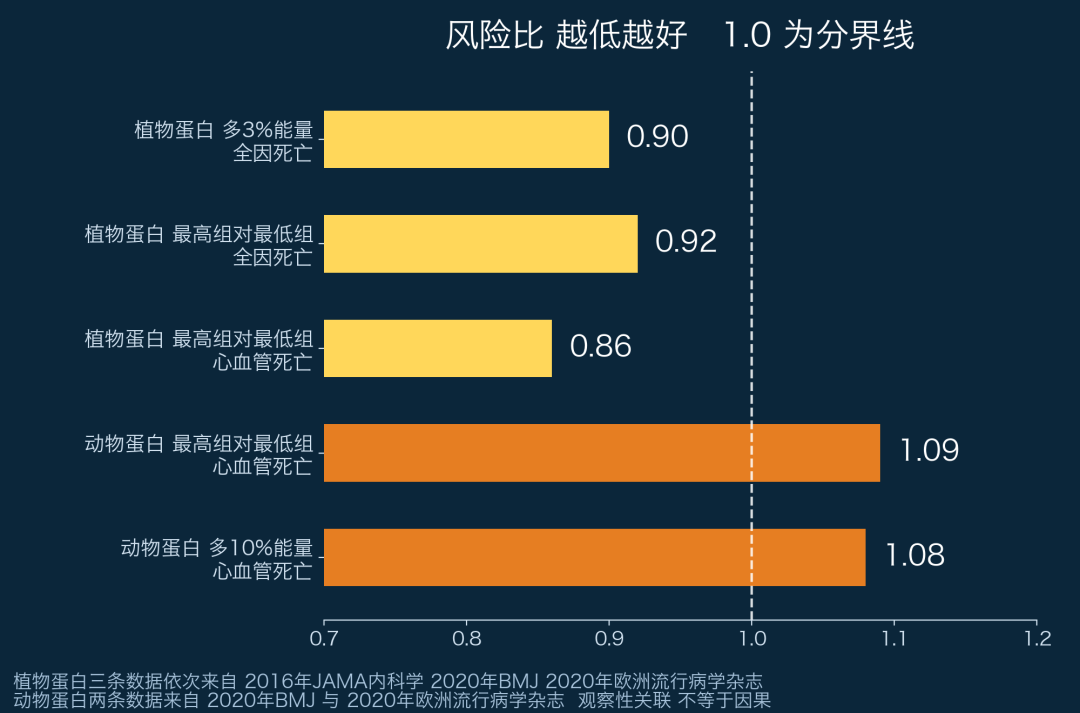
The 2016 study in JAMA Internal Medicine followed more than 130,000 US healthcare professionals [1]. The result: for every additional 3% of energy from plant protein, the risk of all-cause mortality was 10% lower and the risk of cardiovascular death was 12% lower.
An even more intuitive set: replacing 3% of energy from processed red meat with plant protein was associated with a 34% lower risk of all-cause mortality.
1. On longevity, plant protein does have the edge
In the same group, for every additional 10% of energy from animal protein, all-cause mortality showed no significant change (hazard ratio 1.02), but cardiovascular mortality risk was 8% higher. The problem isn't the word "meat"—it's processed meat. Swap it for unprocessed red meat and the hazard ratio is only 0.88; swap it for eggs, 0.81; swap it for plant protein, 0.66 [1].
A larger pooled analysis comes from a 2020 dose-response meta-analysis in The BMJ: 31 prospective cohorts, 715,000 people, 113,000 deaths. The group with the highest plant protein intake had an 8% lower risk of all-cause mortality and a 12% lower risk of cardiovascular death; each additional 3% of daily energy from plant protein was associated with a 5% lower risk of death [2].
The Rotterdam Study in the Netherlands pooled 11 cohorts (350,000 people, 64,000 deaths) and saw the same direction: higher total protein intake was actually associated with a slightly higher risk of all-cause mortality (1.05), mainly from the cardiovascular portion linked to animal protein (1.09); the group with the highest plant protein intake had all-cause mortality of 0.93 and cardiovascular mortality of 0.86 [3].
One boundary that must be made clear: these are all observational studies—what they show is association, not proven causation. And the associations in [1] appeared mainly in people with any one of smoking, drinking, overweight, or physical inactivity; in people with none of these risk factors, the difference was not obvious.
2. On building muscle, animal protein is the better deal
Switch to muscle, and the conclusion flips.
A 2007 crossover trial in The American Journal of Clinical Nutrition: same 18 grams of protein, same energy—one group drank skim milk, the other soy protein, both after resistance training. The muscle protein synthesis rate was 0.10% per hour in the milk group and 0.07% in the soy group [4].
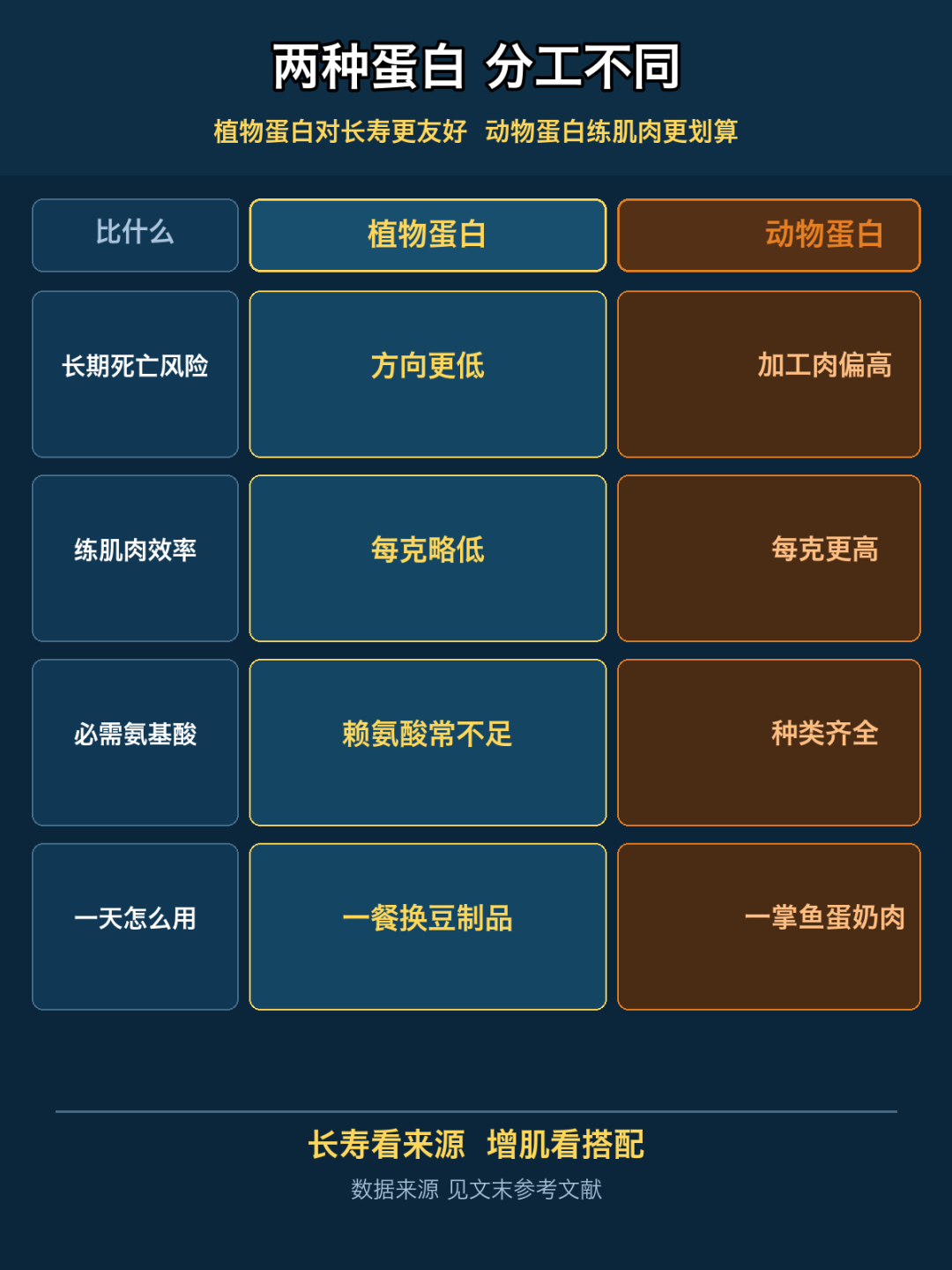
A 2021 review explained why: plant protein does stimulate muscle synthesis less than an equal amount of animal protein after a meal. First, it has a lower content of essential amino acids and is often low in lysine and methionine; second, it is digested and absorbed somewhat more slowly [5].
But don't overstate it. A meta-analysis of randomized controlled trials the same year (16 trials) found: animal protein and plant protein showed no difference in absolute lean body mass or muscle strength; only in people under 50 did the animal protein group have 0.41 kg more lean body mass [6]. In other words, plant protein can build muscle—it's just less efficient per gram of protein.
3. So you don't have to choose one
If you want to live longer: replace some processed meat with soy products. Roughly calculated for 2,000 kcal per day, 3% of energy is about 15 grams of protein—about one cup of 200 ml soy milk plus 100 grams of tofu.
If you want to build muscle, or you're older and worried about losing muscle: keep a palm-sized portion of fish, eggs, milk, or lean meat at each meal, and make up the rest with soy products. This is especially true after age 50, because the disadvantage of plant protein in [6] occurred mainly in younger people; older adults already have lower synthesis efficiency to begin with.
If you eat vegetarian: eat legumes and grains in the same meal so their amino acids complement each other; eat two to three tenths more in total than meat eaters, which roughly makes up for the efficiency gap [5].
Don't ignore the total amount of protein either. In that meta-analysis of 715,000 people, the group with higher total protein intake also had a lower risk of all-cause mortality (0.94) [2]—get enough first, then talk about the source.
Three things you can do today
Today, pick one meal and swap the sausage, bacon, or ham for a plate of tofu or a handful of edamame.
Stop piling protein into dinner: add an egg or a cup of soy milk at breakfast, a palm-sized portion of meat or fish at lunch, and soy products at dinner.
If you eat vegetarian, put rice and legumes in the same meal—don't eat just one kind of bean.
In the long run, the source is more worth choosing than the total amount; when building muscle, the combination matters more than the stance.
If this article helped you think through "beans or meat," forward it to someone in your family who's still torn.
If it was helpful to you, give it a like or a "Wow," and feel free to leave a comment telling us what topics you'd like to see.
✦ Disclaimer: This article is for health education and informational purposes only. It does not constitute medical advice; if you have health concerns, please consult a professional doctor. Conflict of interest statement: This article does not involve any drug or product recommendations and has no financial relationship with the research institutions mentioned in the text.
© 2026 Sunshenghua (Beijing) Medical Technology Co., Ltd.
References
[1] Song M, Fung TT, Hu FB, Willett WC, Longo VD, Chan AT, Giovannucci EL. Association of Animal and Plant Protein Intake With All-Cause and Cause-Specific Mortality. JAMA Intern Med. 2016;176(10):1453-1463. PMID: 27479196
[2] Naghshi S, Sadeghi O, Willett WC, Esmaillzadeh A. Dietary intake of total, animal, and plant proteins and risk of all cause, cardiovascular, and cancer mortality: systematic review and dose-response meta-analysis of prospective cohort studies. BMJ. 2020;370:m2412. PMID: 32699048
[3] Chen Z, Glisic M, Song M, Aliahmad HA, Zhang X, Moumdjian AC, Gonzalez-Jaramillo V, van der Schaft N, Bramer WM, Ikram MA, Voortman T. Dietary protein intake and all-cause and cause-specific mortality: results from the Rotterdam Study and a meta-analysis of prospective cohort studies. Eur J Epidemiol. 2020;35(5):411-429. PMID: 32076944
[4] Wilkinson SB, Tarnopolsky MA, Macdonald MJ, Macdonald JR, Armstrong D, Phillips SM. Consumption of fluid skim milk promotes greater muscle protein accretion after resistance exercise than does consumption of an isonitrogenous and isoenergetic soy-protein beverage. Am J Clin Nutr. 2007;85(4):1031-1040. PMID: 17413102
[5] Pinckaers PJM, Trommelen J, Snijders T, van Loon LJC. The Anabolic Response to Plant-Based Protein Ingestion. Sports Med. 2021;51(Suppl 1):59-74. PMID: 34515966
[6] Lim MT, Pan BJ, Toh DWK, Sutanto CN, Kim JE. Animal Protein versus Plant Protein in Supporting Lean Mass and Muscle Strength: A Systematic Review and Meta-Analysis of Randomized Controlled Trials. Nutrients. 2021;13(2):661. PMID: 33670701