This article is for health education and informational purposes only and does not constitute medical advice; if you have health concerns, please consult a professional doctor.
About 4 in 10 People Are Infected With Helicobacter pylori: Should a Positive Result Be Treated?
You're holding your health check report. Everything else is fine, except one line—"Helicobacter pylori antibody positive"—has been circled by the doctor.
Some people panic: Am I close to getting stomach cancer?
Others put it off: It doesn't hurt or itch, my stomach has never acted up, I'll deal with it later.
Neither reaction is quite right. This article clears up the 6 most common questions all at once.
First, the scale. An analysis pooling 152 studies and 760,000 people found that the pooled prevalence of Helicobacter pylori infection in the Chinese population is 42.8% (95% interval 40.7 to 44.9) [1]. In more memorable terms—about 4 out of every 10 people have it in their stomach. Globally, that figure is 44.1%, or about 4.4 billion people [7].
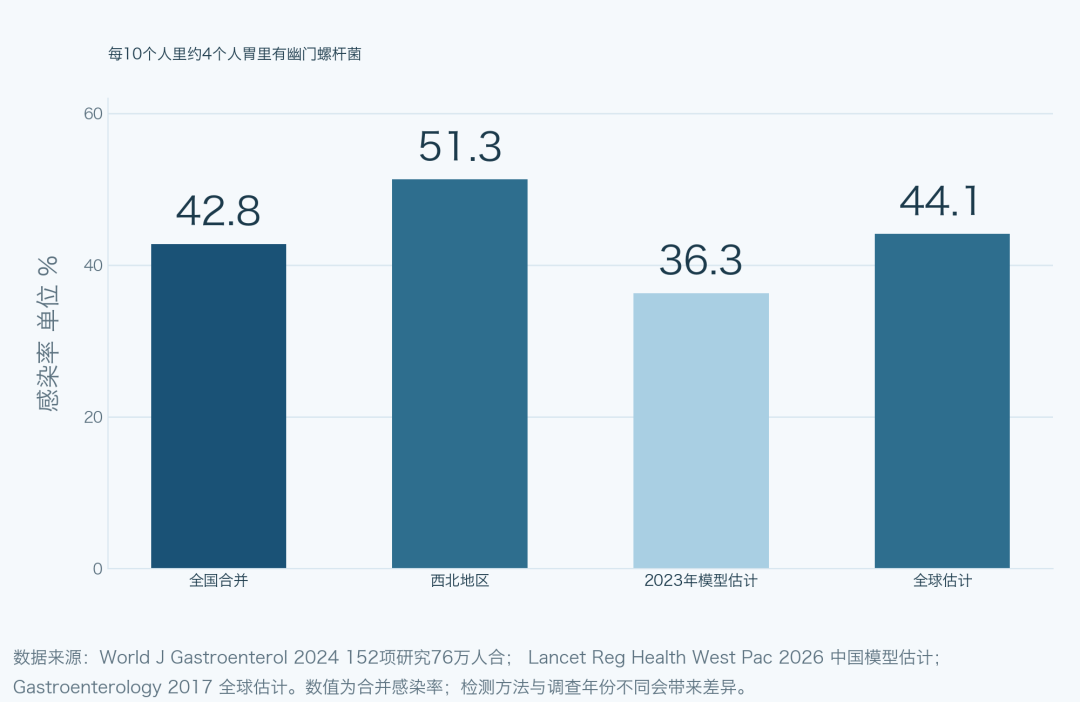
Figure note: Helicobacter pylori infection rates in China and regional differences—national pooled rate 42.8%, Northwest region 51.3%, modeled estimate for 2023 at 36.3%, and global rate at 44.1%.
1. Does a positive antibody test mean the bacteria are still there now?
Not necessarily. Antibodies are a "contact record" left by the immune system; after the bacteria are killed, antibodies can remain positive for a long time. So looking at antibodies alone, you can't tell whether it's "had it before" or "still have it now."
Doctors usually order a urea breath test or a stool antigen test to confirm whether it's a current infection. Don't draw conclusions from the report yourself, and don't assume it's nothing just because "it doesn't hurt."
2. What does it feel like to be infected?
Most people don't feel anything special. Some may experience bloating, acid reflux, bad breath, or vague upper abdominal discomfort.
No symptoms doesn't mean no impact. Once Helicobacter pylori colonizes the stomach, it usually causes long-term chronic inflammation—which is why the World Health Organization classifies it as a Group 1 carcinogen. A 2026 Chinese modeling study estimated that 70.1% of non-cardia gastric cancers in 2023 could be attributed to it [2]; globally, this proportion for non-cardia gastric cancer is about 89% [3].
3. Should it be treated or not?
This is the most frequently asked question. The answer is not "everyone must be treated," nor is it "treat it as soon as it's found"—rather, it depends on risk, and it should be left to a gastroenterologist to judge.
First, the data. A pooled analysis of 10 randomized controlled trials involving 8,323 healthy infected individuals showed: after eradication therapy, the risk of gastric cancer dropped to 0.54 times (95% interval 0.40 to 0.72)—meaning roughly 72 people need to be treated to prevent 1 case of gastric cancer; the risk of gastric cancer death dropped to 0.61 times (95% interval 0.40 to 0.92)—meaning roughly 135 people need to be treated to prevent 1 gastric cancer death. However, all-cause mortality showed no difference between the two groups [4]. An earlier pooled analysis of 6 trials showed consistent direction, with a risk ratio of 0.66 [5].
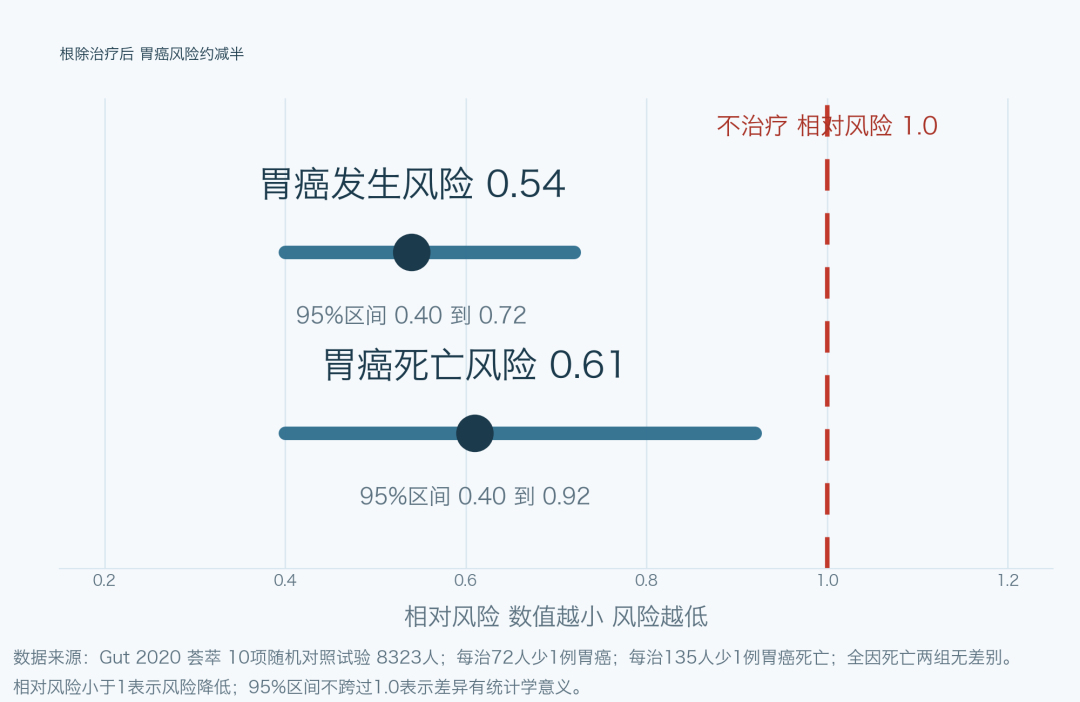
Figure note: Changes in gastric cancer risk after eradication therapy—gastric cancer incidence risk 0.54 times, gastric cancer death risk 0.61 times; both 95% intervals do not cross 1.0.
Note the nuance here: eradication therapy reduces "risk"—it is not a guarantee that "you won't get gastric cancer."
In clinical practice, doctors will more actively recommend evaluation and management for these situations: family history of gastric cancer; long-term upper abdominal discomfort, acid reflux, bloating, or other symptoms; need for long-term use of acid-suppressing drugs or certain pain relievers; iron-deficiency anemia with no other identifiable cause. Whether to treat and how to treat—follow your doctor's orders.
4. Can it be transmitted to family members?
Yes, household transmission is one of the main routes. A follow-up cohort of 891 people in Ningxia quantified the risks specifically: having an infected family member increased recurrence risk by 5.68 times; frequently sharing utensils by 3.46 times; frequently eating out by 7.41 times; smoking by 6.06 times [6].
So if someone in the family tests positive, don't just focus on one person's report. Using serving chopsticks and separating meals, regularly disinfecting utensils, and not sharing toothbrushes or cups—these are very low-cost practices. Whether family members should be tested and treated together—ask the doctor to decide based on age and risk.
5. Can you get reinfected after treatment?
The 1-year recurrence rate from that cohort was 4.1% (37/891) [6]. That is, the vast majority of people are stable within a year after treatment, but "cured" doesn't mean "done forever."
The real trouble is something else: not completing the full course and stopping medication on your own is a major reason for bacterial resistance, making it harder to kill next time. Take the full course your doctor prescribes, day by day—don't stop just because you feel better.
6. What should I pay attention to when getting tested?
The urea breath test is a commonly used non-invasive test—two breaths and you get results. Before testing, you need to stop certain medications as instructed by your doctor—acid-suppressing drugs, antibiotics, and bismuth preparations can all affect results; how long to stop depends on your doctor's advice. When the condition of the gastric mucosa needs to be examined, gastroscopy is more direct and allows biopsy at the same time.
Four things you can do today
-
If only the antibody is positive on your report: see a gastroenterologist to confirm whether it's a current infection—don't judge for yourself that "it's nothing."
-
If you have a family history of gastric cancer or long-term stomach discomfort: proactively mention to your doctor whether evaluation is needed.
-
If someone in your family is infected: start using serving chopsticks and separating meals today, and regularly disinfect utensils.
-
If you're already in treatment: finish the full course—don't stop midway.
Helicobacter pylori is not an irrelevant number on a health check report, nor is it a death sentence. It is a risk that can be evaluated and managed—provided you don't treat "no symptoms" as "no problem."
If this article helped you make sense of your report, consider sharing it with that family member who "has an arrow on their report but doesn't take it seriously."
If you found this helpful, give it a like or a "reading" click, and feel free to leave a comment telling us what topics you'd like to see.
✦
Disclaimer: This article is for health education and informational purposes only and does not constitute medical advice; if you have health concerns, please consult a professional doctor.
Conflict of interest statement: This article does not involve any drug or product recommendations and has no conflict of interest with the studies cited.
© 2026 Sunsheng Hua (Beijing) Medical Technology Co., Ltd.
References
[1] Xie L, Liu GW, Liu YN, et al. Prevalence of Helicobacter pylori infection in China from 2014-2023: a systematic review and meta-analysis. World J Gastroenterol. 2024;30(43):4636-4656. PMID: 39575409
[2] Sun D, Han W, Alarid-Escudero F, et al. Trends in Helicobacter pylori prevalence, force of infection, and attributable disease burden in China: a systematic review and modelling study. Lancet Reg Health West Pac. 2026;74:101979. PMID: 42757050
[3] Plummer M, Franceschi S, Vignat J, et al. Global burden of gastric cancer attributable to Helicobacter pylori. Int J Cancer. 2015;136(2):487-490. PMID: 24889903
[4] Ford AC, Yuan Y, Moayyedi P. Helicobacter pylori eradication therapy to prevent gastric cancer: systematic review and meta-analysis. Gut. 2020;69(12):2113-2121. PMID: 32205420
[5] Ford AC, Forman D, Hunt RH, et al. Helicobacter pylori eradication therapy to prevent gastric cancer in healthy asymptomatic infected individuals: systematic review and meta-analysis of randomised controlled trials. BMJ. 2014;348:g3174. PMID: 24846275
[6] Niu M, Su X, Ma Z, Li L. Recurrence of Helicobacter pylori after successful eradication in Northwestern China: rates, risk factors, and resistance profiles. Infect Drug Resist. 2026;19:636223. PMID: 42898539
[7] Hooi JKY, Lai WY, Ng WK, et al. Global prevalence of Helicobacter pylori infection: systematic review and meta-analysis. Gastroenterology. 2017;153(2):420-429. PMID: 28456631