2 Cups of Tea a Day, 13% Lower All-Cause Mortality Risk: 498,000 People Followed for 11 Years
This article is for health education purposes only and is intended for informational reference; it does not constitute medical advice. If you have health concerns, please consult a professional physician.
A daily cup of tea is a fixed habit for many Chinese people. But if you ask what it actually does, most people can only manage the word "antioxidant" before running out of things to say.
In 2022, the Annals of Internal Medicine published a prospective cohort study of 498,000 people: those who drank 2 to 3 cups of tea per day had a 13% lower all-cause mortality risk than those who drank no tea.
This doesn't mean tea cures disease—it's a pattern observed over the long term. The two figures below lay out this dataset.
1. How Much to Drink Before It Matters: 2 to 3 Cups, Then It Plateaus
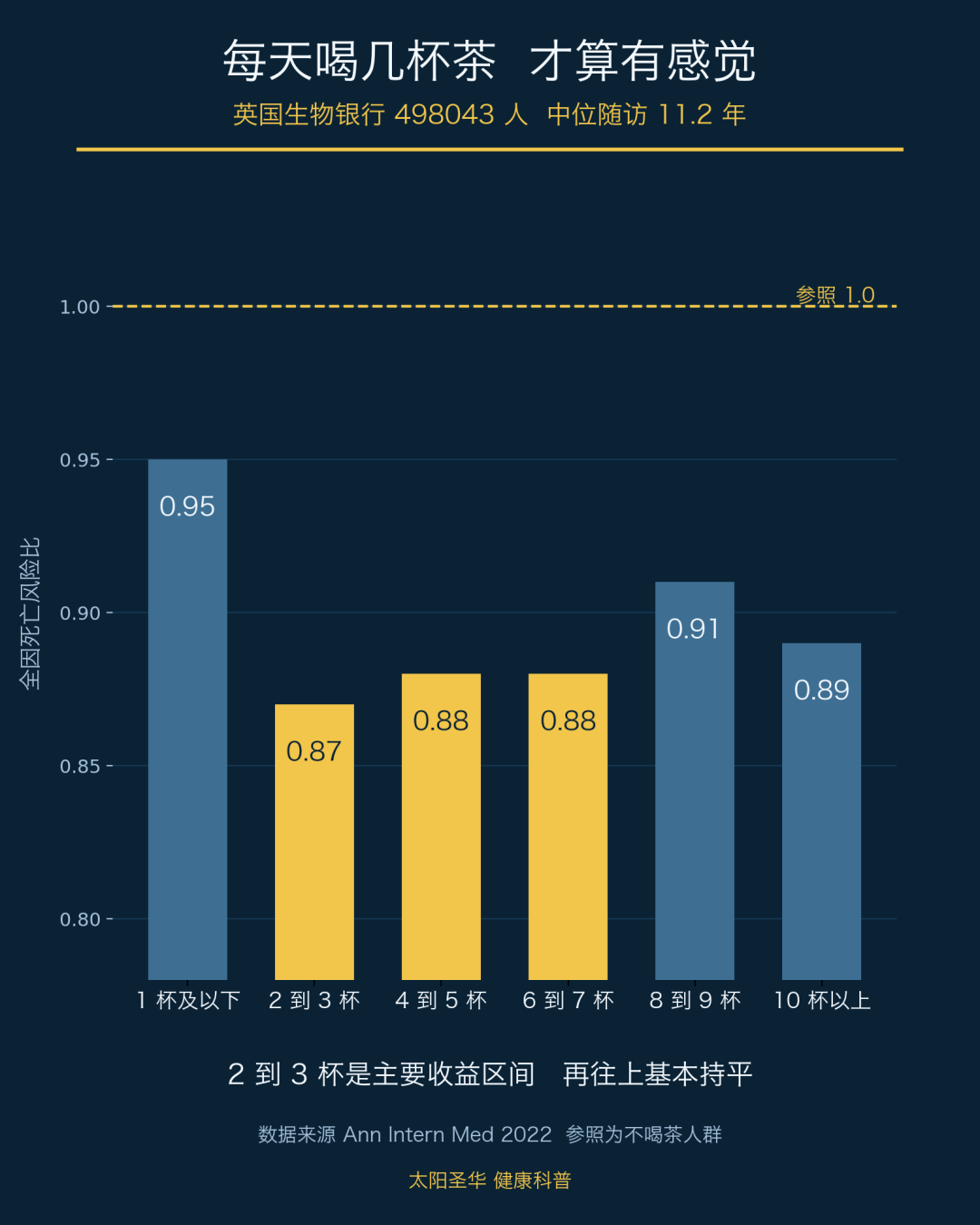
The UK Biobank included 498,043 people aged 40 to 69, with a median follow-up of 11.2 years, using non-tea drinkers as the reference:
-
1 cup or fewer per day: hazard ratio 0.95, almost no difference
-
2 to 3 cups per day: 0.87, i.e., 13% lower
-
4 to 5 cups per day: 0.88
-
6 to 7 cups per day: 0.88
-
8 to 9 cups per day: 0.91
-
10 or more cups per day: 0.89
The curve becomes clear here: the step from 0 to 2 cups is where the benefit is concentrated, and after that it essentially plateaus—drinking 10 or more cups brings no additional benefit[1].
More interestingly, the study also found that results were similar regardless of whether participants also drank coffee or what their caffeine-metabolism genotype was. In other words, caffeine is probably not the main thing at work.
2. What It Mainly Protects Is the Blood Vessels
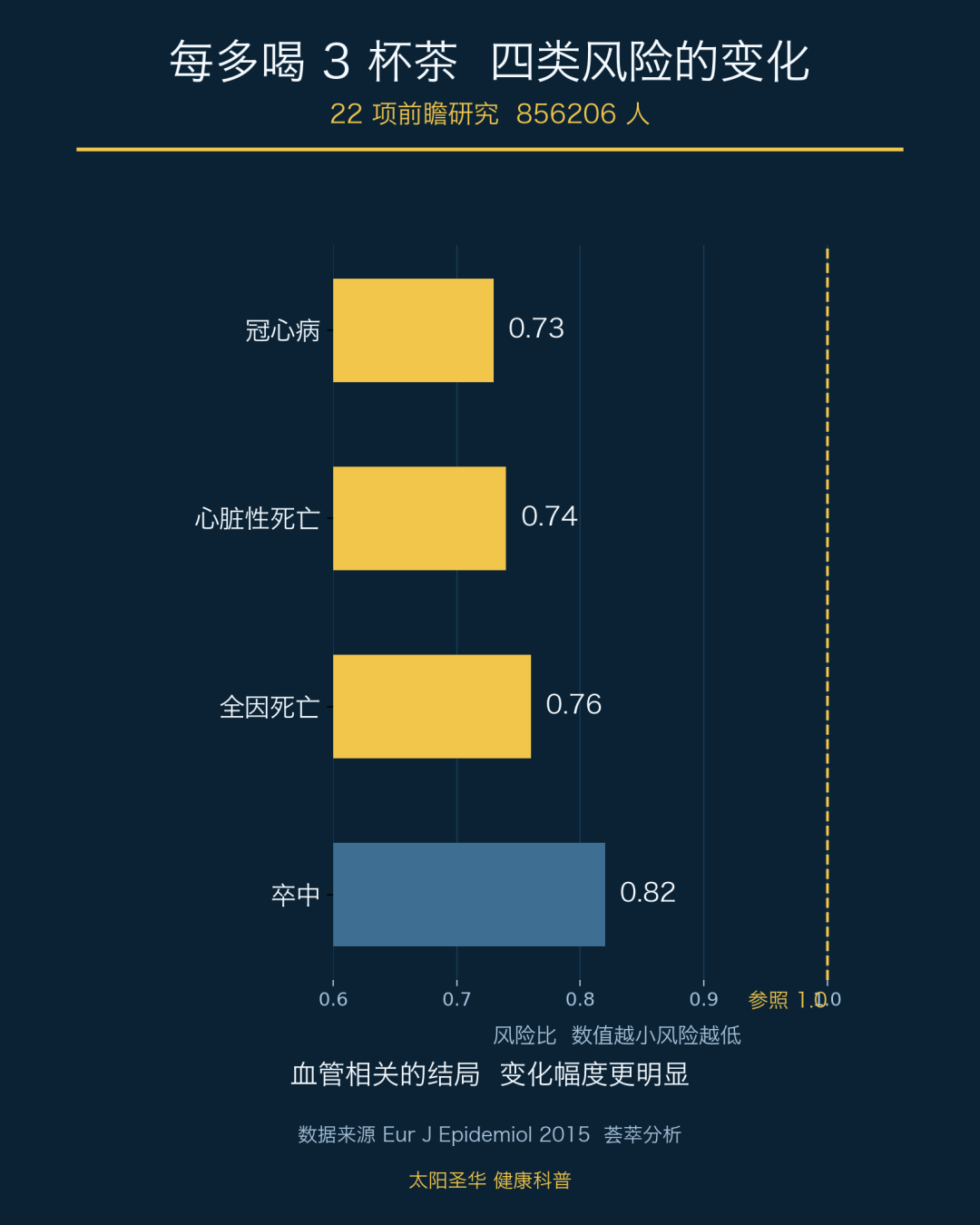
A meta-analysis of 22 prospective studies covering 856,000 people provides more detailed numbers: each additional 3 cups of tea per day was associated with a 27% lower risk of coronary heart disease, 26% lower risk of cardiac death, 18% lower risk of stroke, and 24% lower risk of all-cause mortality[2].
Human trials also line up at the mechanistic level: in 9 controlled studies with about 500 mL of tea per day, brachial artery flow-mediated vasodilation improved by 2.6 percentage points, a relative increase of about 40%[7]. Slightly better vascular endothelial function, over the long term, echoes slightly fewer cardiovascular events.
3. On Blood Sugar, Don't Overstate It
In a pooled analysis of 19 cohort studies covering 1.076 million people, those who drank 4 or more cups per day had a 17% lower risk of type 2 diabetes; but when all tea intake levels were pooled together, the combined hazard ratio was 0.96, with the confidence interval crossing 1—not significant overall[3].
Harder evidence comes from randomized controlled trials: in 7 trials with 510 people at high risk of diabetes, drinking green tea or taking green tea extract produced no significant changes in fasting blood glucose, fasting insulin, HbA1c, or insulin resistance index[4].
To put it in two sentences: tea may offer a little help with prevention, but tea is not a blood-sugar-lowering tool, nor can it replace dietary control and a doctor's treatment plan.
4. Brain and Metabolism: Signals Present, Effects Modest
On cognition, in a meta-analysis of 389,000 people, tea drinkers had a hazard ratio of 0.68 for cognitive impairment, with each additional cup lowering risk by about another 11%[5].
On metabolism, we need to pour some cold water: in data from 8 randomized trials of green tea catechins, resting energy expenditure increased by only about 158 kJ on average—roughly 38 kcal—and changes in fat oxidation rate did not reach statistical significance[6]. Expecting tea to "burn off" fat is unrealistic.
So its real value lies in substitution: swapping the sugary drink in your hand for plain tea inherently cuts a fair number of calories.
5. How to Drink It for the Most Benefit
-
Don't drink it too hot. The International Agency for Research on Cancer, under the World Health Organization, classifies beverages above 65°C as Group 2A—probably carcinogenic to humans. Let it sit for a few minutes after brewing before drinking[8]
-
Don't add sugar, and don't pair it with sweets. Milk tea and fruit tea with added sugar and cheese foam are not the same thing as the "tea" discussed in this article
-
Go easy on strong tea after the afternoon. People who metabolize caffeine slowly can easily have their sleep disrupted, and poor sleep has a bigger impact on weight and metabolism
-
If you're pregnant, anemic, or taking medication, ask your doctor first about how much to drink
One Thing You Can Do Today
Swap the sugary drink in your hand for a cup of plain tea, keep it to 2 to 3 cups throughout the day, and let it cool to a comfortable temperature before drinking.
Tea is not a longevity drug. It's simply the kind of everyday choice where—since you're going to drink something anyway—choosing it is better than choosing something sweet.
If this article was helpful to you, give it a like or a "reading" click, and feel free to leave a comment telling us what topics you'd like to see.
Disclaimer: This article is for health education purposes only and is intended for informational reference; it does not constitute medical advice. If you have health concerns, please consult a professional physician.
Conflict of Interest Statement: This article does not involve any drug or product recommendations and has no conflict of interest with the research institutions mentioned in the text.
© 2026 Sunshenghua (Beijing) Medical Technology Co., Ltd.
References
[1] Inoue-Choi M, et al. Tea Consumption and All-Cause and Cause-Specific Mortality in the UK Biobank: A Prospective Cohort Study. Ann Intern Med. 2022;175(9):1201-1211. PMID: 36037472
[2] Zhang C, et al. Tea consumption and risk of cardiovascular outcomes and total mortality: a systematic review and meta-analysis of prospective observational studies. Eur J Epidemiol. 2015;30(2):103-113. PMID: 25354990
[3] Li X, et al. Daily higher tea consumption is associated with a reduced risk of type 2 diabetes: A cohort study and updated systematic review and meta-analysis. Nutr Res. 2023;118:116-127. PMID: 37647847
[4] Wang X, et al. Effects of green tea or green tea extract on insulin sensitivity and glycaemic control in populations at risk of type 2 diabetes mellitus: a systematic review and meta-analysis of randomised controlled trials. J Hum Nutr Diet. 2014;27(5):501-512. PMID: 24206044
[5] Zhu Y, et al. Moderate coffee or tea consumption decreased the risk of cognitive disorders: an updated dose-response meta-analysis. Nutr Rev. 2024;82(6):738-748. PMID: 37523229
[6] Kapoor MP, et al. Physiological effects of epigallocatechin-3-gallate (EGCG) on energy expenditure for prospective fat oxidation in humans: A systematic review and meta-analysis. J Nutr Biochem. 2017;43:1-10. PMID: 27883924
[7] Ras RT, et al. Tea consumption enhances endothelial-dependent vasodilation; a meta-analysis. PLoS One. 2011;6(3):e16974. PMID: 21394199
[8] IARC Working Group. Drinking Coffee, Mate, and Very Hot Beverages. IARC Monographs. Lyon: IARC; 2018. PMID: 31310458