One Multivitamin a Day, 390,000 People Followed for 27 Years: The Results Are a Bit Surprising
This article is for health education purposes only and is for informational reference only; it does not constitute medical advice. If you have health concerns, please consult a professional doctor.
Many people buy multivitamins for their parents for a simple reason: taking them is better than not taking them—what if they help?
But this claim has never been verified. Looking at several large population studies and large-scale randomized trials from recent years together, the assumption that "taking them is better than not taking them" doesn't quite hold up.
The 5 cards below use 5 sets of numbers to make it clear: which supplements may be taken in vain, and which people actually need them.

1. 390,000 People Followed for 27 Years: No Lower Mortality
In 2024, JAMA Network Open pooled three large U.S. prospective cohorts: 390,000 people, 164,000 deaths, and follow-up of up to 27 years. For people who took a multivitamin every day, the all-cause mortality hazard ratio was 1.04 (range 1.02 to 1.07)—not lower, but slightly higher. The study specifically addressed reverse causation—the possibility that people start taking supplements only after their health declines—and also adjusted for confounders such as smoking, education, and diet. The conclusion did not change [1].
In plain terms: This type of observational study can only show that "people who took them did not live longer"; it cannot prove that "people who took them will have their lives shortened." But at the very least, the data do not support the purchasing rationale of "spending money to buy insurance."
2. 84 Studies, 740,000 People: The Measurable Benefit Is Very Small
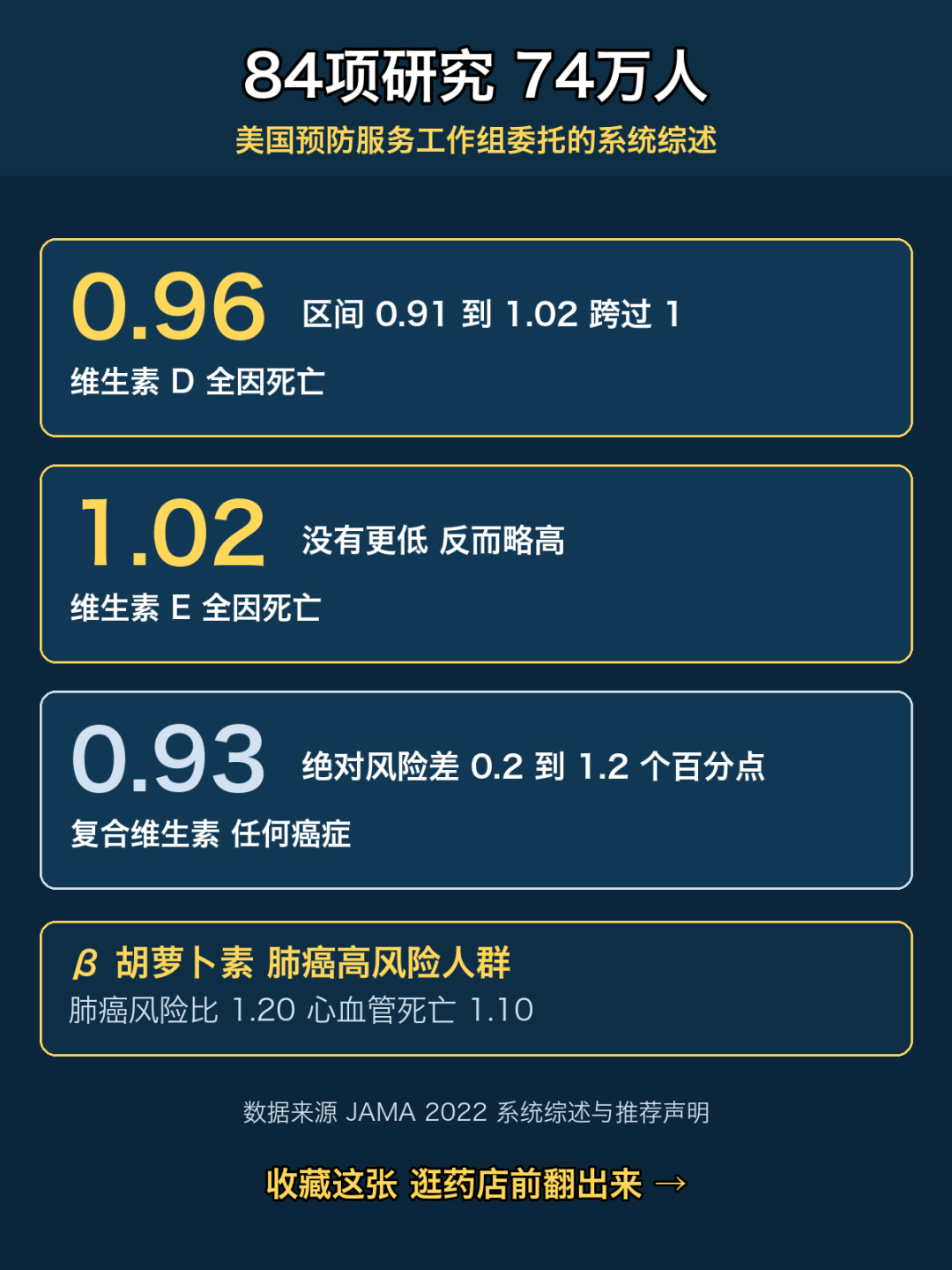
In 2022, a systematic review commissioned by the U.S. Preventive Services Task Force and published in JAMA included 84 studies and 739,800 people: for vitamin D, the all-cause mortality hazard ratio was 0.96 (range 0.91 to 1.02)—when the range crosses 1, that means "no difference"; for vitamin E, it was 1.02; for multivitamins and any cancer, the hazard ratio was 0.93 (range 0.87 to 0.99), which is statistically different, but the absolute risk difference was only 0.2 to 1.2 percentage points [2]. The recommendation statement accompanying the same evidence was even more direct: beta-carotene and vitamin E are explicitly not recommended for preventing cardiovascular disease and cancer [3].
In plain terms: With millions of person-years of data, the measurable benefit is far smaller than what advertisements claim. And in people at high risk of lung cancer, beta-carotene actually falls on the side of increased risk.
3. 25,000 People Randomized: Neither Vitamin D nor Fish Oil Passed
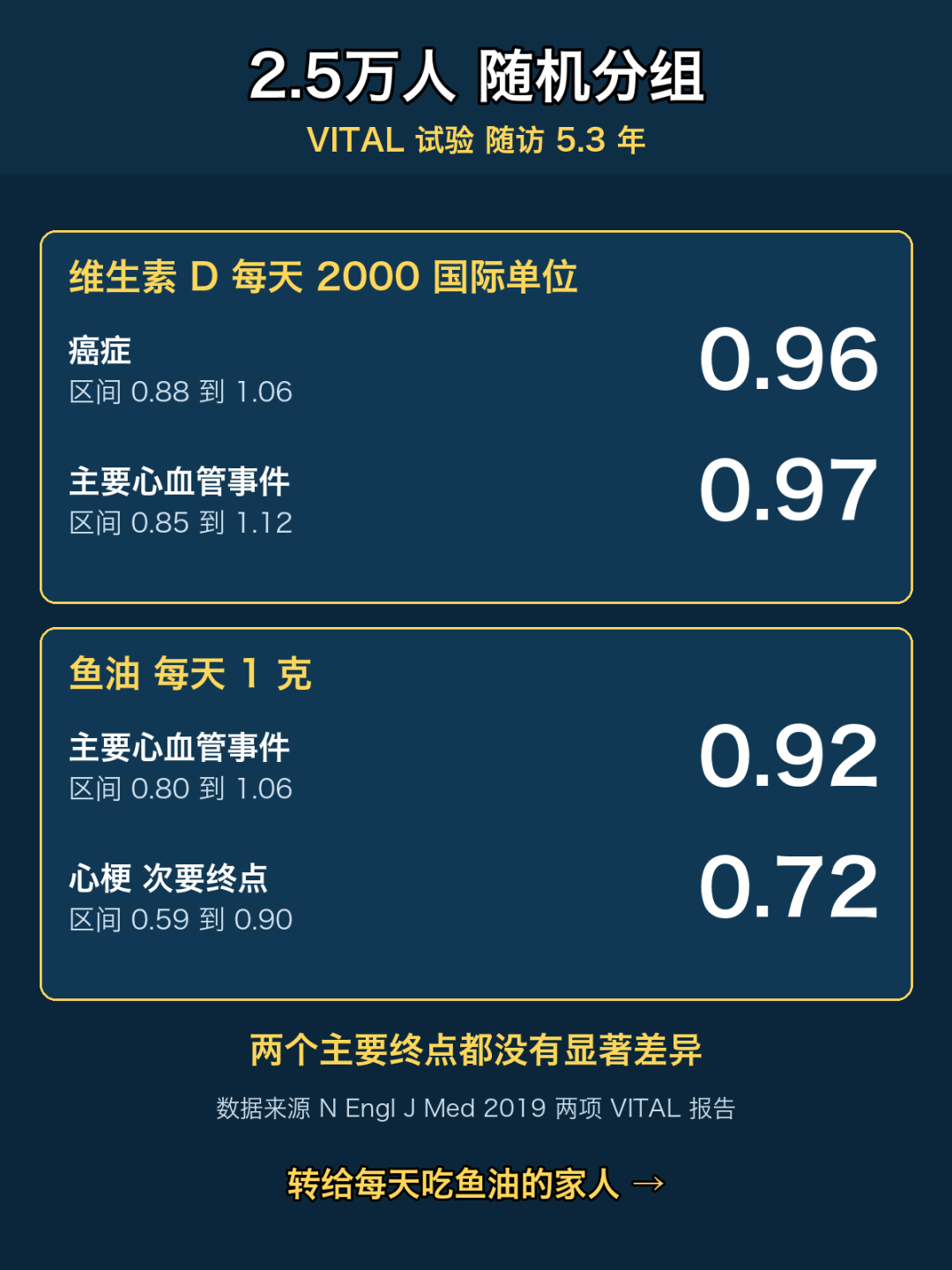
The VITAL trial, with 25,871 people and 5.3 years of follow-up, is rare hard evidence in this area. For 2,000 international units of vitamin D per day: the cancer hazard ratio was 0.96 (range 0.88 to 1.06), and major cardiovascular events 0.97 (range 0.85 to 1.12)—neither primary endpoint was met [4]. For 1 gram of fish oil per day: major cardiovascular events 0.92 (range 0.80 to 1.06), also with no significant difference; however, for the secondary endpoint of heart attack, the hazard ratio was 0.72 (range 0.59 to 0.90), which was indeed somewhat lower [5].
In plain terms: Fish oil is not completely useless, but its results are concentrated in one secondary endpoint and cannot support the expectation of "one pill a day to prevent a first heart attack." Before spending money, first distinguish primary endpoints from secondary endpoints.

4. The Same Amount Is Only Meaningful When It Comes from Food
A 2019 cohort study in the Annals of Internal Medicine of 30,000 people followed for 6.1 years: people who reached recommended amounts of vitamin A, vitamin K, magnesium, zinc, and copper had lower risks of all-cause and cardiovascular death. But this association appeared only in people who "got enough from food"—people who reached the same amounts through supplements did not show this association [6]. Over-supplementing also has a cost: people whose calcium intake exceeded the upper limit had a cancer mortality hazard ratio of 1.62 (range 1.07 to 2.45), mainly from calcium tablets at more than 1,000 milligrams per day [6].
In plain terms: Nutrients are not simply "counted once they go in"; the body responds differently depending on the source. Food also contains dietary fiber, phytochemicals, and protein—things a pill cannot pack in.
5. These 5 Groups of People Really Do Need Supplements
-
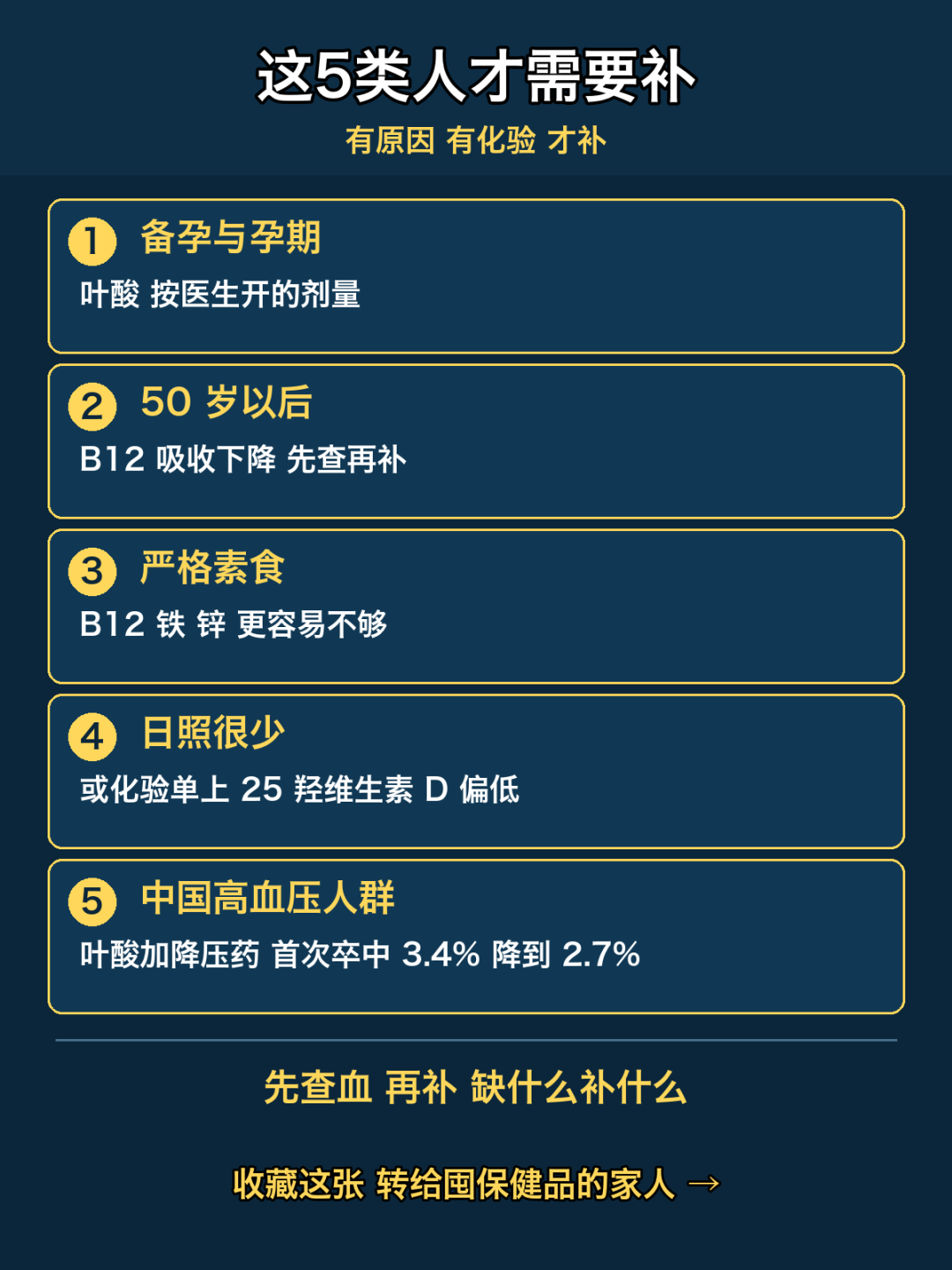
Preparing for pregnancy and during pregnancy: folic acid, taken at the dose prescribed by a doctor.
-
After age 50: stomach acid decreases and absorption capacity declines; B12 can be checked first and then supplemented.
-
Strict vegetarians: B12, iron, and zinc are more likely to be insufficient.
-
People with very little sun exposure, or with low 25-hydroxyvitamin D on lab tests: supplement at the dose given by a doctor.
-
People with hypertension in China: in the CSPPT trial, the group taking blood pressure medication plus folic acid had a first stroke rate of 2.7%, versus 3.4% in the group taking blood pressure medication alone, with a hazard ratio of 0.79 (range 0.68 to 0.93); there was no difference in all-cause mortality [7].
What these five points have in common is: first have a clear reason or lab result, then supplement. Conversely, taking them just because "everyone else is taking them" amounts to spending money to buy peace of mind.
Three Things You Can Do Today
-
Check the bottles at home: if the ingredient list includes beta-carotene, do not take it long term, especially if you smoke.
-
Replace "supplementing" with "eating": one serving of dark green vegetables, one serving of soy products, and one egg a day is more practical than adding another bottle.
-
If you really need to supplement, test first and then supplement: get blood tests for 25-hydroxyvitamin D, B12, and ferritin, and supplement only what you lack—do not supplement according to advertisements.
A multivitamin is not insurance; at best it is a policy with no coverage amount written on it. What truly provides a safety net for the body is the vegetables, beans, eggs, and bit of exercise every day.
Share this with someone in your family who is stockpiling health supplements, so they can take a look at the ingredient list first; save this article and pull it out to compare before your next trip to the pharmacy.
If this has been helpful to you, give it a like or a "Wow," and feel free to leave a comment telling us what topics you would like to see.
Disclaimer: This article is for health education purposes only and is for informational reference only; it does not constitute medical advice. If you have health concerns, please consult a professional doctor.
Conflict of interest statement: This article does not involve any product promotion or commercial collaboration, and has no conflict of interest with the research institutions mentioned in the text.
© 2026 Sun Shenghua (Beijing) Medical Technology Co., Ltd.
References
-
Loftfield E, O'Connell CP, Abnet CC, et al. Multivitamin Use and Mortality Risk in 3 Prospective US Cohorts. JAMA Netw Open. 2024;7(6):e2418729. PMID: 38922615
-
O'Connor EA, Evans CV, Ivlev I, et al. Vitamin and Mineral Supplements for the Primary Prevention of Cardiovascular Disease and Cancer: Updated Evidence Report and Systematic Review for the US Preventive Services Task Force. JAMA. 2022;327(23):2334-2347. PMID: 35727272
-
US Preventive Services Task Force. Vitamin, Mineral, and Multivitamin Supplementation to Prevent Cardiovascular Disease and Cancer: US Preventive Services Task Force Recommendation Statement. JAMA. 2022;327(23):2326-2333. PMID: 35727271
-
Manson JE, Cook NR, Lee IM, et al. Vitamin D Supplements and Prevention of Cancer and Cardiovascular Disease. N Engl J Med. 2019;380(1):33-44. PMID: 30415629
-
Manson JE, Cook NR, Lee IM, et al. Marine n-3 Fatty Acids and Prevention of Cardiovascular Disease and Cancer. N Engl J Med. 2019;380(1):23-32. PMID: 30415637
-
Chen F, Du M, Blumberg JB, et al. Association Among Dietary Supplement Use, Nutrient Intake, and Mortality Among U.S. Adults: A Cohort Study. Ann Intern Med. 2019;170(9):604-613. PMID: 30959527
-
Huo Y, Li J, Qin X, et al. Efficacy of folic acid therapy in primary prevention of stroke among adults with hypertension in China: the CSPPT randomized clinical trial. JAMA. 2015;313(13):1325-1335. PMID: 25771069