This article is for health education purposes only and is not intended as medical advice. Please consult a healthcare professional if you have any health concerns.
✦ ✦ ✦
Does this sound familiar? You sit down in the morning, and the next time you look up, it's already dark. By the end of the day, you've barely left your chair.
First, some data: An Australian cohort study of 220,000 people found that those who sat for more than 11 hours a day had a 40% higher risk of all-cause mortality compared to those who sat for less than 4 hours a day[[1]]. A Lancet meta-analysis covering over a million people provided a more detailed conclusion: people who sat for more than 8 hours a day and exercised almost not at all had a 59% higher risk of death compared to those who "sat less + moved more"[[2]].
The good news is: the harm of prolonged sitting can be offset by exercise. Today, with 4 graphics, we'll explain exactly how sitting is changing your body—and how to "break up" the damage.

Signal 1: Your fat-burning switch has been turned off
Muscles are the main force behind fat consumption. When you sit for extended periods, the large muscle groups in your legs are barely working, and the activity of lipoprotein lipase (LPL)—the enzyme responsible for breaking down blood lipids—drops by about 90%[[3]]. This is why people who sit a lot tend to store more fat—it's not that they eat too much, it's that they can't "burn" it.

Signal 2: Blood sugar creeps up
When muscles contract, they help "escort" glucose from the blood into cells. When muscles don't move, blood sugar tends to stay elevated. A randomized crossover trial found that getting up and walking for 2 minutes every 20 minutes can significantly lower post-meal blood sugar[[4]].

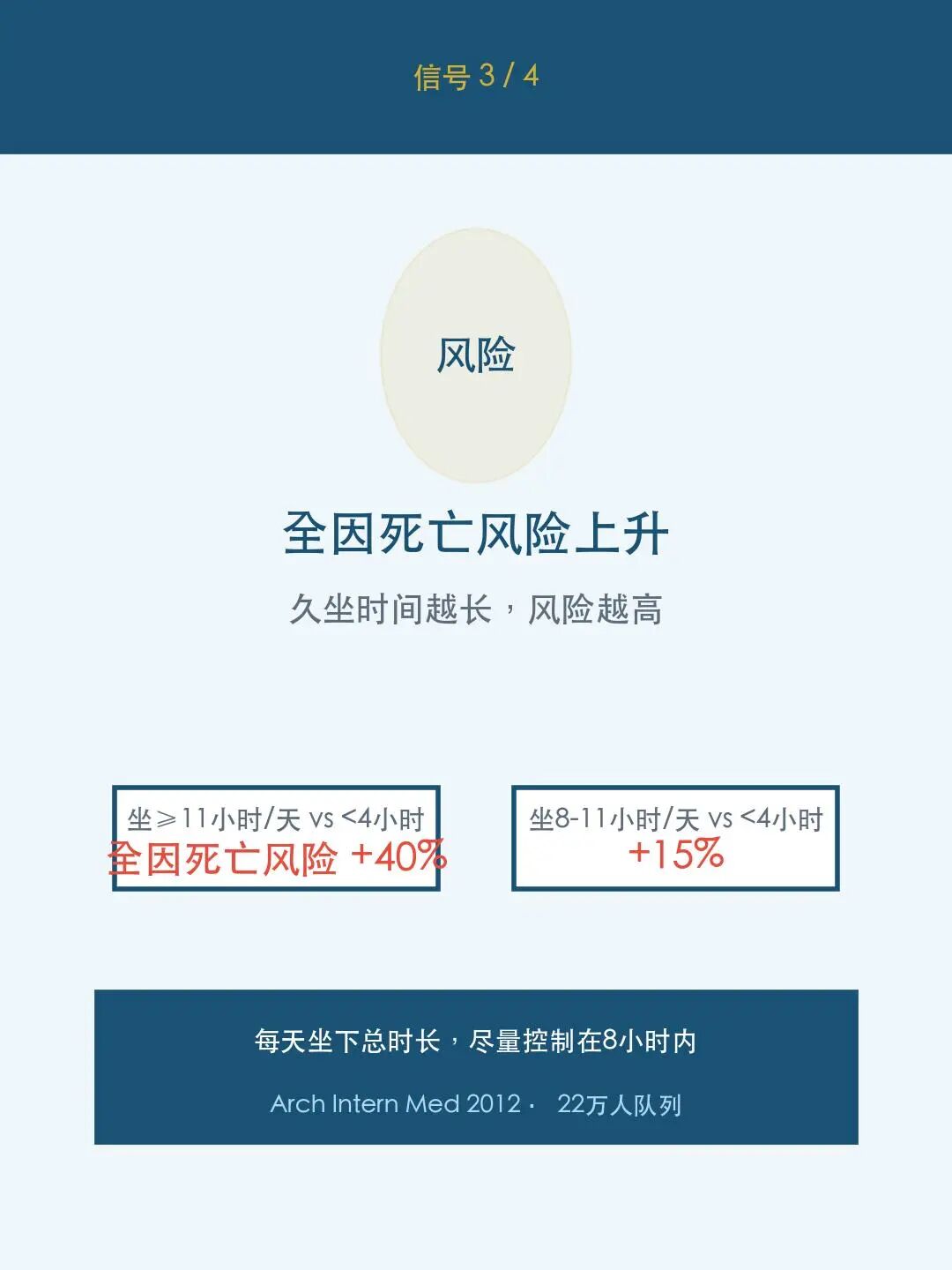
Signal 3: All-cause mortality risk rises
The harm of prolonged sitting isn't just metabolic. A cohort of 220,000 people showed that sitting 8–11 hours a day was associated with a 15% higher risk of death compared to sitting less than 4 hours; exceeding 11 hours raised the risk by 40%—and this association was independent of exercise levels[[1]].
Signal 4: Exercise really can save you
The Lancet meta-analysis provides the key answer: 60–75 minutes of moderate-intensity exercise per day can essentially offset the mortality risk associated with prolonged sitting[[2]]. Exercise isn't optional—it's the "antidote" for those who sit all day.

What to do? "Break up" your sitting
You don't need to exercise for two hours at a time—the key is to interrupt:
-
Every 30–45 minutes of sitting, get up and move for 1–2 minutes;
-
Stand up and walk a few steps when taking a phone call, getting water, or taking out the trash;
-
Get off one stop early on your commute and walk;
-
Accumulate at least 150 minutes of brisk walking or jogging per week.

✦ ✦ ✦
The damage of prolonged sitting is "accumulated," and so is the remedy—every 2-minute standing break is a reboot for your metabolism.
We suggest saving this action card and sharing it with family and friends who sit all day.
If you found this content helpful, feel free to hit "Like" or "Wow," and leave a comment telling us what topics you'd like to see.
✦ ✦ ✦
References
-
van der Ploeg HP, et al. Sitting time and all-cause mortality risk in 222 497 Australian adults. Arch Intern Med. 2012;172(6):494-500. PMID: 22450936.
-
Ekelund U, et al. Does physical activity attenuate, or even eliminate, the detrimental association of sitting time with mortality? A harmonised meta-analysis of data from more than 1 million men and women. Lancet. 2016;388(10051):1302-1310. PMID: 27475271.
-
Hamilton MT, et al. Role of low energy expenditure and sitting in obesity, metabolic syndrome, type 2 diabetes, and cardiovascular disease. Diabetes. 2007;56(11):2655-2667. PMID: 17827399.
-
Dunstan DW, et al. Breaking up prolonged sitting reduces postprandial glucose and insulin responses. Diabetes Care. 2012;35(5):976-983. PMID: 22374636.
✦ ✦ ✦
Disclaimer: This article is based on publicly available published research data and is intended for health education reference only. It does not constitute any medical advice or medication guidance. Individual health conditions vary; please consult a healthcare professional promptly if you have any health concerns.
Conflict of Interest Statement: The author of this article has no conflicts of interest with any research institutions, journals, or commercial entities mentioned in the text.
© 2026 Sun Saint Hua (Beijing) Medical Technology Co., Ltd.