How Many Steps a Day Are Enough? Benefits Start at 6000
Disclaimer: This article is for health education purposes only and is intended for informational reference; it does not constitute medical advice. If you have health concerns, please consult a professional doctor.
✦ ✦ ✦
10,000 steps a day is probably the most widely circulated piece of health advice out there. But is it a scientific conclusion, or a pedometer advertising slogan? Large-scale studies published in recent years tell a somewhat different story: the number of steps that's truly "enough" is far fewer than 10,000.
Here's the bottom line: for most adults, 6,000 to 8,000 steps already captures most of the benefits; the gains rise fastest when going from 2,000-something steps to 4,000-something steps. 10,000 steps certainly doesn't hurt, but it's the icing on the cake, not the threshold.

1. Where Did "10,000 Steps" Come From?
Many people assume 10,000 steps came from the WHO or some research study, but it's really more of a marketing symbol. In 1965, a Japanese pedometer manufacturer launched a product called the "Manpo-kei" (10,000-step meter)—the name was chosen to be catchy and sell well, not because of any experimental finding. The number was subsequently cited repeatedly by the media and insurance advertising, gradually becoming the "standard."
The scientific community only began using large samples and wearable accelerometers to actually count steps in the past decade or so. The conclusions are more nuanced than "10,000"—and more useful.
2. Study 1: Older Women, Benefits Plateau After About 7,500 Steps
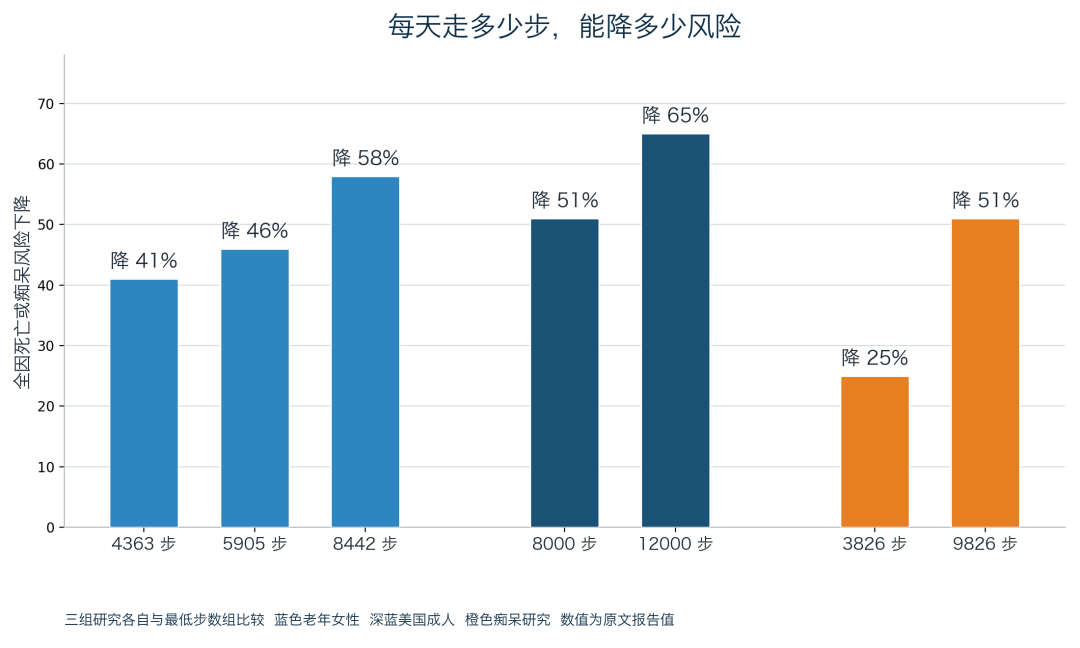
Research from Harvard and other institutions followed 16,741 women with a mean age of 72, using accelerometers to record actual step counts, with a mean follow-up of 4.3 years [1]. They were divided into four groups by step count, with median daily steps of approximately 2,718, 4,363, 5,905, and 8,442. Compared with the lowest group, all-cause mortality risk was: 41% lower, 46% lower, and 58% lower, respectively.
The key detail lies in the shape of the curve: risk declined steadily as steps increased, then began to flatten out at around 7,500 steps—beyond that, the additional benefit was minimal.
3. Study 2: From 4,000 to 8,000 Steps, Risk Drops by Half
Another study based on the US National Health and Nutrition Examination Survey analyzed 4,840 adults (mean age 56.8), with a mean follow-up of 10.1 years, during which 1,165 deaths occurred [2].
Using 4,000 steps per day as the reference: at 8,000 steps, all-cause mortality risk was 51% lower; at 12,000 steps, it was 65% lower. In other words, the jump from 4,000 to 8,000 is where the biggest value lies; going from 8,000 to 12,000 only adds a little more.
4. Study 3: Around Age 60, the Answer Is Different
A 2022 meta-analysis in The Lancet Public Health pooled step count and all-cause mortality data from 15 international cohorts [3], with age-specific conclusions:
-
Aged 60 and above: after 6,000 to 8,000 steps per day, risk reduction tends to plateau;
-
Under 60: the plateau appears at 8,000 to 10,000 steps.
The older you are, the fewer steps you need—because the baseline is different, and marginal benefits appear earlier. So "10,000 steps" for a 70-year-old is actually overachieving.
5. Study 4: Brain Protection Too—Benefits Start Before 4,000 Steps
Step count isn't just about cardiovascular health. A study tracking 78,430 adults with a median follow-up of 6.9 years found a nonlinear relationship between daily steps and dementia risk [4]:
-
The "optimal dose" for the greatest risk reduction was about 9,826 steps per day (51% lower risk);
-
At 3,826 steps per day, half of the maximum reduction was already achieved (25% lower risk).
In plain terms: don't underestimate those 3,000-something steps a day—for many sedentary people, going from 2,000 to 4,000 steps is the best bang for your buck.
6. Does Walking Speed Matter?
It matters, but don't put the cart before the horse. In the first study above, step intensity (walking speed) was initially associated with mortality risk, but after adjusting for total step count, most of the association became weaker or even non-significant [1]. The takeaway: get enough steps first, then worry about speed. Walking only 2,000 steps but at a brisk pace all the way doesn't beat 10,000 steps at a slow pace.
7. How to Put It Into Practice: Three Points
First, check how many steps you're currently getting. Your phone's built-in health app has this—look at your 7-day average, not a single day's peak.
Second, add 2,000 steps to that baseline. For sedentary people, going from 3,000 to 5,000 steps yields the fastest gains; don't rush to 10,000 right away—it's easy on the knees and hard to sustain.
Third, scattered walking counts too. Getting off one stop early on your commute, standing up and walking during phone calls, taking a 10-minute stroll after meals—all of it counts toward the total. Steps don't need to be continuous, and you don't need to do them all at once.
One more reminder: step count isn't a universal metric. Getting enough sleep, eating right, and avoiding prolonged sitting are all essential; if you have cardiovascular or joint conditions, consult your doctor before increasing your activity.

One Thing You Can Do Today
Open your phone and check your 7-day average step count, and write it in the comments. Check again at the same time next week—starting by adding 2,000 steps to your average is the most reliable starting point.
If you found this useful, give it a like and a "Wow", and share it with that friend who's always posting their 10,000 steps.
Conflict of interest statement: This article is for educational purposes and does not involve any commercial promotion. It has no financial relationship with any product or manufacturer mentioned in the text. © 2026 Sun Holy Hua. All rights reserved.
References
[1] Lee IM, et al. Association of Step Volume and Intensity With All-Cause Mortality in Older Women. JAMA Intern Med. 2019;179(8):1105-1112. PMID: 31141585
[2] Saint-Maurice PF, et al. Association of Daily Step Count and Step Intensity With Mortality Among US Adults. JAMA. 2020;323(12):1151-1160. PMID: 32207799
[3] Paluch AE, et al. Daily steps and all-cause mortality: a meta-analysis of 15 international cohorts. Lancet Public Health. 2022;7(3):e219-e228. PMID: 35247352
[4] Del Pozo Cruz B, et al. Association of Daily Step Count and Intensity With Incident Dementia in 78 430 Adults Living in the UK. JAMA Neurol. 2022;79(10):1059-1063. PMID: 36066874