Every 0.1 Meter Slower, 12% Higher Risk of Death: The 4-Meter Hallway Self-Test
This article is for health education purposes only and is intended for informational reference. It does not constitute medical advice; if you have health concerns, please consult a professional physician.
Making the same trip to the grocery store, some people walk it in ten minutes, others take twenty. Most people chalk this up to "getting old" and think nothing more of it.
But in research, walking speed isn't a vague feeling—it's a number that can be measured: 4 meters, a stopwatch, one older adult. And what this number can predict going forward is more closely tied to "whether I can still live independently" than body weight or blood pressure.
Let's start with the conclusion: this test costs nothing, and it's worth every person over 60 measuring once this week in their own hallway.
First, Some Numbers: The Cost of Slowing Down
A 2018 meta-analysis published in JAMA Internal Medicine pooled 48 independent cohorts totaling 101,945 people, with a mean age of 72.2 years and a median follow-up of 5.4 years: for every 0.1 meter per second slower walking speed, the risk of earlier death was 12% higher and the risk of cardiovascular disease was 8% higher[2]. In the same analysis, cancer risk was not associated with walking speed—it's not a universal indicator, but for cardiovascular and cerebrovascular health, the signal is clear.
An earlier JAMA analysis pooled 9 cohorts of 34,485 community-dwelling adults aged 65 and older, with follow-up of 6 to 21 years: for every 0.1 meter per second faster walking speed, the risk of death was 12% lower[1]. At the same age of 75, moving from slower to faster walking speed, 10-year survival for men could go from 19% to 87%, and for women from 35% to 91%[1].
In plain terms: those two seconds lost on a 4-meter hallway reflect the combined performance of your heart, lungs, muscles, and nerves.

4 Meters, Measurable at Home
Measure out a 4-meter stretch of flat ground. Stand up straight, start the timer once you begin walking, and walk at your usual pace—don't deliberately speed up or slow down. Divide 4 by the number of seconds you took, and that's your walking speed.
Compare against three tiers: above 1.0 meter per second, most studies consider this relatively low risk; below 1.0 meter per second, among 3,047 adults with a mean age of 74, this falls into the high-risk group, with a mortality risk about 64% higher than the low-risk group[3]; if you're not sure whether you count as fast or slow, remember 0.92 meters per second—that's the average for 34,000 older adults[1].
In plain terms: after testing, you don't need to remember a score—just a date and a number. Test again three months later; tracking the trend is more useful than a single measurement.

What Happens in Three Years: The Research Has Numbers
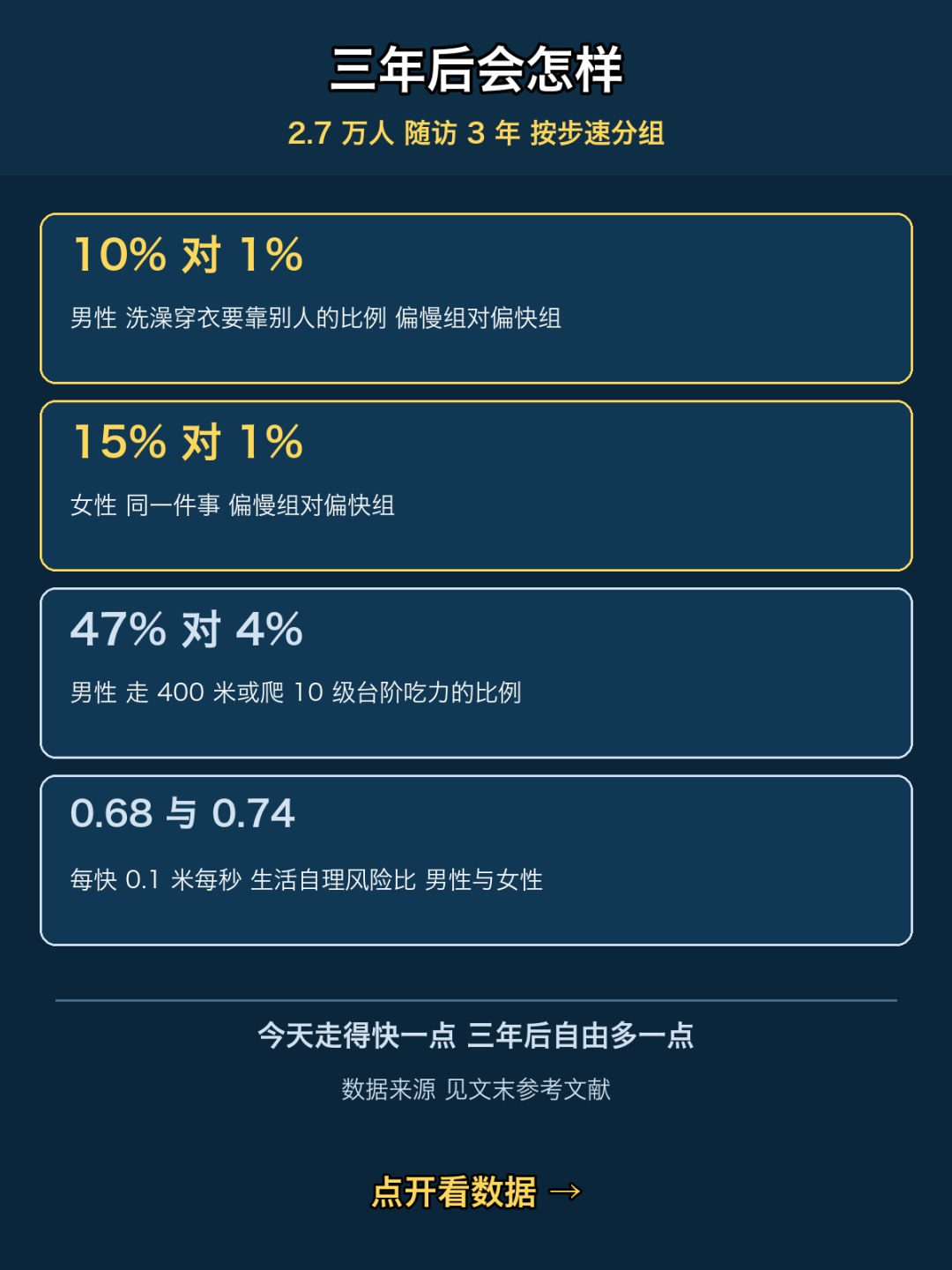
The Journals of Gerontology pooled 7 studies of 27,220 adults aged 65 and older, grouping walking speed into tiers by 0.2 meters per second to see what happened within three years[4]: the proportion needing help with bathing or dressing dropped from 10% in the slower walking speed group to 1% in the faster group for men, and from 15% to 1% for women; the proportion having difficulty walking 400 meters or climbing 10 steps dropped from 47% to 4% for men, and from 40% to 6% for women.
In plain terms: this walk isn't about a race time—it's about whether you can take care of yourself down the road.
Why We Slow Down: Slowness Is the Result, Not the Cause
The 2019 consensus from the European Working Group on Sarcopenia lists low muscle strength as a core feature of sarcopenia, with muscle quantity and quality used to confirm the diagnosis, while slow walking and slow rising from a chair belong to the layer of declining physical function[5]. Translated into plain terms: the strength in your legs goes first, and only then does your speed drop.
Next is cardiopulmonary blood supply not keeping up—you get winded after a few steps, and your speed naturally won't be fast; then there's joint pain and poor balance—pain makes you walk less, walking less makes you weaker, a vicious cycle; and there's prolonged sitting and bed rest—a few weeks without getting up, and your leg circumference visibly shrinks.
The 2019 consensus from the Asian Working Group for Sarcopenia screens using walking speed, grip strength, and the five-times sit-to-stand test together, precisely because looking at any single indicator alone makes it easy to miss cases[6].

How to Train It Back: Train the Legs, and the Balance Too
Training requires no equipment. Twice a week, do chair sit-to-stands (sit upright, arms crossed over your chest, 10 repetitions for 2 sets); walk briskly for 10 to 15 minutes daily, to the point of slight breathlessness where you can still talk; stand on one leg for 20 seconds each, holding a wall first, then letting go once stable. Don't skimp on protein—include a palm-sized portion of fish, eggs, dairy, or beans at every meal; spreading it across meals is better than making it up in one.
Three months later, return to the same hallway and test again: if you've dropped more than 0.1 meters per second, or if it comes with leg weakness or numbness, it's worth a visit to the hospital for a check—anemia, thyroid, blood sugar, vitamin D, and heart function are all on the possible list behind "walking slower," and let your doctor judge based on your situation.

A Reminder
Walking speed is a screening tool, not a verdict. On days when you have a cold, poor sleep, or knee pain, your measurement will be slower; one slow reading doesn't mean anything—only a sustained decline over six months is worth taking seriously.
Go home this week and measure your parents once in the hallway, and note the number in your phone's memo app. This may be the cheapest checkup there is.
Slowness isn't aging—it's muscle leaving the stage.
If this was helpful to you, give it a like or a "Wow," and feel free to leave a comment telling us what topics you'd like to see.
✦
Disclaimer: This article is a popular-science interpretation of publicly available research information and does not constitute medical advice. Please consult a physician for specific screening and exercise plans.
Conflict of interest statement: This article does not involve any drug or product recommendations and has no financial relationship with the research institutions mentioned in the text.
© 2026 Sunshenghua (Beijing) Medical Technology Co., Ltd.
References
[1] Studenski S, Perera S, Patel K, et al. Gait speed and survival in older adults. JAMA. 2011;305(1):50-58. PMID: 21205966
[2] Veronese N, Stubbs B, Volpato S, et al. Association Between Gait Speed With Mortality, Cardiovascular Disease and Cancer: A Systematic Review and Meta-analysis of Prospective Cohort Studies. J Am Med Dir Assoc. 2018;19(11):981-988.e7. PMID: 30056008
[3] Cesari M, Kritchevsky SB, Penninx BW, et al. Prognostic value of usual gait speed in well-functioning older people--results from the Health, Aging and Body Composition Study. J Am Geriatr Soc. 2005;53(10):1675-1680. PMID: 16181165
[4] Perera S, Patel KV, Rosano C, et al. Gait Speed Predicts Incident Disability: A Pooled Analysis. J Gerontol A Biol Sci Med Sci. 2016;71(1):63-71. PMID: 26297942
[5] Cruz-Jentoft AJ, Bahat G, Bauer J, et al. Sarcopenia: revised European consensus on definition and diagnosis. Age Ageing. 2019;48(1):16-31. PMID: 30312372
[6] Chen LK, Woo J, Assantachai P, et al. Asian Working Group for Sarcopenia: 2019 Consensus Update on Sarcopenia Diagnosis and Treatment. J Am Med Dir Assoc. 2020;21(3):300-307.e2. PMID: 32033882