This article is for health education purposes only and is intended for informational reference. It does not constitute medical advice; if you have health concerns, please consult a professional physician.
Two Meal Plans With Identical Calories, a 1.8-Kilogram Weight Difference in Two Weeks
If two groups of people eat exactly the same number of calories each day, with sugar, salt, and dietary fiber matched item by item, and both groups are allowed to eat freely until full, would their weight be the same?
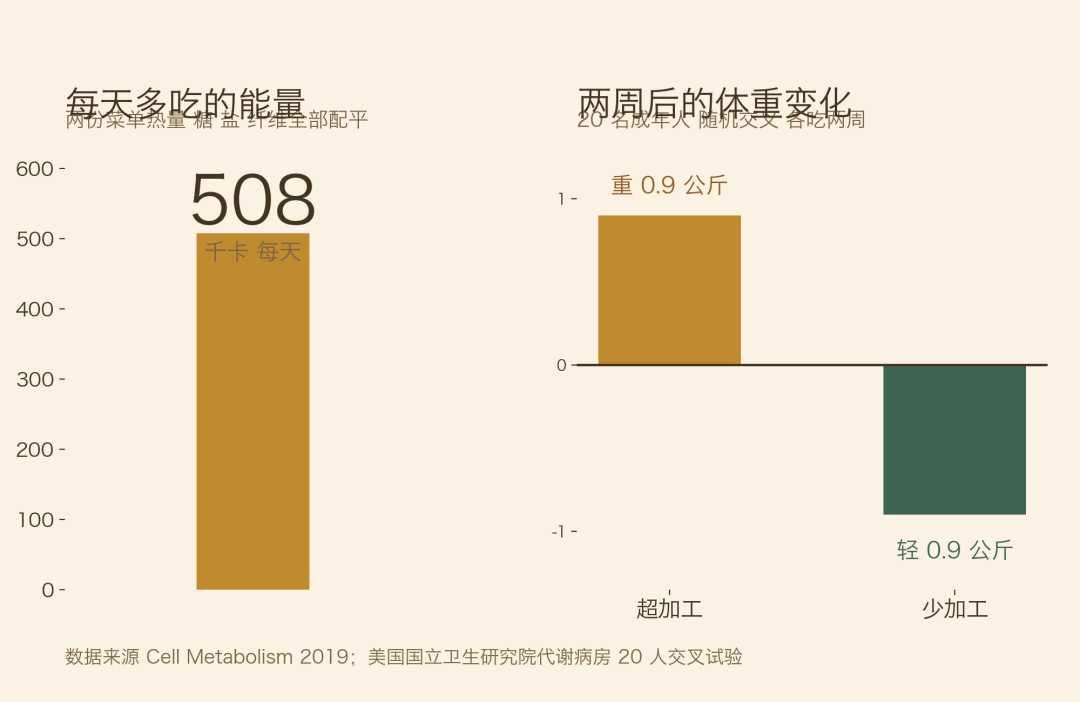
In 2019, the US National Institutes of Health admitted 20 adults to a metabolic ward and ran this experiment. Each group ate their assigned diet for two weeks, with the order randomly swapped. The result: one group gained 0.9 kilograms in two weeks, while the other lost 0.9 kilograms.[1]
There was only one difference: one group ate ultra-processed foods, and the other ate minimally processed whole foods.
An Inpatient Trial: Calories Were Matched, Yet People Still Ate More
What made this trial rigorous was the word "matched." The researchers aligned the two menus on calories, energy density, macronutrient ratios, sugar, sodium, and dietary fiber—even the portion sizes served at each meal were the same. Participants ate as much as they wanted, with no restrictions.[1]
The result: the ultra-processed group ate 508 kcal more per day. Of that excess, 280 kcal came from carbohydrates and 230 kcal from fat, while protein barely changed (−2 kcal). Weight change was highly correlated with energy intake (r = 0.8): the ultra-processed group gained an average of 0.9 kilograms, while the minimally processed group lost an average of 0.9 kilograms.[1]
Note the causal chain here: it is not that "ultra-processed foods are high in calories"—calories were matched; it is that people unconsciously eat more. A 1.8-kilogram difference over two weeks translates into a very real weight difference over a year.
Why You Eat More Without Realizing It: Three Mechanisms
First, fullness signals arrive too late. Ultra-processed foods are soft in texture and require almost no chewing, so a meal is eaten very quickly. A pooled analysis of 22 experimental studies showed that when eating quickly, energy intake was significantly higher (standardized mean difference 0.45, 95% CI 0.25 to 0.65), while hunger 3.5 hours between meals did not increase from eating more slowly.[5] In other words, slowing down only reduces intake without increasing hunger.
Second, the same bite carries more calories. Foods with high energy density are small in volume and weak in satiety—your stomach hasn't even stretched yet, and you've already exceeded your calories. This is determined by the formulation, not by willpower.
Third, the excess intake is almost purely carbohydrates and fat. Protein intake did not differ between the two groups, suggesting the body has self-regulation for protein needs, but carbohydrates and fat have no such brake.
More Than Calories: The Association Holds Under a Different Calculation
The French NutriNet-Santé cohort followed 105,159 adults over a median of 5.2 years. For every 10-percentage-point increase in the share of ultra-processed foods in the diet, cardiovascular disease risk was 12% higher (hazard ratio 1.12, 95% CI 1.05 to 1.20), coronary heart disease 13% higher, and cerebrovascular disease 11% higher.[2]
The key point: after the researchers adjusted one by one for nutritional quality indicators such as saturated fat, sodium, sugar, and dietary fiber, the association still remained.[2] This suggests that "ultra-processed" itself may bring something beyond calories and nutrients—additives, packaging contact materials, and substances newly formed during processing are all still under study.[2]
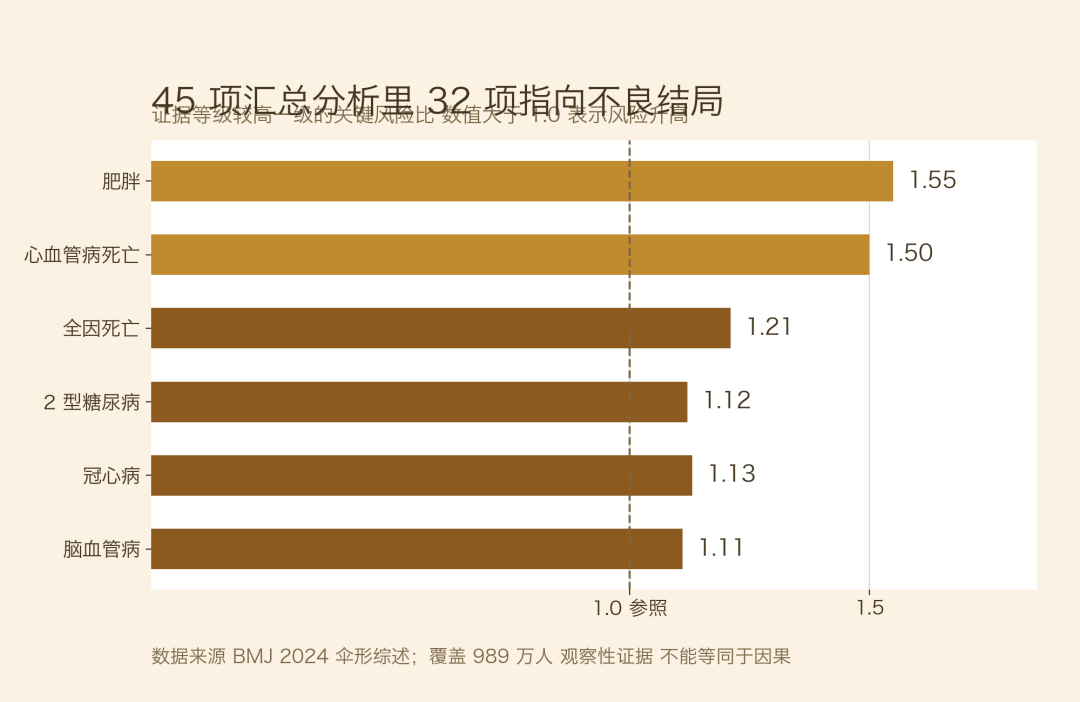
A 2024 umbrella review in The BMJ painted a fuller picture: 45 pooled analyses covering 9.89 million people, of which 32 (71%) showed that higher ultra-processed food intake was associated with worse health outcomes. Among the tier with higher evidence grades, findings included a cardiovascular mortality risk ratio of 1.50, a risk ratio of 1.12 for type 2 diabetes per 10-percentage-point increase; an odds ratio of 1.55 for obesity and a risk ratio of 1.21 for all-cause mortality.[3]
It must be made clear: this is observational evidence, and the vast majority was rated as low or very low quality, so it cannot be treated as causal conclusions.[3] But the direction is consistent with the inpatient trial.
This Is Not Just a Western Problem: Chinese Data Are Also Climbing
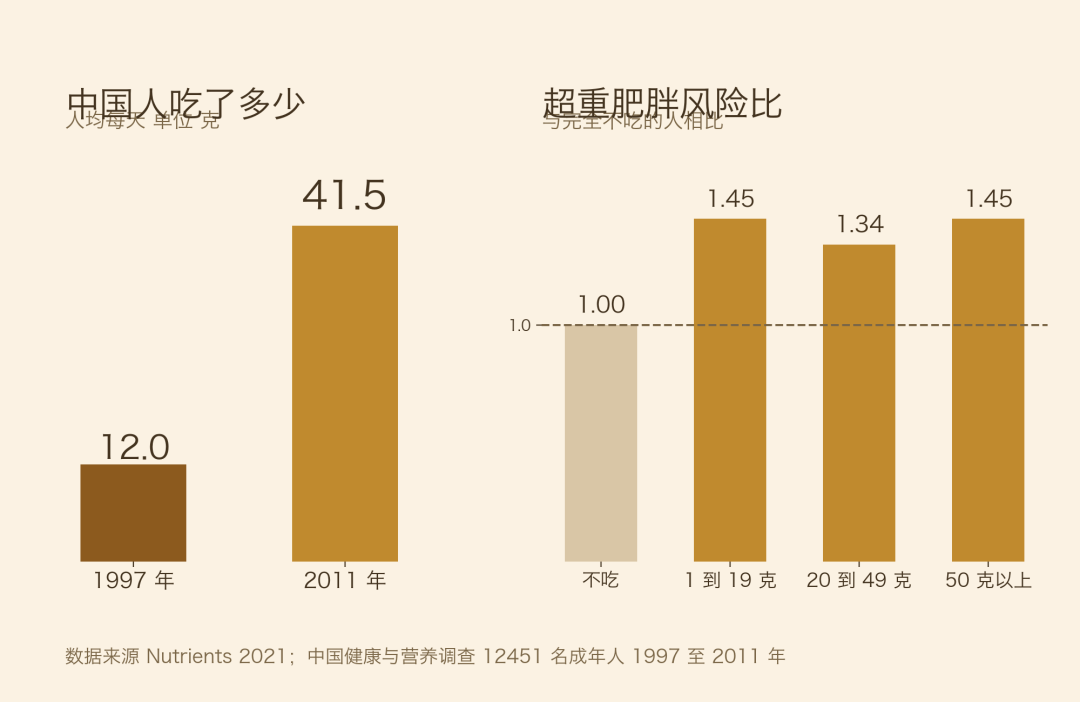
The China Health and Nutrition Survey followed 12,451 adults from 1997 to 2011. Per capita ultra-processed food intake rose from 12.0 grams to 41.5 grams per day, and its share of the daily diet rose from 1.0% to 3.6%.[4]
Compared with those who consumed none at all, those eating 1 to 19 grams per day had a 45% higher risk of overweight/obesity (BMI reaching 25), those eating 20 to 49 grams had a 34% higher risk, and those eating 50 grams or more also had a 45% higher risk; for central obesity, the risks were 54%, 35%, and 50% higher, respectively.[4]
The figure of 3.6% still looks low, but the trend is worth noting: it roughly tripled in 12 years, and this dataset ends in 2011. Today's food delivery, convenience stores, and pre-packaged snacks are far more dense than they were then.
Five Things You Can Do Today
First, look at the ingredient list, not the advertising copy. The longer the ingredient list and the more names you can't pronounce (thickeners, emulsifiers, flavorings, colorings), the closer it is to ultra-processed. The NOVA classification defines ultra-processed as "industrial formulations made from food extracts and additives."[6]
Second, let whole foods fill half your plate. The goal is not zero ultra-processed food, but to bring it down from "every meal" to "occasionally." Rice, eggs, leafy greens, tofu, and whole cuts of meat all need no ingredient list.
Third, cut liquid calories first. Sugary drinks, milk tea, and flavored yogurt are typical ultra-processed products and produce almost no satiety—cutting these costs the least.
Fourth, slow your eating pace to 20 minutes. Put down your chopsticks, cut food into smaller pieces, and don't eat while scrolling on your phone. The pooled analysis above shows that eating slowly reduces intake without increasing hunger.[5]
Fifth, make three swaps at home. Swap breakfast cereal for oatmeal plus eggs; swap potato chips for plain nuts (a small handful); swap sausages and ham for freshly sliced chicken breast or beef. Swaps are easier to sustain than "giving up."
If your weight changes noticeably over a few months and is accompanied by abnormal blood sugar, blood lipids, or blood pressure, don't adjust your diet on your own—go to an endocrinology or nutrition department for an evaluation.
The problem with ultra-processed food is not that it is "toxic," but that it is designed to be too easy to overeat. You don't need to declare war on food—you just need to know which things are worth eating slowly.
If this article makes you want to check the ingredient lists in your home, consider forwarding it to the person you eat with.
If you found this helpful, give it a like or a "Wow," and feel free to leave a comment telling us what topics you'd like to see.
✦ ✦ ✦
Disclaimer: This article is for health education purposes only and is intended for informational reference. It does not constitute medical advice and cannot replace the diagnosis and treatment of a professional physician. Individual circumstances vary considerably; if you have health concerns, please consult a professional physician.
Conflict of interest statement: This article involves no product recommendations or commercial partnerships and has no conflicts of interest with the research institutions or journals mentioned in the text.
© 2026 Sunsheng Hua (Beijing) Medical Technology Co., Ltd.
References
[1] Hall KD, Ayuketah A, Brychta R, et al. Ultra-Processed Diets Cause Excess Calorie Intake and Weight Gain: An Inpatient Randomized Controlled Trial of Ad Libitum Food Intake. Cell Metab. 2019;30(1):67-77.e3. PMID: 31105044
[2] Srour B, Fezeu LK, Kesse-Guyot E, et al. Ultra-processed food intake and risk of cardiovascular disease: prospective cohort study (NutriNet-Santé). BMJ. 2019;365:l1451. PMID: 31142457
[3] Lane MM, Gamage E, Du S, et al. Ultra-processed food exposure and adverse health outcomes: umbrella review of epidemiological meta-analyses. BMJ. 2024;384:e077310. PMID: 38418082
[4] Li M, Shi Z. Ultra-Processed Food Consumption Associated with Overweight/Obesity among Chinese Adults-Results from China Health and Nutrition Survey 1997-2011. Nutrients. 2021;13(8):2796. PMID: 34444957
[5] Robinson E, Almiron-Roig E, Rutters F, et al. A systematic review and meta-analysis examining the effect of eating rate on energy intake and hunger. Am J Clin Nutr. 2015;100(1):123-151. PMID: 24847856
[6] Monteiro CA, Cannon G, Levy RB, et al. Ultra-processed foods: what they are and how to identify them. Public Health Nutr. 2019;22(5):936-941. PMID: 30744710