Poor Teeth, Losing Teeth One by One: 45% Higher Risk of Cognitive Impairment
This article is for health education purposes only and is intended for informational reference; it does not constitute medical advice. If you have health concerns, please consult a professional doctor.
You brush your teeth, spit out foam tinged with blood, rinse twice, and carry on. Teeth loosen one after another, fall out one after another, and you figure it's just age catching up. A 2024 analysis pooling 22 studies and 4.24 million people says there's a line connecting these two things to the brain [1].
People with poor periodontal health have a 45% higher risk of cognitive impairment (odds ratio 1.45, 95% confidence interval 1.20 to 1.76); those who have already lost teeth have an 80% higher risk (1.80, 1.50 to 2.15) [1]. The more teeth lost, the higher the risk climbs.
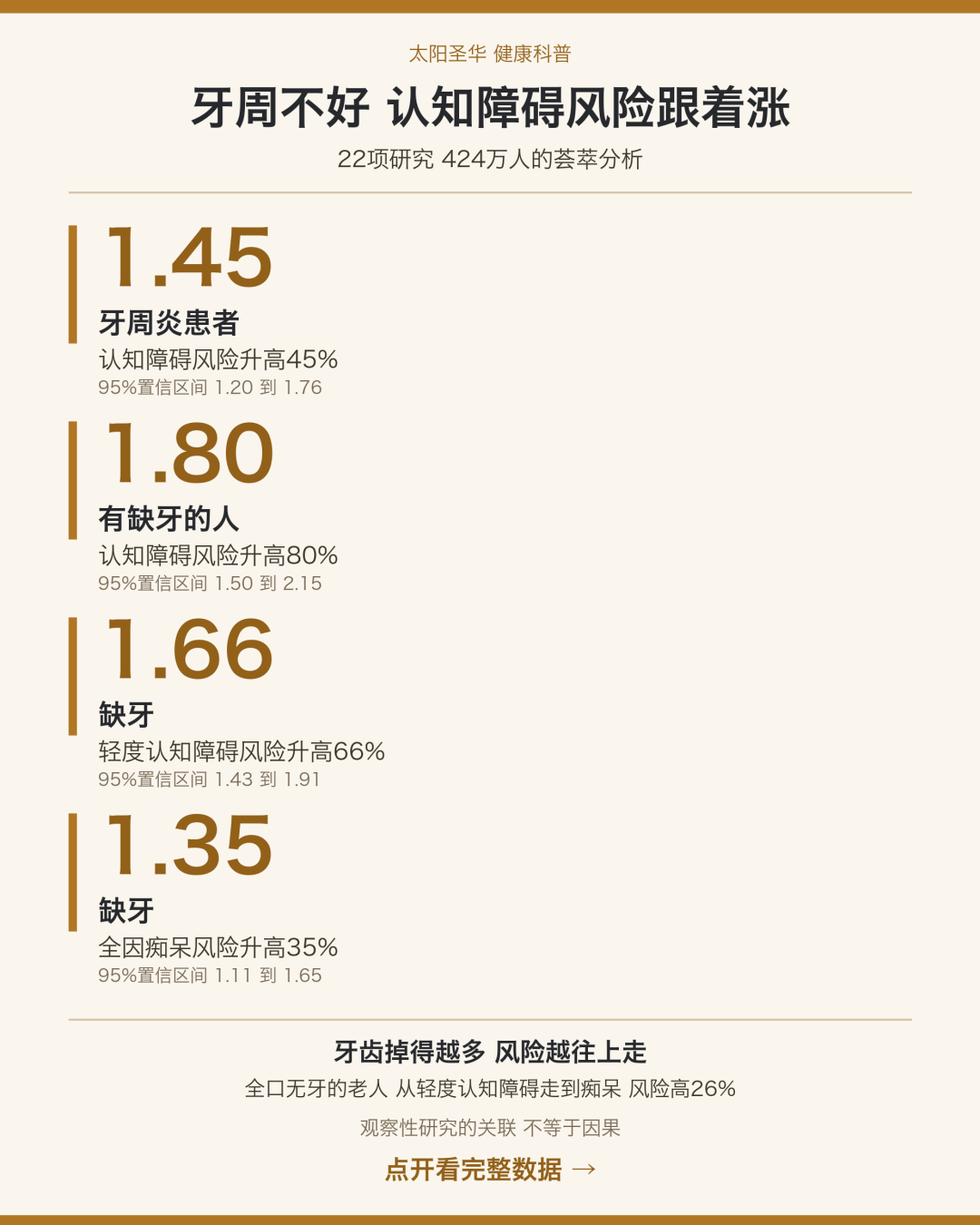
Figure caption: One graphic lays out four dimensions of periodontal health—periodontitis, missing teeth, occlusal support, and chewing ability—each pointing to an elevated risk of cognitive impairment.
A 2026 study following 22,205 people aged 50 and older in China, the UK, and the US for 12.3 years broke the process down further: among people with complete tooth loss, the risk of progressing from mild cognitive impairment to dementia was 26% higher (hazard ratio 1.26, 1.12 to 1.40), and the risk of death was 27% higher [2]. For this small slice of risk, the authors calculated an attributable fraction of 6.52%.
Why Inflammation in the Mouth Pulls on the Brain
Periodontitis is not just a bit of bleeding from the gums. Bacteria and toxins sit around the tooth roots long-term, forming a persistent inflammatory focus, and inflammatory factors travel through the bloodstream to the whole body; poor chewing also drags down nutrition and social interaction. All of these pathways are slowly draining the brain's reserve.
About 11.2% of people worldwide have severe periodontitis, making it the sixth most common disease in humans [3].
It's Not Just the Brain—the Heart and Blood Sugar Are on the List Too
A consensus statement from the European Federation of Periodontology and the World Heart Federation states plainly: severe periodontitis has an independent association with cardiovascular disease [3].
The evidence on blood sugar is even harder. A 2022 Cochrane updated systematic review included 35 randomized trials and 3,249 patients who had both diabetes and periodontitis: after 3 to 4 months of standard periodontal treatment, glycated hemoglobin fell by an average of 0.43% (4.7 mmol/mol), by 0.30% at 6 months, and by 0.50% at 12 months, with moderate-quality evidence [4]. This is one of the few associations that can speak through randomized trials.
But Don't Mistake Association for Causation
Another 2026 systematic review tightened the conclusions further: the pooled association across 9 studies was about 2.12 (1.51 to 2.98), and the authors noted that the certainty of evidence was low, that all included studies were observational, and that confounding factors are very hard to rule out cleanly [5].
So the accurate statement is: people with poor periodontal health have a higher proportion of cognitive problems. Conversely, "brush your teeth well and you can prevent dementia" currently has no randomized trial support. There's no need to panic, but don't keep treating it as a purely dental trifle either.
Our own numbers are more direct: the Fourth National Oral Health Epidemiological Survey shows that the periodontal health rate is only 9.1% among people aged 35 to 44, just 5.0% among those aged 55 to 64, and the detection rate of gingival bleeding among those aged 35 to 44 is as high as 87.4%. For the vast majority of adults, their periodontal health left the healthy zone long ago.
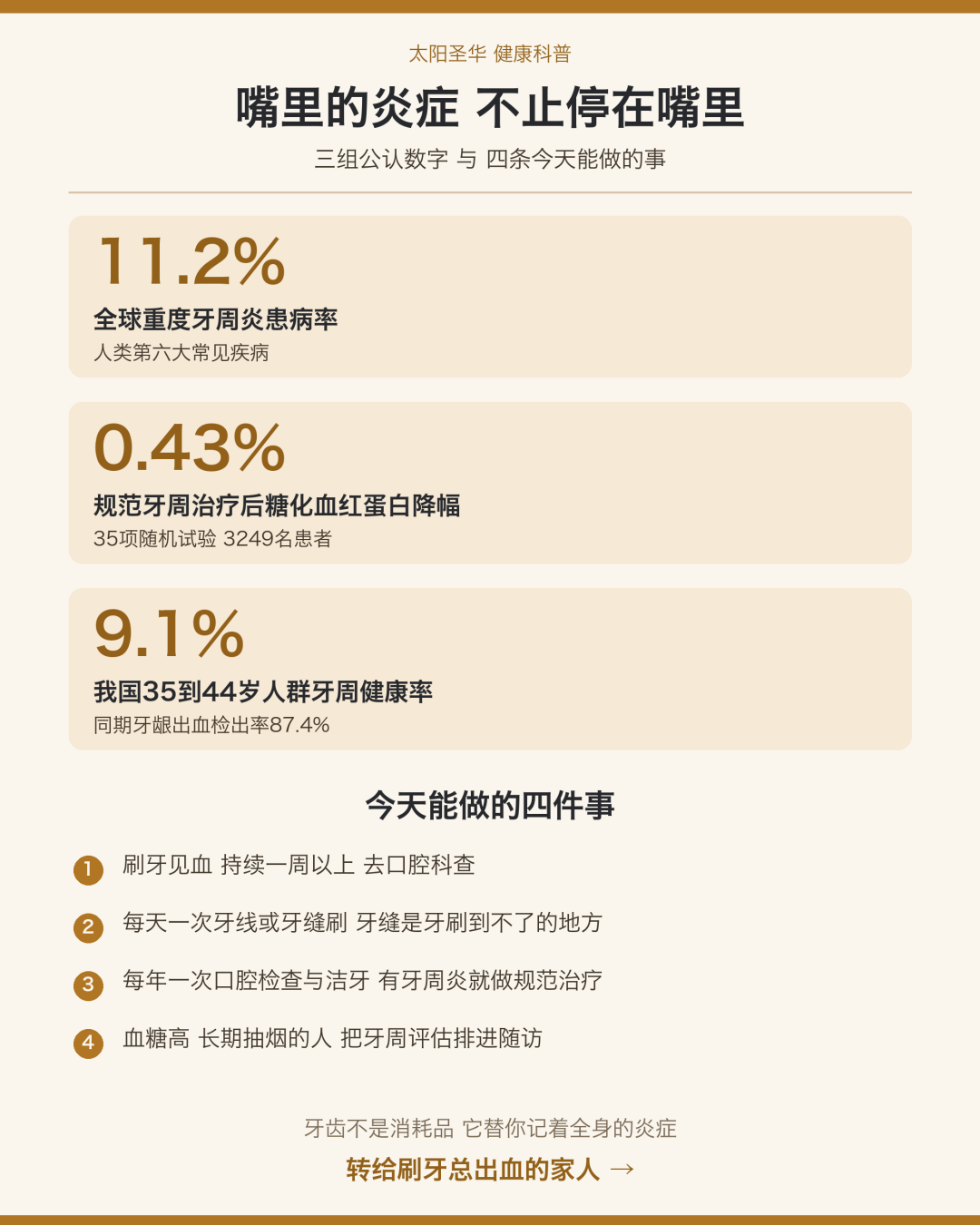
Figure caption: Three sets of epidemiological numbers plus four actionable steps—fewer than one in ten Chinese adults has healthy periodontium, and standard treatment can bring blood sugar markers down.
Four Things You Can Do Today
-
Watch for blood when brushing: Bleeding gums are not "internal heat"—they're an inflammation signal. If it lasts more than a week, go to the dental department and get it checked.
-
Floss or use interdental brushes once a day: The gaps between teeth are places the toothbrush can't reach, and often where periodontitis gets its start.
-
Get an oral exam and cleaning once a year: If the doctor says it's periodontitis, get standard periodontal therapy—don't just get a cleaning and call it done.
-
If your blood sugar is high or you smoke long-term: Put oral exams on your chronic disease follow-up schedule; these two things should be managed together in the first place.
How good your teeth are reflects the inflammation level of your whole body. Teeth are not consumables—they've been keeping the books for you all along.
If this article was helpful to you, give it a like or a "reading" click, and feel free to leave a comment telling us what topics you'd like to see. We also suggest forwarding it to that family member who always bleeds when brushing and still says it's nothing.
✦
Disclaimer: This article is for health education purposes only and is intended for informational reference; it does not constitute medical advice. The data cited come from publicly published medical literature and cannot replace a professional doctor's in-person consultation and individualized assessment.
Conflict of interest statement: This article does not involve any drug or product recommendations, and the author has no financial relationship with the research institutions mentioned in the text.
© 2026 Sunshenghua (Beijing) Medical Technology Co., Ltd.
References
[1] Fu Y, Li C, Hu C, et al. Meta Analysis of the Correlation between Periodontal Health and Cognitive Impairment in the Older Population. J Prev Alzheimers Dis. 2024;11(5):1307-1315. PMID: 39350376
[2] Tang L, Qiu C, Chi C, et al. Edentulism and cognitive transitions: A multi-state analysis. J Alzheimers Dis. 2026;114(1):276-285. PMID: 42803715
[3] Sanz M, Marco Del Castillo A, Jepsen S, et al. Periodontitis and cardiovascular diseases: Consensus report. J Clin Periodontol. 2020;47(3):268-288. PMID: 32011025
[4] Simpson TC, Clarkson JE, Worthington HV, et al. Treatment of periodontitis for glycaemic control in people with diabetes mellitus. Cochrane Database Syst Rev. 2022;4(4):CD004714. PMID: 35420698
[5] Alsaigh H, Alsharief M, Aljabr A, et al. Association Between Periodontal Disease and Cognitive Impairment: A Systematic Review and Meta-Analysis. Dent J (Basel). 2026;14(10). PMID: 42930444