This article is for health education purposes only and is intended for informational reference; it does not constitute medical advice. If you have any health concerns, please consult a professional doctor.
✦ ✦ ✦
When the first hairy crab of autumn is served, the chopsticks of people with gout stop in midair.
On one side is the old saying, "Seafood is high in purines—eat it and you'll have a flare." On the other is the craving: "This season comes only once a year." But for people with elevated blood uric acid, should they hold back on this one bite?
Lay out the research and you'll find something more interesting: seafood is indeed not innocent, but it may not be the thing you should avoid most.
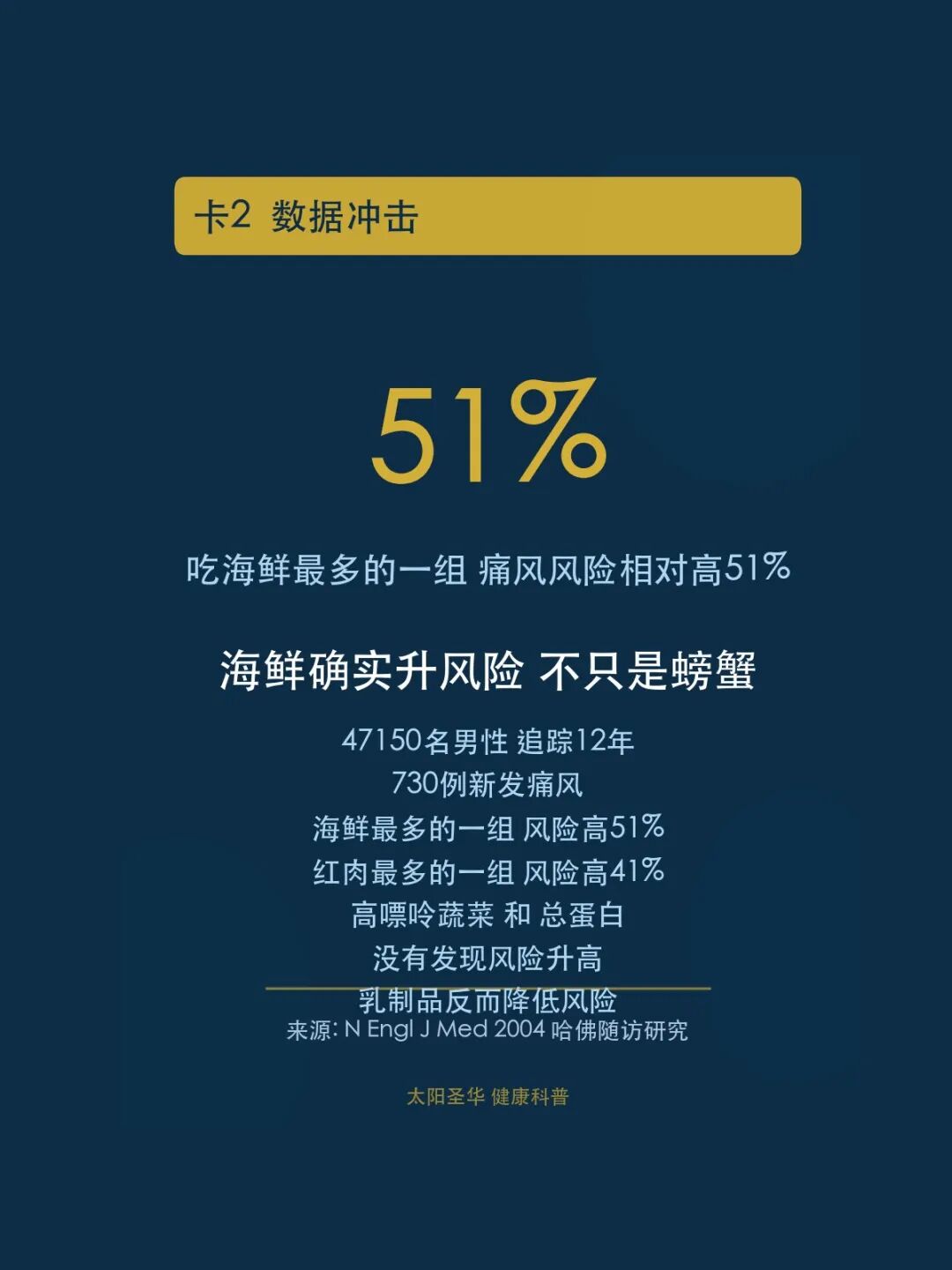
First, the data. A cohort study that followed 47,150 men for 12 years recorded 730 new cases of gout: dividing the population into five groups by seafood intake, the group that ate the most had a 51% higher risk of gout than the group that ate the least; the group that ate the most red meat had a 41% higher risk[1]. A contemporaneous Chinese meta-analysis showed that the prevalence of hyperuricemia among adults in mainland China is about 13.3% and that of gout about 1.1%[4]—roughly 1 in every 8 adults has elevated blood uric acid.
The 5 cards below explain once and for all "whether you can eat it, how much to eat, and what to pair it with."
1. First, the conclusion: yes, but with three preconditions
Don't eat it during an acute flare; if your blood uric acid hasn't yet dropped into the target range, also hold off for now; if your condition is usually stable, you can eat it—about one crab at a time, with roughly 100 to 150 grams of crab meat[8]. Crab roe and crab paste have higher purine levels than crab meat, so just taste a few bites to satisfy the craving—don't make them the main event.
And the most easily overlooked point is on the third card.
2. Seafood does raise risk, but it's not just crab
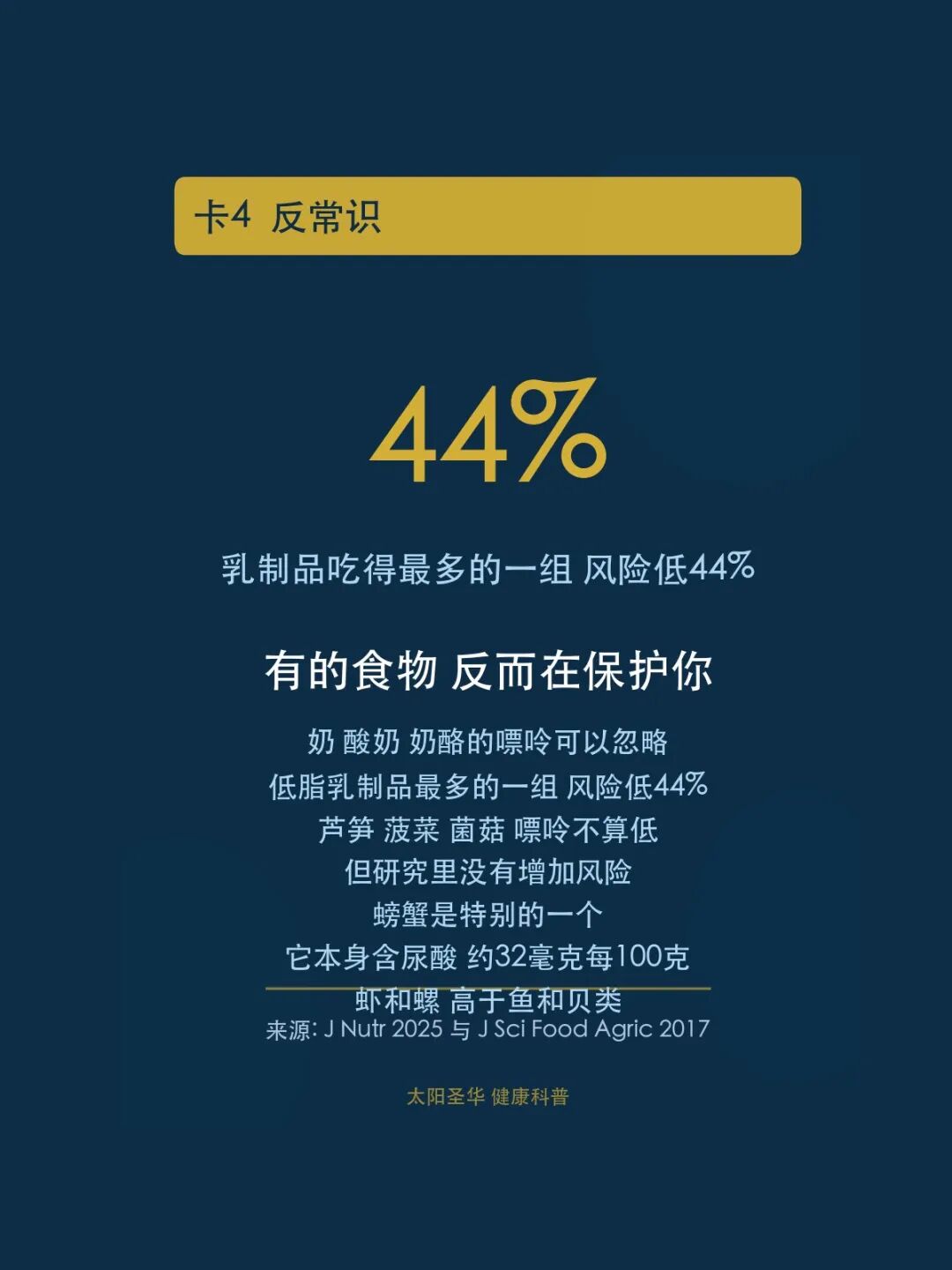
The same study also has two comparisons worth remembering: vegetables that are not low in purines (asparagus, spinach, mushrooms) and total protein intake did not raise gout risk; and the group that ate the most dairy products actually had a 44% lower risk (RR 0.56)[1].
In other words, the purine number is not the only grading standard—the type of food itself also plays a role.
3. What you should avoid more than crab is these two things
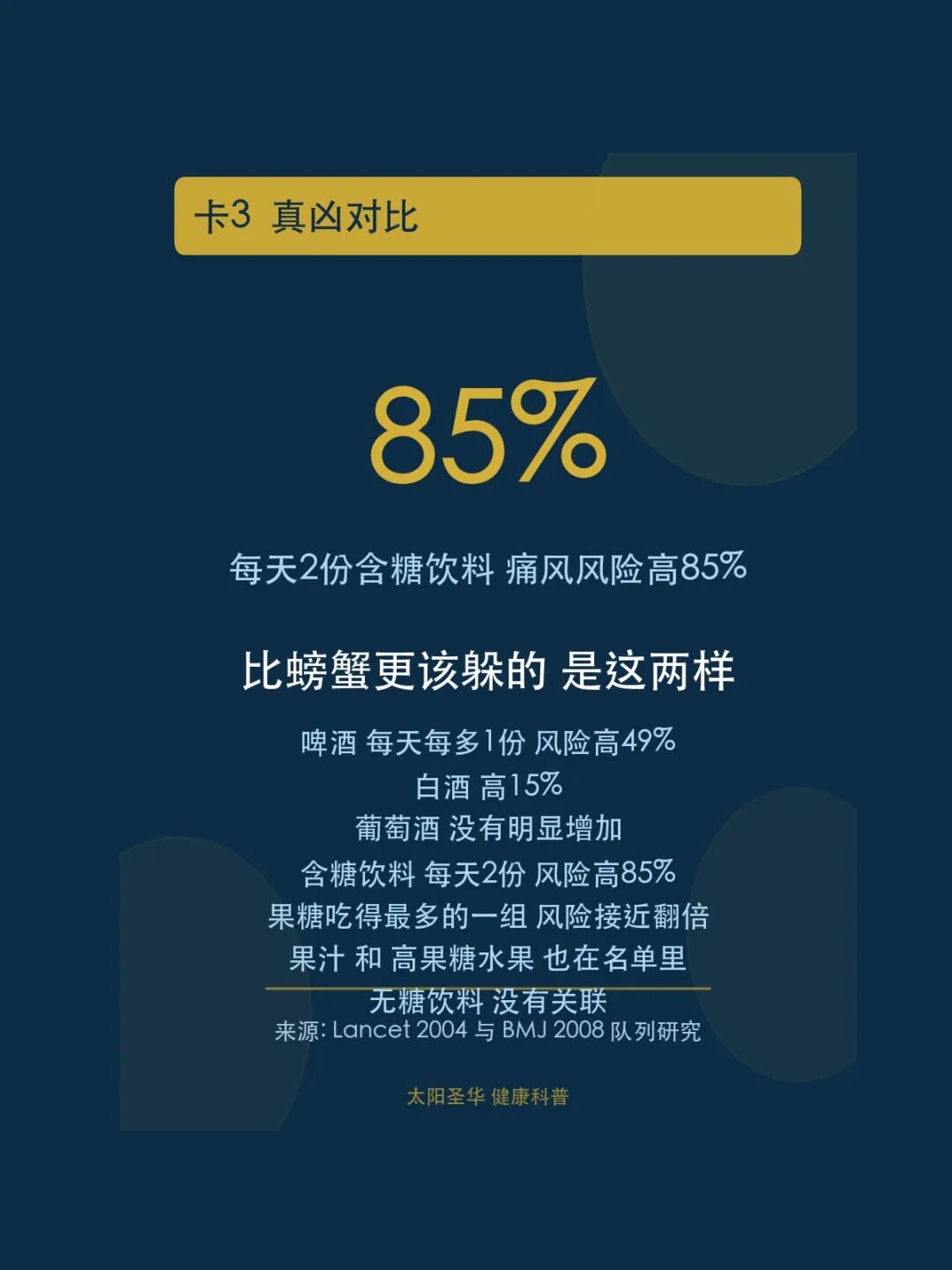
Alcohol, especially beer. Data from the same population show: consuming 15 to 29.9 grams of alcohol per day raises gout risk by 49%; 30 to 49.9 grams by 96%; and at 50 grams or more per day, the risk rises to 2.53 times. By type of alcohol, each additional serving of beer per day raises risk by 49%, liquor by 15%, while wine shows no significant increase[2].
Sugary drinks and fructose. Two or more servings of sugary drinks per day raise gout risk by 85%; the group with the highest fructose intake has nearly double the risk; fruit juice and high-fructose fruits such as apples and oranges are also on the list. Sugar-free drinks show no association[3].
The most common pairings for autumn crab are exactly these two—crab with yellow rice wine, and a sweet drink after the meal. The crab may not bring you down, but pairing it wrong will.
4. One special thing about crab
The purine database updated by the U.S. Department of Agriculture in 2025 covers 61 common foods: total purines in meat and seafood range from 96 to 448 milligrams per 100 grams, legumes and vegetables only 9 to 72, while milk, yogurt, cheese, and eggs have almost negligible purines[5].
The most special point is this: among the foods tested, only crab contains notable uric acid, about 32 milligrams per 100 grams[5]. In addition, shrimp and snails have higher purines than fish and shellfish, and within the same fish, the skin and liver are higher than the flesh[6]. The differences within the word "seafood" are bigger than you imagine.
5. If you want to eat crab, remember these 5 things
- Don't pair it with alcohol, especially not beer: switch to plain water or weak tea;
- One crab at a time: 100 to 150 grams of crab meat, and go easy on crab roe and crab paste;
- Eat less red meat that day: save the quota for this crab meal;
- Drink more water, and eat more dairy and vegetables: replace part of your meat and seafood with dairy, vegetables, and fruit—dairy products and fruits and vegetables are on the opposite side of risk in the evidence[1];
- Set a stop-loss line: if your blood uric acid hasn't reached target or you're in the middle of a flare, hold off for now; eat once your recheck shows it has come down.
Finally, here's some quantifiable good news: in randomized controlled trials, the DASH diet (more vegetables and fruits, low-fat dairy, less red meat and fewer sugary drinks) lowered participants' serum uric acid by an average of 0.35 mg/dL; among those with elevated baseline uric acid, the reduction reached 1.29 mg/dL [7]. When you get the dietary direction right, uric acid really does respond.
Forward this card to that older relative at home who "can't enjoy anything without alcohol and can't enjoy anything without crab"—enjoy the autumn foods, but don't let beer take the blame for the crab. We also suggest saving these 5 cards and flipping through them before get-togethers.
If you found this helpful, give it a like or a "Wow," and feel free to leave a comment telling us what topics you'd like to see.
✦ ✦ ✦
Disclaimer: This article is health education for informational reference only and does not constitute medical advice; if you have health concerns, please consult a professional doctor. Conflict of interest statement: This article involves no commercial promotion; all content and data come from publicly published research and guidelines.
References
[1] Choi HK, Atkinson K, Karlson EW, Willett W, Curhan G. Purine-rich foods, dairy and protein intake, and the risk of gout in men. N Engl J Med. 2004;350(11):1093-1103. PMID:15014182
[2] Choi HK, Atkinson K, Karlson EW, Willett W, Curhan G. Alcohol intake and risk of incident gout in men: a prospective study. Lancet. 2004;363(9417):1277-1281. PMID:15094272
[3] Choi HK, Curhan G. Soft drinks, fructose consumption, and the risk of gout in men: prospective cohort study. BMJ. 2008;336(7639):309-312. PMID:18244959
[4] Liu R, Han C, Wu D, et al. Prevalence of Hyperuricemia and Gout in Mainland China from 2000 to 2014: A Systematic Review and Meta-Analysis. Biomed Res Int. 2015;2015:762820. PMID:26640795
[5] Wu X, Heydorn KC, Kamat M, et al. Determination of Purine Contents in Commonly Consumed United States Foods: Updating the USDA and ODS-NIH Purine Database. J Nutr. 2025;155(12):4331-4344. PMID:41173372
[6] Qu X, Sui J, Mi N, Lin H. Determination of four different purines and their content change in seafood by high-performance liquid chromatography. J Sci Food Agric. 2017;97(2):520-525. PMID:27080363
[7] Juraschek SP, Gelber AC, Choi HK, Appel LJ, Miller ER 3rd. Effects of the Dietary Approaches to Stop Hypertension (DASH) Diet and Sodium Intake on Serum Uric Acid. Arthritis Rheumatol. 2016;68(12):3002-3009. PMID:27523583
[8] FitzGerald JD, Dalbeth N, Mikuls T, et al. 2020 American College of Rheumatology Guideline for the Management of Gout. Arthritis Care Res (Hoboken). 2020;72(6):744-760. PMID:32391934
© 2026 Sun Sheng Hua (Beijing) Medical Technology Co., Ltd.