This article is for health education purposes only and is intended for informational reference. It does not constitute medical advice; please consult a professional doctor for any health concerns.
Can White Hair Turn Black Again? 14 People's Hair Offers a Surprising Answer
You've probably pulled out that white hair in the mirror more than once.
Two of the most widely repeated sayings about it: pull one and ten will grow; once it's white, there's no going back.
The first is false. The second has been half-overturned by a study.
First, some numbers from a large group. A global survey covering 4,192 healthy volunteers found that among those aged 45 to 65, 74% already had white hair, with an average white hair proportion of 27%. The folk saying that "by 50, half of people have half-white hair" is actually an overestimate—only 6% to 23% of people actually reach 50 with more than half their hair white, depending on ethnicity and hair color[1].
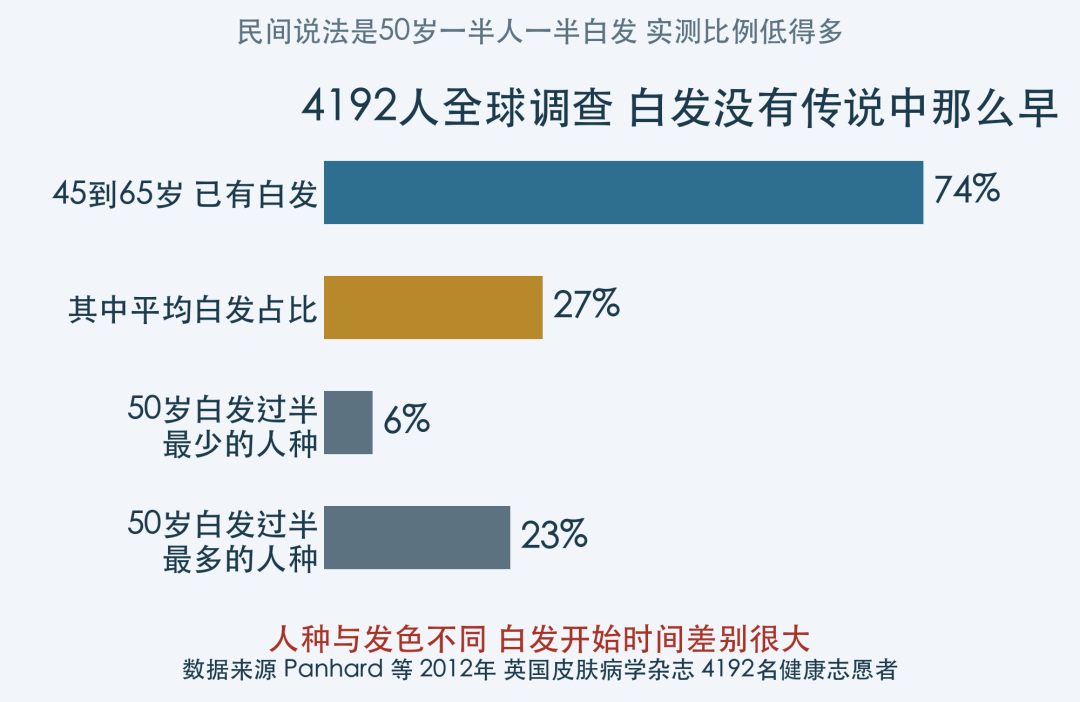
Figure 1: White hair distribution in a global survey of 4,192 people—74% of those aged 45 to 65 have white hair, but far fewer than legend suggests have majority-white hair by age 50
Question 1: Where does white hair actually come from?
Every hair grows from its own follicle, and at the base of each follicle is a small group of melanocyte stem cells responsible for "coloring" the newly growing hair.
With age, this group of cells gradually becomes depleted and loses the ability to migrate and divide, so the hair that grows out no longer carries pigment and appears white.
The key point: once a hair emerges from the scalp, its color is set. The already-white segment won't turn black no matter how you wash, apply products, or rub it—only the part that hasn't yet grown out can change.
Question 2: Does pulling one really make ten grow?
No.
One hair corresponds to one follicle, and follicles are independent of each other. Pulling out one hair won't cause neighboring follicles to turn white or to grow extra hairs.
But pulling has a cost: repeatedly pulling at the same spot can cause folliculitis and local scarring, and in severe cases that area may never grow hair again. When you see a white hair, clipping it close to the root with scissors is safer than pulling.
Question 3: Does stress really accelerate graying?
Animal experiments have revealed the mechanism. A 2020 study in Nature showed that in mice under acute stress, melanocyte stem cells rapidly become depleted, causing hair to turn white. Interestingly, this process is neither caused by immune attack nor by adrenal stress hormones, but by hyperactivation of the sympathetic nerves innervating the hair follicle, which triggers a massive instantaneous release of norepinephrine[3].
In plain terms: stress directly "shouts" at the hair follicle through the nerves—it's not a slow depletion but can happen very quickly.
Question 4: Can white hair turn black again?
This is the most counterintuitive question of all.
A 2021 study published in eLife mapped pigmentation along the length of individual hairs from 14 volunteers (7 women and 7 men, average age 35, ranging from 9 to 65 years old). The result: hair that had already turned white did indeed show natural repigmentation[2].
The speed was faster than expected: the fastest hair completed a full transition from white to black in about 3 to 7 days, with a median of about 3 months; repigmentation was on average about 30% faster than graying[2].
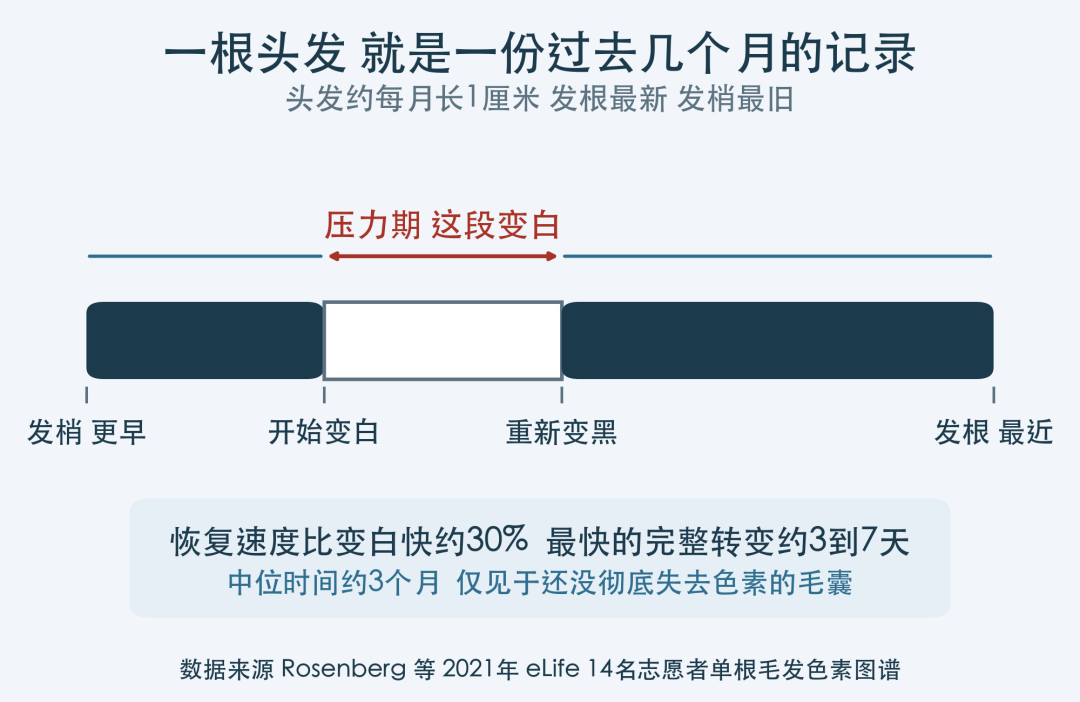
Figure 2: A timeline on a single hair—hair grows about 1 cm per month, with dark and white segments alternating, effectively recording the past several months' status on one strand
Even more striking is the human side: one 35-year-old man had 5 two-toned hairs whose color patterns closely synchronized with his own recorded stress levels (correlation coefficient 0.80), with the lowest-stress month corresponding precisely to the hair turning dark again[2].
But a reality check is essential: 14 people and a few dozen hairs do not equal "all white hair can be reversed." The researchers' own explanation is a "threshold" model—only follicles still at the critical point, not yet fully depleted, may recover color as stress subsides; the older you are and the longer the hair has been white, the harder it is to cross that threshold.
Question 5: Can eating certain things turn it black again?
Three studies are worth noting, but remember: they describe "correlation," not "causation."
A case-control study of 52 people who developed white hair before age 20 found their average blood vitamin B12 was 198 pg/ml, compared with 343 pg/ml in age-matched controls; folate and biotin were also lower[4].
A retrospective analysis of 71 people with premature graying found that B12 deficiency and hypothyroidism were significantly associated with premature graying, while anemia, ferritin, and fasting blood glucose showed no significant relationship[5].
A 2025 review summarized: genetics, oxidative stress, smoking, and diet are all associated with premature graying, but no medication has been proven to restore color to white hair[6].
The conclusion is practical: don't buy a pile of supplements on your own for white hair. Get tested first (B12, folate, thyroid function, complete blood count), and only supplement what you're deficient in—that's what targeted treatment means.
Question 6: When should you see a doctor?
If any of the following occur, don't just chalk it up to "getting older":
-
Patchy graying starting before age 20 (for Asians, roughly before 25)
-
White hair accompanied by fatigue, cold intolerance, weight changes, or palpitations—check thyroid, anemia, and B12
-
Sudden patchy graying within weeks—see a dermatologist to rule out conditions like alopecia areata
-
White patches on the skin in areas of white hair—seek medical attention promptly
Four things you can do today
-
Clip, don't pull: Snip each one at the root; don't damage the follicle.
-
Make "the lowest-stress month" your norm: Keep a regular schedule, do aerobic plus strength exercise weekly, and sleep about 7 hours.
-
Don't smoke: In existing epidemiological data, smoking is associated with premature graying[6].
-
Don't supplement blindly: First get a complete blood count, B12 and folate, and thyroid function tests—supplement only what you lack.
White hair isn't your body counting down—it's more like a record: the months when you were under the most stress really do get written into your hair.
If someone in your family also worries about white hair, share this with them.
If you found this helpful, give it a like or a "reading" click, and feel free to leave a comment telling us what topics you'd like to see.
✦
Disclaimer: This article is for health education purposes only and is intended for informational reference. It does not constitute medical advice; please consult a professional doctor for any health concerns.
Conflict of interest statement: This article does not involve any product, drug, or brand recommendations, and has no financial relationship with the research institutions mentioned.
© 2026 Sunshenghua (Beijing) Medical Technology Co., Ltd.
References
[1] Panhard S, Lozano I, Loussouarn G. Greying of the human hair: a worldwide survey, revisiting the '50' rule of thumb. Br J Dermatol. 2012;167(4):865-873. PMID: 22716034
[2] Rosenberg AM, Rausser S, Ren J, et al. Quantitative mapping of human hair greying and reversal in relation to life stress. eLife. 2021;10:e67437. PMID: 34155974
[3] Zhang B, Ma S, Rachmin I, et al. Hyperactivation of sympathetic nerves drives depletion of melanocyte stem cells. Nature. 2020;577(7792):676-681. PMID: 31969699
[4] Daulatabad D, Singal A, Grover C, Chhillar N. Prospective analytical controlled study evaluating serum biotin, vitamin B12, and folic acid in patients with premature canities. Int J Trichology. 2017;9(1):19-24. PMID: 28761260
[5] Sonthalia S, Priya A, Tobin DJ. Demographic characteristics and association of serum vitamin B12, ferritin and thyroid function with premature canities in Indian patients from an urban skin clinic of North India: a retrospective analysis of 71 cases. Indian J Dermatol. 2017;62(3):304-308. PMID: 28584374
[6] Desai DD, Karim M, Nohria A, et al. Premature hair graying: a multifaceted phenomenon. Int J Dermatol. 2025;64(5):819-829. PMID: 39697103