Swapping White Rice for Whole Grains: 32% Lower Diabetes Risk, but Only 0.2 kg Less Weight
This article is for health education purposes only and is intended for informational reference. It does not constitute medical advice; if you have health concerns, please consult a professional doctor.
The same bowl of rice—steamed white rice versus steamed brown rice—does not take the same path through the body.
Some people switch to whole grains for three months, their blood sugar looks better, but the scale barely moves. This is not a waste, nor is it that whole grains don't work—it's that we've been looking at the wrong indicator all along.
When you swap white rice for whole grains, what exactly do you gain, and what do you not?
First, Let's Lay Out the Numbers
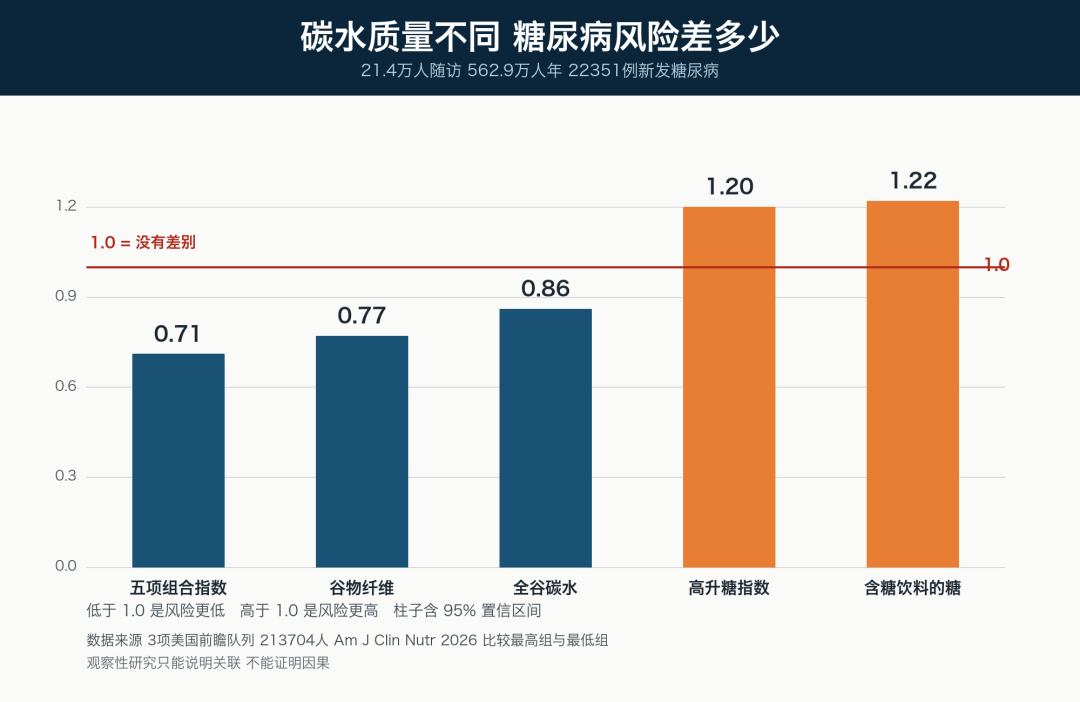
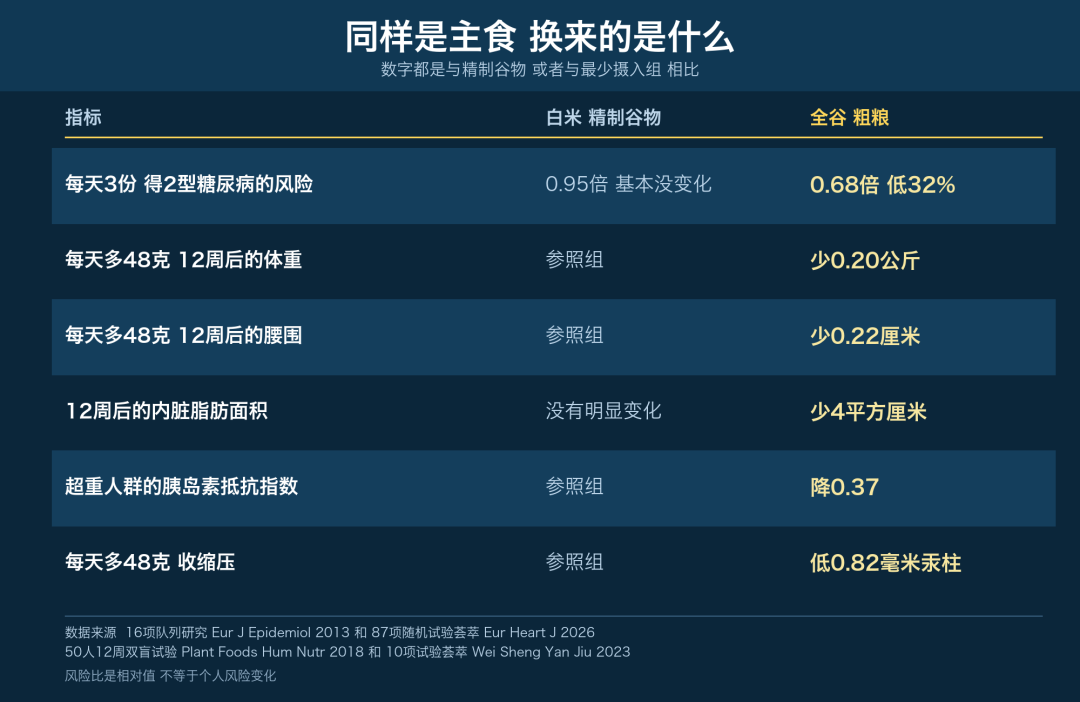
A pooled analysis of 16 prospective cohort studies draws a very clear dividing line: people who eat 3 servings of whole grains per day have a 32% lower risk of type 2 diabetes than those who eat the least (hazard ratio 0.68); while eating 3 servings of refined grains—that is, white rice and white flour—the risk barely changes (0.95). [1]
Another 2026 study followed 214,000 adults over 5.629 million person-years and tracked 22,351 incident cases of diabetes. The researchers broke down carbohydrate quality for comparison, and the direction was consistent: the group with the most whole-grain-source carbohydrates had a 14% lower risk; the group with the most cereal fiber had a 23% lower risk; while the group with high glycemic index had a 20% higher risk, and the group with the most sugar from sugar-sweetened beverages had a 22% higher risk. [2]
What's used here is "hazard ratio" and "association," not "if you eat it you definitely won't get sick." But for people who eat staple foods three times a day, this direction is already meaningful enough.
Why the Scale Doesn't Budge
This is where whole grains are often misunderstood. In 2026, the European Heart Journal pooled 87 randomized controlled trials across 101 reports, and the conclusion was quite restrained: eating an extra 48 grams of whole grains per day, over 12 weeks, resulted in an average of 0.20 kg less body weight and 0.22 cm less waist circumference. [3]
In the same analysis, total cholesterol dropped 0.10 mmol/L, LDL dropped 0.07 mmol/L, triglycerides dropped 0.04 mmol/L, fasting blood glucose dropped 0.03 mmol/L, and systolic blood pressure was 0.82 mmHg lower. The range with larger effect sizes fell at 60 to 100 grams per day, roughly 2 to 3 servings. [3]
So whole grains are not a shortcut to weight loss. They are more like a trend correction on a long-term lab report: what changes is those few lines of test values, not the number on the scale.
What's Really Changed Is Where Fat Is Stored
Fifty Japanese individuals with BMI ≥ 23 underwent a 12-week double-blind trial, swapping refined wheat bread for whole-wheat bread: the whole-wheat group lost 4 square centimeters of visceral fat area, while the refined group showed no significant change. [4]
A three-arm randomized trial published in 2026 by a team from the Chinese Center for Disease Control and Prevention also offered similar clues. Among 144 adults at high risk of diabetes, assigned to 100 grams per day, 50 grams per day, or no replacement, after 12 weeks the 100-gram group showed a significant drop in the triglyceride-glucose index, and triglycerides dropped along with it. [5]
Waist circumference and visceral fat are closer to metabolic risk than body weight. This explains why some people don't lose weight but their lab reports look better.
But Whole Grains Are Not the Same as Glucose-Lowering Drugs
Pooled results from 10 randomized controlled trials in overweight and obese populations: whole grains lowered fasting blood glucose by an average of 0.08 mmol/L and the insulin resistance index by 0.37; however, postprandial blood glucose, fasting insulin, and triglycerides showed no statistically significant differences. [6]
In other words, whole grains help a little, but they are not "eat them and you can eat freely." In reality, there are still three pitfalls that can cancel out the benefits.
First, preparation. The same whole grain—the softer it's cooked, the more it's blended into a paste or ground into powder—the faster it raises blood sugar.
Second, pairing. Whole-grain biscuits, whole-grain bread, and whole-grain cereal often have quite a bit of sugar and oil added, making them higher in calories than white rice.
Third, total amount. Whole grains are still staple foods—a bowl of brown rice still has the calories of a bowl of rice; switching to whole grains doesn't mean you can eat more.
Want to Switch? Start with This One Meal
Recommendation 1: Swap one meal a day. Replace the white rice in one meal with about 50 grams of whole grains (dry weight), do this for four weeks first, then check your blood sugar and how your stomach feels.
Recommendation 2: Set a goal of 60 to 100 grams per day. That's about one fist-sized portion of brown rice or oat groats, plus half a corn cob; you don't need to replace everything—replacing half is already meaningful.
Recommendation 3: Choose whole kernels, not powders. Oat groats, brown rice, corn, buckwheat, red beans, and chickpeas all count; whole-grain pastes, whole-grain crisps, and whole-grain biscuits do not.
Recommendation 4: Increase gradually and drink more water. Jumping suddenly from zero to one hundred grams a day can easily cause bloating; the gut needs two to three weeks to adapt.
Recommendation 5: For people with diabetes, stomach conditions, or kidney disease, ask a doctor or dietitian about portions first—don't change them yourself based on ratios found online.
One Last Word
The value of whole grains isn't in those one or two pounds on the scale, but in where blood sugar, blood lipids, and waist circumference are heading over the long term. Treat it as a swap you can stick with for ten years, not a three-week sprint.
If this article helped clarify your thinking, give it a like or a "reading" mark, and feel free to leave a comment telling us what topics you'd like to see. If someone in your family eats refined staple foods, forward this to them for a look.
✦
Disclaimer: This article is for health education purposes only and is intended for informational reference. It does not constitute medical advice; if you have health concerns, please consult a professional doctor.
Conflict of Interest Statement: This article does not involve any product recommendations and has no conflict of interest with the research institutions mentioned in the text.
© 2026 Sunshenghua (Beijing) Medical Technology Co., Ltd.
References
[1] Aune D, Norat T, Romundstad P, Vatten LJ. Whole grain and refined grain consumption and the risk of type 2 diabetes: a systematic review and dose-response meta-analysis of cohort studies. Eur J Epidemiol. 2013;28(11):845-858. PMID: 24158434
[2] AlEssa HB, Xia T, Mousavi SM, Sawicki C, Willett WC, Bhupathiraju SN, Hu FB. Optimal measures of carbohydrate quality to lower the risk of type 2 diabetes: findings from 3 prospective cohort studies. Am J Clin Nutr. 2026;124(1):101337. PMID: 42069223
[3] Naghshi S, Kiani S, Ostadrahimi A, Jayedi A, Mobasseri M, Arefhosseini S, Tutunchi H, Aune D. Whole-grain consumption and cardiometabolic risk: a meta-analysis of randomized trials. Eur Heart J. 2026 September 15:ehag519. PMID: 42743912
[4] Kikuchi Y, Nozaki S, Makita M, Yokozuka S, Fukudome SI, Yanagisawa T, Aoe S. Effects of Whole Grain Wheat Bread on Visceral Fat Obesity in Japanese Subjects: A Randomized Double-Blind Study. Plant Foods Hum Nutr. 2018;73(3):161-165. PMID: 29671172
[5] Dong W, Wang Y, Liu Z, Ou L, Zhuo Q, Gong Z, Liu T. Whole-Grain Staple Replacement and Cardiometabolic Phenotypes in Adults at High Risk of Type 2 Diabetes: An Extended Randomized-Trial Analysis with NHANES and Country-Level Context. Nutrients. 2026;18(17):2758. PMID: 42738932
[6] Shu X, Jiang H, Li B, Hu A. Effects of whole grains on insulin resistance in overweight and obese adults: a Meta-analysis. Wei Sheng Yan Jiu. 2023;52(2):292-299. PMID: 37062696