8 Foods That Look Healthy but Have More Calories Than a Bowl of Rice
This article is for health education purposes only and is intended as general information; it does not constitute medical advice. If you have health concerns, please consult a professional doctor.
At noon I had a chicken breast salad and a glass of fresh juice. By three in the afternoon I was hungry, and I just pushed through it.
Many people fail at losing weight not because they eat too much, but because they eat the wrong things—the energy packed into every bite is far higher than they imagine.
A dietary survey of 7,356 US adults produced a counterintuitive result: people eating a "low energy density" diet ate 300 to 400 grams more food by weight each day than the other group, yet took in 275 to 425 fewer kilocalories[1]. Same fullness, a whole meal's worth of difference.
The 8 items below all carry a healthy label, but their energy density is anything but low.
1. Salad dressing and Thousand Island dressing
One tablespoon is about 15 grams; common salad dressings are 30% to 50% fat, so one spoonful is 60 to 90 kilocalories—two spoonfuls is roughly half a bowl of rice.
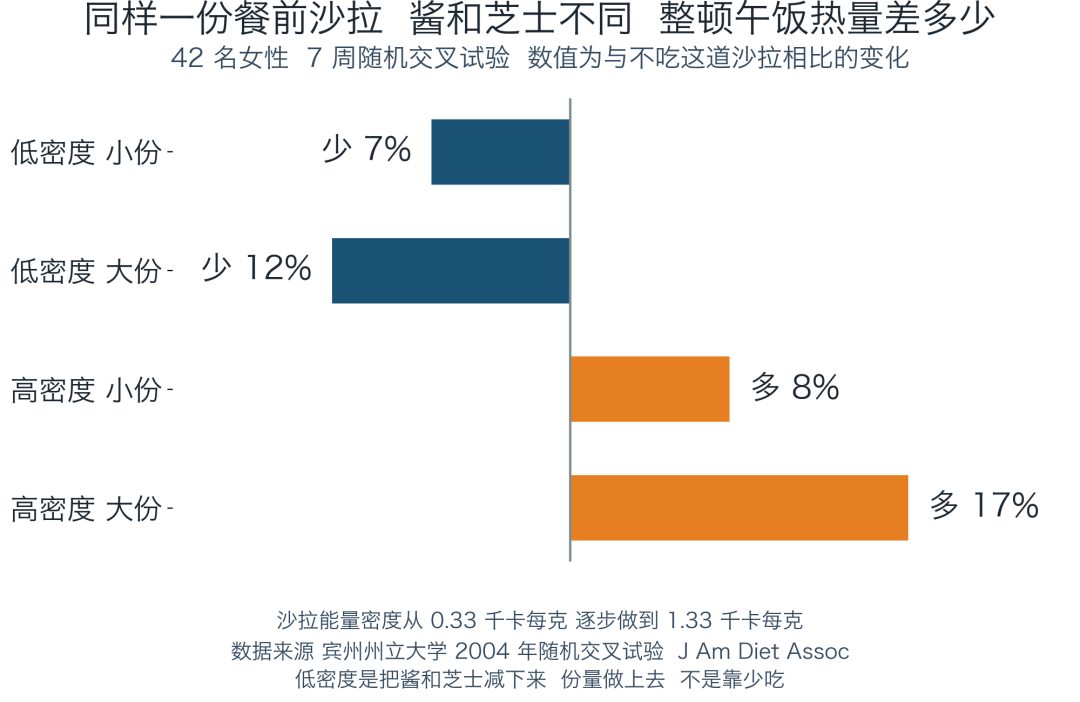
An experiment at Pennsylvania State University was very direct: with the same pre-meal salad, swapping in high-energy-density dressing and cheese added 8% (small portion) to 17% (large portion) to the total calories of the whole lunch; swapping in low-energy-density versions instead cut 7% to 12%[2].
How you use the dressing matters more than the salad itself. Keep it on the side and dip.
2. Freshly squeezed juice
A 250-milliliter glass of orange juice usually takes three oranges. What actually gets removed is the fiber in the fruit pulp and the process of chewing.
In a crossover trial of 58 adults, eating the same 125-kilocalorie apple before a meal: on the whole-apple occasion, total lunch calories were 15% (about 187 kilocalories) lower than the control group; on the apple-juice occasion there was no such effect, and adding extra fiber to the juice did not make up for it[3].
A blood-lipid study of 23 people was even more striking: in the 500-milliliter clear apple juice group, LDL cholesterol was 6.9% higher than in the whole-fruit group—pectin and cell-wall components are filtered out during juicing[4].
A meta-analysis of 17 cohorts also does not support the claim that "juice is a healthy substitute for sugary drinks": the association between juice and type 2 diabetes was not robust, but the study's conclusion explicitly states that juice is likewise not a healthy substitute for sugary drinks[5].
Whole fruit and juice are not the same thing. If you want fruit, eat fruit.
3. Whole-grain biscuits and cereal bars
"Whole grain" describes the ingredient, not the calories. The real stars of these snacks are often oil and sugar.
A meta-analysis of 30 randomized trials plus 38 cohort studies put it clearly: in adults eating freely, reducing free sugar intake lowered body weight by an average of 0.80 kilograms; increasing sugar intake raised body weight by an average of 0.75 kilograms; and when sugar replaced other carbohydrates with total calories held constant, the weight difference was only 0.04 kilograms[6].
So the key was never "whether there is sugar," but the extra energy that sugar brings. Check the ingredient list before buying—if sugar and vegetable oil are in the top three, be careful.
4. Flavored yogurt and "0-fat" yogurt
Fat-free does not mean low-sugar. A 100-to-150-gram cup of flavored yogurt often has more than 10 grams of sugar—the fat that was removed is often replaced by sugar to restore the texture.
Roughly estimating from the nutrition labels of common products, the calories in these small cups are not far from a small bowl of rice, yet they are often treated as "a snack that doesn't count."
Choose plain unsweetened yogurt and add fruit or a few nuts yourself—you control both the sweetness and the calories.
5. Fruit and vegetable crisps
They are not "the same as eating a serving of vegetables." Most fruit and vegetable crisps on the market are made by vacuum low-temperature frying, with fat content often at 20% to 40%—a 50-gram bag has 250 to 350 kilocalories.
Before buying, look at the fat line in the nutrition facts panel, not just the "low-temperature" and "non-puffed" claims on the package.
6. Small daily nut packs
Nuts themselves are good. The problem is "stacking," not the nuts.
In the Nurses' Health Study II, 51,188 women were followed for 8 years: those who ate nuts more than twice a week gained an average of 5.04 kilograms, versus 5.55 kilograms for those who almost never ate them; their obesity risk was also slightly lower (risk ratio 0.77)[7].
In other words, nuts are fine to eat, but they should replace something else, not be added on top of your usual intake. A handful of 25 grams of mixed nuts is about 150 kilocalories, close to half a bowl of rice.

7. Instant oatmeal and crunchy cereal
Oats themselves are fine; once sugar and oil are added to make crunchy flakes, that's not necessarily true. The shorter the ingredient list, the simpler—the kind with just the word "oats" is not much different from what you cook yourself.
8. "Light meal" delivery salad bowls
The carbs are cut, but they give you two packets of dressing. A chicken breast salad with two packets of dressing often exceeds a bowl of rice with toppings in calories, while the protein may not even be enough.
When ordering, note "dressing on the side," and add a separate egg or a portion of soy products—satiety feels completely different.
One rule you can use forever
Don't ask "Is this healthy?" Ask "How many kilocalories are in this bite?"
Low-energy-density foods: high in water, high in fiber, large in volume—such as whole fruit, vegetables, soup, tofu. High-energy-density foods: high in oil, high in sugar, dried—such as dressings, crisps, biscuits, nuts, juice.
Make the former the star and the latter the seasoning. Adjust this order and, without going hungry, the calories come down on their own.
Three things you can do today
① Keep salad dressing on the side and dip, don't pour. ② Swap juice for whole fruit, one serving a day. ③ When buying snacks, first check the top three ingredients—if sugar and oil are near the top, pick something else.
What makes you gain weight is often not that bowl of rice, but the two spoonfuls of dressing beside it.
Share this with a friend who is dieting on salad, and save them half a year of detours.
If this was helpful, give it a like or a "reading," and feel free to leave a comment telling us what topics you'd like to see.
✦
Disclaimer: This article is for health education purposes only and is intended as general information; it does not constitute medical advice. If you have health concerns, please consult a professional doctor.
Declaration of interests: This article does not involve any drug or product recommendations and has no financial relationship with the research institutions mentioned in the text.
© 2026 Sun Shenghua (Beijing) Medical Technology Co., Ltd.
References
-
Ledikwe JH, Blanck HM, Kettel Khan L, Serdula MK, Seymour JD, Tohill BC, Rolls BJ. Dietary energy density is associated with energy intake and weight status in US adults. Am J Clin Nutr. 2006;83(6):1362-1368. PMID: 16762948
-
Rolls BJ, Roe LS, Meengs JS. Salad and satiety: energy density and portion size of a first-course salad affect energy intake at lunch. J Am Diet Assoc. 2004;104(10):1570-1576. PMID: 15389416
-
Flood-Obbagy JE, Rolls BJ. The effect of fruit in different forms on energy intake and satiety at a meal. Appetite. 2009;52(2):416-422. PMID: 19110020
-
Ravn-Haren G, Dragsted LO, Buch-Andersen T, Jensen EN, Jensen RI, Németh-Balogh M, et al. Intake of whole apples or clear apple juice has contrasting effects on plasma lipids in healthy volunteers. Eur J Nutr. 2013;52(8):1875-1889. PMID: 23271615
-
Imamura F, O'Connor L, Ye Z, Mursu J, Hayashino Y, Bhupathiraju SN, Forouhi NG. Consumption of sugar sweetened beverages, artificially sweetened beverages, and fruit juice and incidence of type 2 diabetes: systematic review, meta-analysis, and estimation of population attributable fraction. BMJ. 2015;351:h3576. PMID: 26199070
-
Te Morenga L, Mallard S, Mann J. Dietary sugars and body weight: systematic review and meta-analyses of randomised controlled trials and cohort studies. BMJ. 2013;346:e7492. PMID: 23321486
-
Bes-Rastrollo M, Wedick NM, Martinez-Gonzalez MA, Li TY, Sampson L, Hu FB. Prospective study of nut consumption, long-term weight change, and obesity risk in women. Am J Clin Nutr. 2009;89(6):1913-1919. PMID: 19403639