This article is for health education and informational purposes only and does not constitute medical advice; please consult a professional doctor for any health concerns.
✦ ✦ ✦
Autumn is here—is your weight quietly creeping up too?
Don't rush to blame your cravings. After 195 adults were weighed continuously for a full year, researchers found: average net weight gain in fall and winter was nearly 1 kg, and by the following spring and summer, that weight had not come off on its own[[1]]. Today's card set explains clearly "why it's easy to gain weight in fall and winter," then gives you 5 cards to protect your results. Share them with the person in your family who "gains weight every autumn."
✦ ✦ ✦
1 / 6 Start with the conclusion: average fall-winter weight gain is nearly 1 kg, and it doesn't come back off in spring or summer
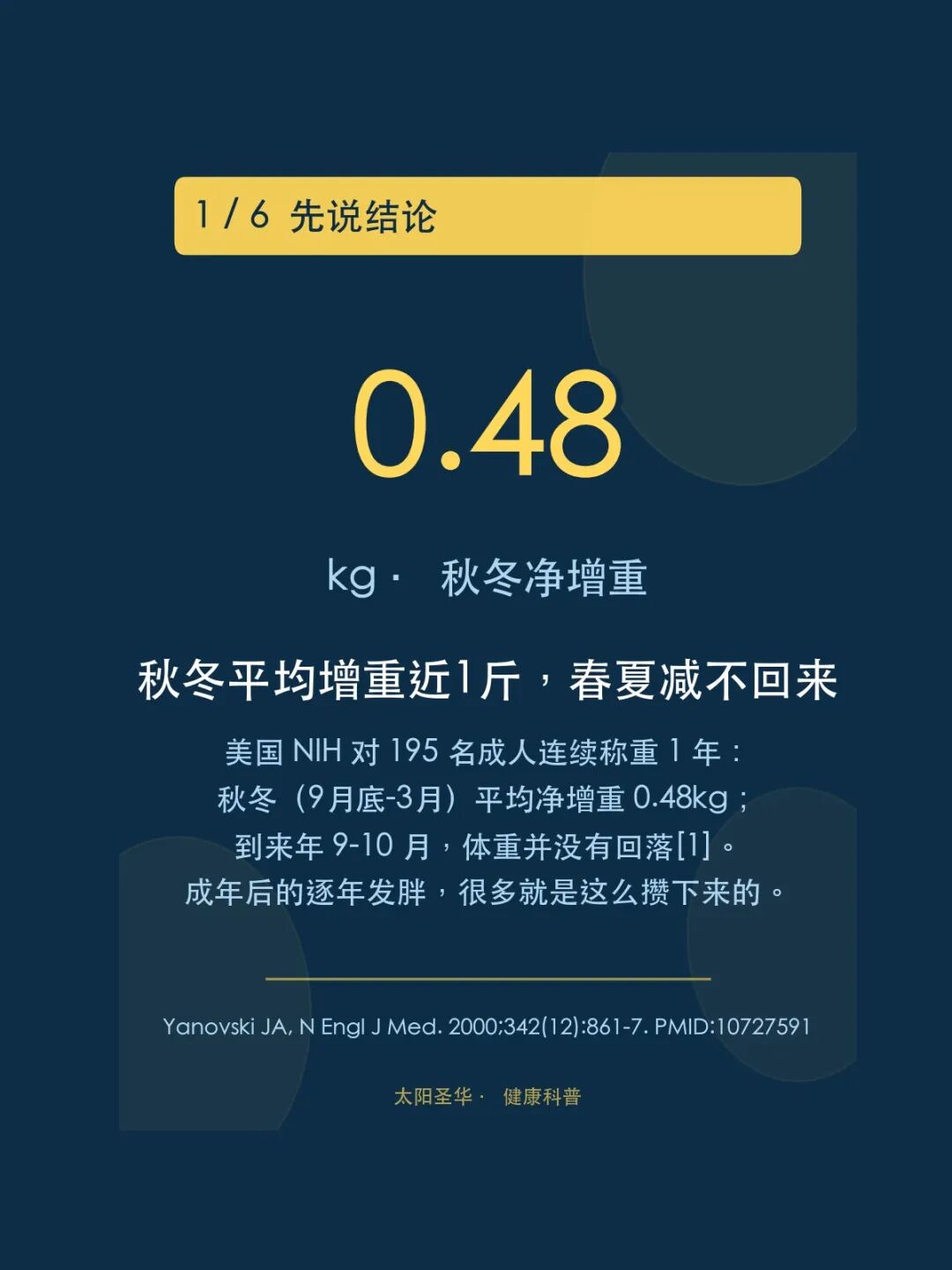
The U.S. NIH weighed 195 adults continuously for 1 year: average net weight gain in fall and winter (late September to March) was 0.48 kg; when they were weighed again the following September-October, the weight had not fallen back[[1]]. A lot of the year-by-year weight gain in adulthood is "accumulated" just like this—not from overeating on one day, but from quietly keeping a little extra every fall and winter.
✦ ✦ ✦
2 / 6 The body is stockpiling: in autumn, you unknowingly eat 86 kcal more

Data from a full-year follow-up of 593 people showed: daily calorie intake in autumn was 86 kcal higher than in spring, and the proportion of fat and saturated fat also peaked for the year in autumn[[2]]. An extra 86 kcal per day may not sound like much, but in a month that's 2,580 kcal—roughly the calories in 6 bowls of rice, all of which turn into numbers on the scale.
✦ ✦ ✦
3 / 6 The data: weight peaks in winter, and waist circumference is largest in winter

In the same study, body weight fluctuated by about 0.5 kg over the year and peaked in winter[[2]]; a 4-year continuous monitoring study of 18,000 people in the Netherlands also found that both BMI and waist circumference were higher in winter than in summer, and the seasonal difference in abdominal obesity was more obvious than in overall obesity[[3]]. In winter, people move the least and store the most, and the waist and abdomen are hit first.
✦ ✦ ✦
4 / 6 Misconception: "putting on autumn fat" ≠ adding fat—prioritize protein

The traditional idea of "putting on autumn fat" mostly adds high-oil, high-sugar foods, but what you really need in fall and winter is protein—fish, poultry, eggs, milk, and beans, with 1 serving at each meal[[7]]. Especially for people over 60, a daily intake of 1.2-1.5 g of protein per kilogram of body weight is recommended to protect muscle and prevent muscle loss in fall and winter[[5]]. If you supplement correctly, autumn fat becomes "building strength" rather than "building fat."
✦ ✦ ✦
5 / 6 Break the cycle: weighing yourself once a week works better than not weighing at all

A systematic review pooling 17 studies found: regular self-weighing is associated with greater weight loss and does not bring negative psychological effects such as anxiety or depression[[4]]. It is recommended to weigh yourself on the same day each week, in the morning on an empty stomach, using the same scale, and simply record the number and watch the trend—tracking the trend keeps you from being frightened by "eating too much one day" and keeps "fall-winter weight gain" from happening quietly.
✦ ✦ ✦
6 / 6 You can do it today: three small things to protect your results

① Eat vegetables and meat first, then rice, and make sure to have 1 serving of protein at each meal; ② weigh yourself once a week and watch the trend; ③ get 150 minutes of brisk walking or jogging each week, plus 2 strength-training sessions[[6]]. Fall and winter are not destined to make you gain weight—it's "input without output" that causes weight gain. Carry your summer exercise habits into autumn; it's worth more than any "big autumn tonic."
✦ ✦ ✦
Action advice: Start tonight—first set yourself a small rule to "weigh in every Monday morning," then put this week's brisk walks into your calendar. No dieting, no spending money; stick with it for 4 weeks and watch the trend, and you'll already have beaten most people.
If this was helpful to you, give it a like or a "reading" reaction, and feel free to leave a comment telling us what topics you'd like to see. We suggest sharing it with the person in your family who "gains weight every autumn," so you can protect yourselves together through fall and winter.
✦ ✦ ✦
Disclaimer: The content of this article is compiled based on publicly available academic literature and is for health education reference only. It does not constitute medical advice; please consult a professional doctor for individual circumstances.
Conflict of interest statement: The author has no conflicts of interest with the studies mentioned in this article.
© 2026 Sun Saint Hua (Beijing) Medical Technology Co., Ltd.
References
-
Yanovski JA, et al. A prospective study of holiday weight gain. N Engl J Med. 2000;342(12):861-867. PMID:10727591
-
Ma Y, et al. Seasonal variation in food intake, physical activity, and body weight in a predominantly overweight population. Eur J Clin Nutr. 2006;60(4):519-528. PMID:16340952
-
Visscher TL, Seidell JC. Time trends (1993-1997) and seasonal variation in body mass index and waist circumference in the Netherlands. Int J Obes Relat Metab Disord. 2004;28(10):1309-1316. PMID:15314624
-
Zheng Y, et al. Self-weighing in weight management: a systematic literature review. Obesity (Silver Spring). 2015;23(2):256-265. PMID:25521523
-
Bauer J, et al. Evidence-based recommendations for optimal dietary protein intake in older people: a position paper from the PROT-AGE Study Group. J Am Med Dir Assoc. 2013;14(8):542-559. PMID:23867520
-
World Health Organization. WHO guidelines on physical activity and sedentary behaviour. Geneva: WHO; 2020.
-
Chinese Nutrition Society. Dietary Guidelines for Chinese Residents (2022). Beijing: People's Medical Publishing House; 2022.