Does Fasted Exercise Burn More Fat? 27 Studies Provide the Answer
This article is for health education purposes only and does not constitute medical advice; please consult a professional doctor if you have health concerns
In parks in the early morning, there are always two groups of people: one group runs on an empty stomach, firmly believing in "fasted fat burning"; the other group eats breakfast before exercising, afraid of hypoglycemia and fainting on the way. Does fasted exercise really burn more fat? This question has been debated for over a decade, and now a meta-analysis of 27 studies plus randomized trials can provide a fairly reliable answer.
First, three key data points:
-
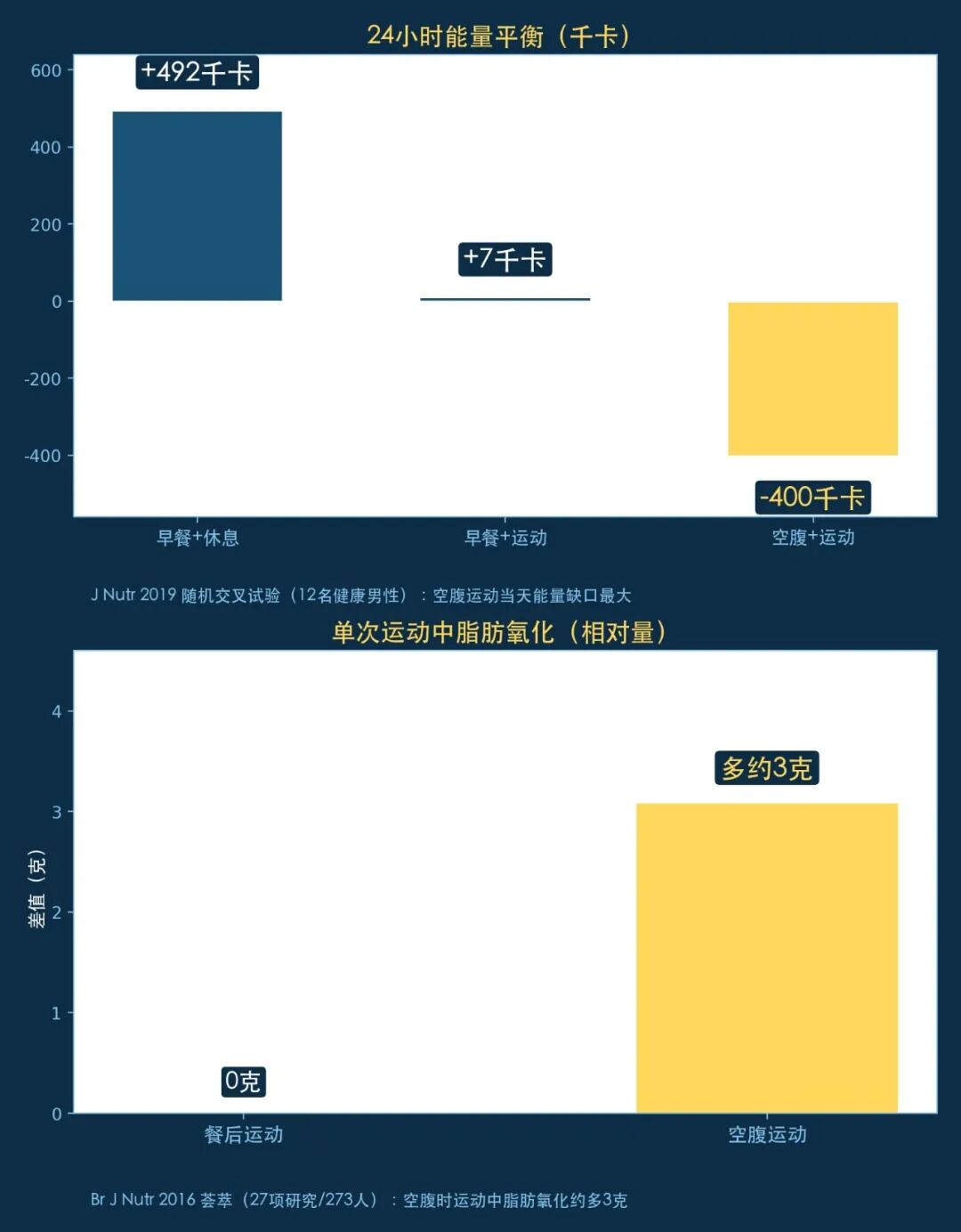
Meta-analysis of 27 studies, 273 participants: during exercise, the fasted state does burn slightly more fat than the fed state, with a single-session difference of about 3 grams[[1]];
-
Randomized crossover trial (12 healthy men): on the day they skipped breakfast and exercised directly, the 24-hour energy balance was -400 kcal; when they ate breakfast first and then exercised, it was +7 kcal[[2]];
-
But a 4-week randomized controlled trial (20 young women, calorie-restricted diet + 3 times per week of 1-hour aerobic exercise): both the fasted group and the fed group significantly lost weight and fat, but there was no significant difference between the two groups[[3]].
1. During Exercise: Fasting Does Burn Slightly More Fat, But the Amount Is Negligibly Small
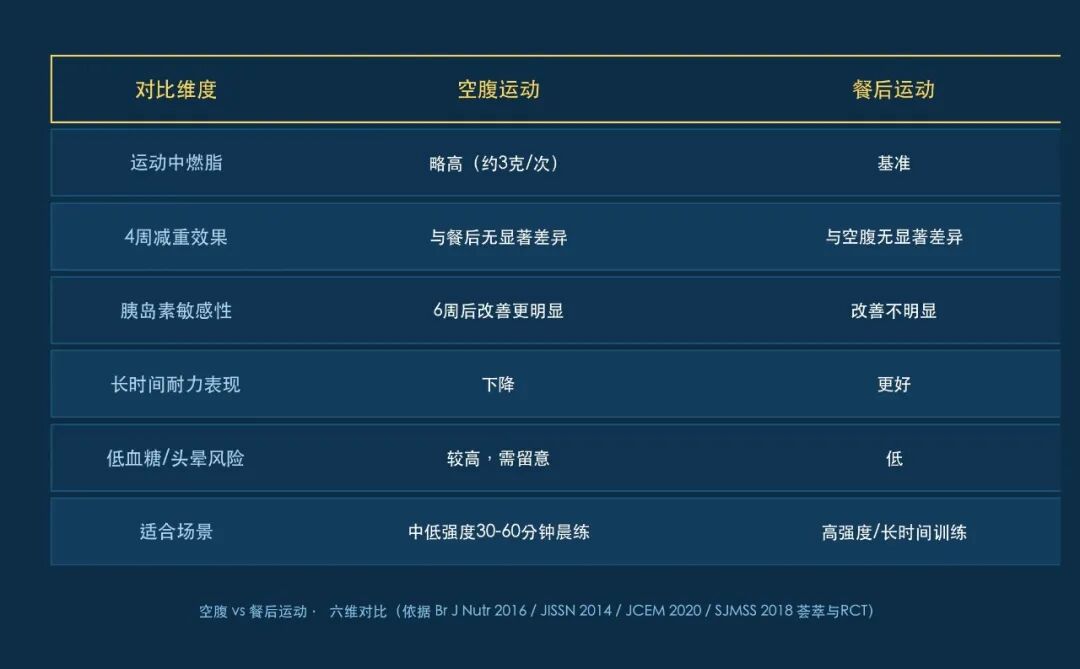
The meta-analysis showed that when doing the same aerobic exercise, fat oxidation during exercise is higher in the fasted state[[1]]. Sounds great, but put the number back into real life: about 3 extra grams of fat burned per session, roughly 27 kcal—the calories of half an apple. That tiny difference can be replaced with a glass of milk or a bite of bread after training.
In plain terms: "Fasting burns more fat" is true, but it's "burning half an apple more," not "burning off a whole meal more."
2. 4-Week Trial: No Difference in Weight Loss
A cleanly designed randomized controlled trial in 2014: 20 young women, all on a calorie-restricted diet, doing 1 hour of steady-state aerobic exercise 3 times per week, with the only difference being that one group exercised fasted and the other exercised fed. After 4 weeks, both groups had significant reductions in body weight and body fat, but there was no significant difference between the groups[[3]].
In plain terms: For short-term weight loss, what determines the result is the total calorie deficit and whether you can stick with it, not the "fasted or not" switch.
3. What Really Creates a Difference May Be "Metabolism"
If what you care about is not just the number on the scale, but whether blood sugar is stable and whether insulin sensitivity is good—which are key indicators for long-term weight loss and anti-aging—then the picture is different.
A 6-week training study published in 2020 in the Journal of Clinical Endocrinology & Metabolism (overweight/obese men): in the group that exercised before eating (fasted), post-meal insulin levels decreased significantly, and the insulin sensitivity index improved markedly (+25 vs -21, P=0.01); while in the group that exercised after eating, the improvement was not significant[[4]].
In plain terms: The greatest value of fasted exercise may not be "how much more you burn that day," but "long-term making the body better at using sugar and less prone to storing fat."
4. The Costs Must Also Be Made Clear: Performance and Risks
-
Meta-analysis (46 studies): eating before exercising leads to better performance in long-duration endurance exercise (over 60 minutes)[[5]];
-
In the fasted state, blood free fatty acids rise[[5]], which sounds like "burning fat," but it offers limited help for high-intensity training;
-
Risk warning: doing high-intensity exercise on an empty stomach increases the risk of hypoglycemia and dizziness; diabetic patients using glucose-lowering drugs or insulin should absolutely not train hard on an empty stomach and should consult a doctor first.
In plain terms: Fasting is suitable for "moderate-to-low intensity, 30-60 minute" morning exercise; for high-intensity, long-duration training, it's still better to eat first.
5. Action Recommendations: Just Choose According to This
Your Goal Recommendation
Just want to lose weight Choose the time you can stick with, don't agonize over fasting; the calorie deficit is the main character
Want to improve blood sugar/metabolism Do fasted morning exercise 2-3 times per week, 30-45 minutes of moderate-to-low intensity (brisk walking/jogging/cycling), and eat a protein-containing breakfast within 30 minutes after exercise
High-intensity/long-duration training Eat 1 hour in advance, mainly carbohydrates, don't tough it out on an empty stomach
Diabetes/history of hypoglycemia Consult a doctor, do not train hard on an empty stomach
One-sentence summary: The extra fat burned by fasted exercise is so small it can be ignored; its real value lies in metabolism—but the premise is that the intensity should not be too high, the duration should not be too long, and you should eat promptly after exercise.
There is no standard answer for fasted versus fed, only the answer that "suits you." Consider sharing this with friends who agonize every day over whether to eat breakfast before a morning run, save this comparison table, and it will be useful tomorrow morning.
If this was helpful to you, give it a like or a "reading" reaction, and feel free to leave a comment telling us what topics you'd like to see.
Disclaimer: The content of this article is based on publicly available medical literature and is for health education reference only. It does not constitute medical advice; individual situations differ, and please consult a professional doctor for specific health concerns. Conflict of interest statement: The author of this article has no conflicts of interest with the research mentioned. © 2026 Sun Saint Hua (Beijing) Medical Technology Co., Ltd.
References: 1. Vieira AF, et al. Effects of aerobic exercise performed in fasted v. fed state on fat and carbohydrate metabolism in adults: a systematic review and meta-analysis. Br J Nutr. 2016;116(7):1153-1164. 2. Edinburgh RM, et al. Skipping Breakfast Before Exercise Creates a More Negative 24-hour Energy Balance: A Randomized Controlled Trial in Healthy Physically Active Young Men. J Nutr. 2019;149(8):1326-1334. 3. Schoenfeld BJ, et al. Body composition changes associated with fasted versus non-fasted aerobic exercise. J Int Soc Sports Nutr. 2014;11:54. 4. Edinburgh RM, et al. Lipid Metabolism Links Nutrient-Exercise Timing to Insulin Sensitivity in Men Classified as Overweight or Obese. J Clin Endocrinol Metab. 2020;105(3):dgz104. 5. Aird TP, et al. Effects of fasted vs fed-state exercise on performance and post-exercise metabolism: A systematic review and meta-analysis. Scand J Med Sci Sports. 2018;28(5):1476-1493.