Can Vitamin C Prevent Colds? What 11,000 People Say May Surprise You
This article is for health education purposes only and is intended for informational reference; it does not constitute medical advice. If you have health concerns, please consult a professional doctor.
✦ ✦ ✦
This winter's round of colds has already been making its way around the office. That tube of vitamin C effervescent tablets in the drawer—many people take them from October all the way to March. But oddly enough, the colleague who takes them most diligently is often still the first one to catch something.
Is it that they're not taking enough, or was this whole idea wrong from the start?
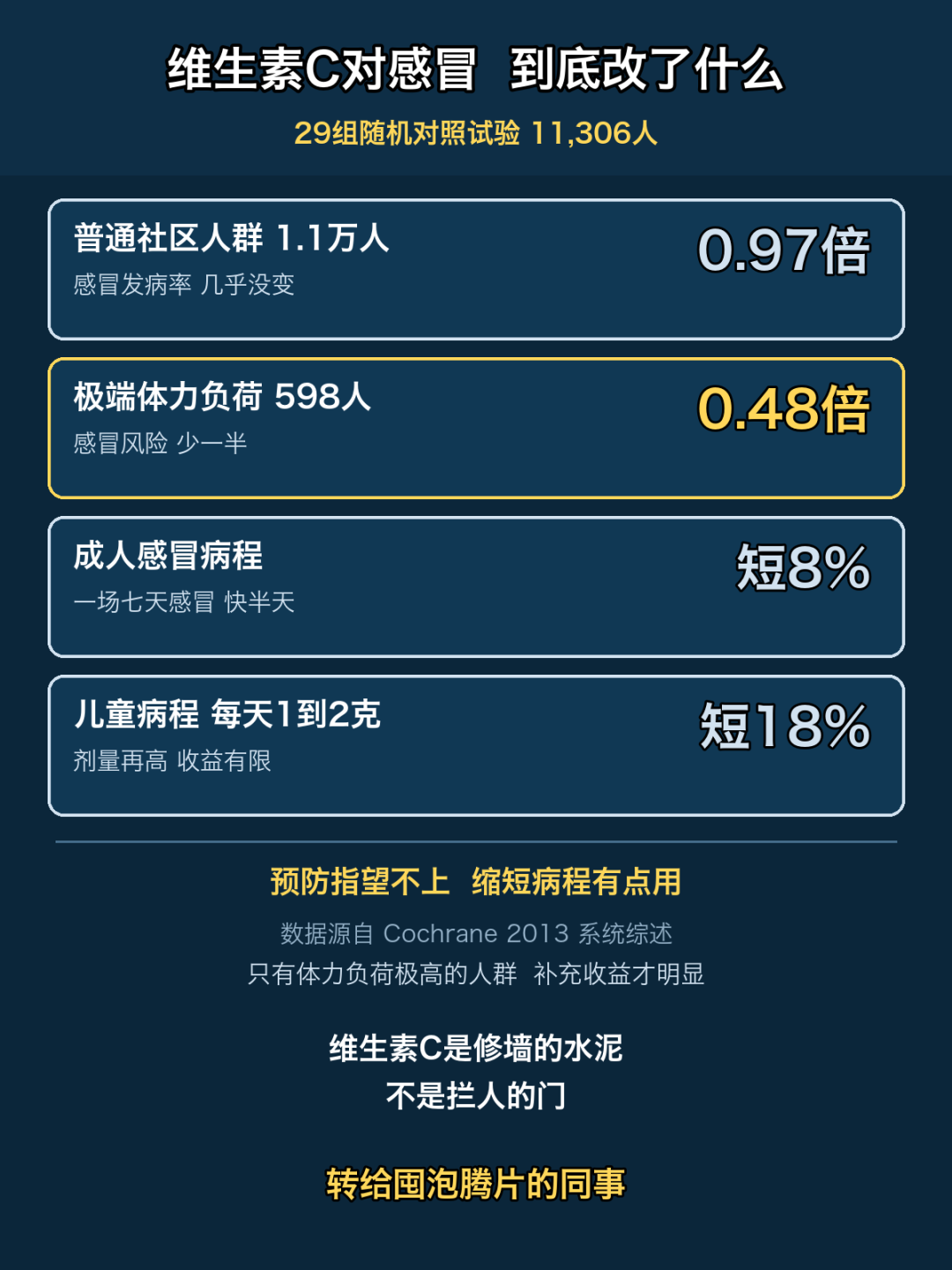
A 2013 Cochrane systematic review pooled 29 randomized controlled trials involving 11,306 people and ran the numbers: in the general community population, regular daily vitamin C supplementation gave a cold risk ratio of 0.97, with a confidence interval of 0.94 to 1.00—essentially no change[1]. The review authors put it plainly: routine vitamin C supplementation in the general population lacks supporting evidence.
1. Why the prevention hurdle can't be cleared
Colds aren't caused by a single virus but are a set of symptoms caused by more than two hundred different viruses. What vitamin C does is support immune cell function and maintain epithelial barriers—basic housekeeping tasks[3]. A deficiency does make you more susceptible to infection, but once you have enough, adding more doesn't conjure up an extra line of defense out of thin air. It's more like the cement that repairs the wall, not the gate that keeps people out.
2. What actually changes is the duration, not the incidence
In the same review, regular supplementation shortened cold duration by 8% (3% to 12%) in adults and by 14% (7% to 21%) in children; children taking 1 to 2 grams per day had duration shortened by 18%[1]. What does 8% mean: a cold of about seven days ends half a day earlier. It has an effect, but it's a long way from "take it and you won't catch a cold."
There is one exception group. Marathon runners, cross-country skiers, and soldiers training in polar regions—598 people combined—had a cold risk of 0.48, nearly cut in half[1]. Under high-intensity physical load, immune status temporarily dips, and supplementation in this group has relatively clear benefits. Office workers with daily commutes and late nights working overtime are not on this list.
3. How much do you actually need per day
The Chinese Nutrition Society's recommended intake for adults is 100 milligrams per day, with a tolerable upper intake level of 2,000 milligrams per day. Research suggests plasma vitamin C approaches saturation at 100 to 200 milligrams per day[3], and most of anything beyond that is excreted in urine. One medium kiwifruit, one orange, and half a green pepper—roughly enough for a day's worth.
4. Why effervescent tablets make it so easy to overdo it
A single commercially available effervescent tablet often contains 1,000 milligrams of vitamin C, plus a fair amount of sodium on the side. One tablet a day already far exceeds what the body needs. Men who take high-dose vitamin C supplements long-term have a higher risk of kidney stones[4]. As for taking large doses for a few days when you have a cold, the evidence for therapeutic supplementation remains inconsistent to this day; two trials saw a dose response only at 6 to 8 grams per day[2]—a dose not suitable for trying at home on your own.

5. So how should you actually prevent colds in winter
Wash your hands, open windows for ventilation, wear a mask in crowded places, get enough sleep, and get a flu vaccine according to local recommendations. The evidence for these measures is stronger than for any vitamin C tablet.
Three things you can do today
-
Don't buy vitamin C supplements specifically to prevent colds—first check whether you're getting a serving of fresh fruits and vegetables every day.
-
If you're already taking them, don't exceed 1,000 milligrams a day, and don't stack them with multivitamins or juice on top.
-
If a cold lasts more than a week with a fever that won't go away, go to the hospital for tests—don't try to tough it out by increasing the dose.
Vitamin C is a good nutrient, not a talisman.
Share this with that colleague who stocks up on effervescent tablets every winter.
If you found this helpful, give it a like or a "Wow," and feel free to leave a comment telling us what topics you'd like to see.
✦ ✦ ✦
Disclaimer: This article is for health education purposes and does not constitute medical advice; the data cited come from publicly published research and do not involve any drug or product recommendations.
Conflict of interest statement: This article has no financial relationship with any company or product mentioned in the text.
© 2026 Sunsaint Hua (Beijing) Medical Technology Co., Ltd.
References
[1] Hemilä H, Chalker E. Vitamin C for preventing and treating the common cold. Cochrane Database Syst Rev. 2013;2013(1):CD000980. PMID: 23440782
[2] Hemilä H. Vitamin C and Infections. Nutrients. 2017;9(4):339. PMID: 28353648
[3] Carr AC, Maggini S. Vitamin C and Immune Function. Nutrients. 2017;9(11):1211. PMID: 29099763
[4] Thomas LD, Elinder CG, Tiselius HG, et al. Ascorbic acid supplements and kidney stone incidence among men: a prospective study. JAMA Intern Med. 2013;173(5):386-388. PMID: 23381591