This article is for health education purposes only and is intended for informational reference; it does not constitute medical advice. If you have any health concerns, please consult a professional doctor.
✦ ✦ ✦
"I just can't lose weight—could it be a vitamin D deficiency?" When a downward arrow shows up on a health check report, many people treat vitamin D supplements as a shortcut to weight loss. But a study that used genes as the "judge" points the other way: it's not that a vitamin D deficiency makes you fat—it's that being fat comes first. Today, with one graphic, we'll make the relationship between "fat" and "vitamin D" clear.
✦ ✦ ✦
First, the data: people with obesity are indeed more likely to be deficient in vitamin D
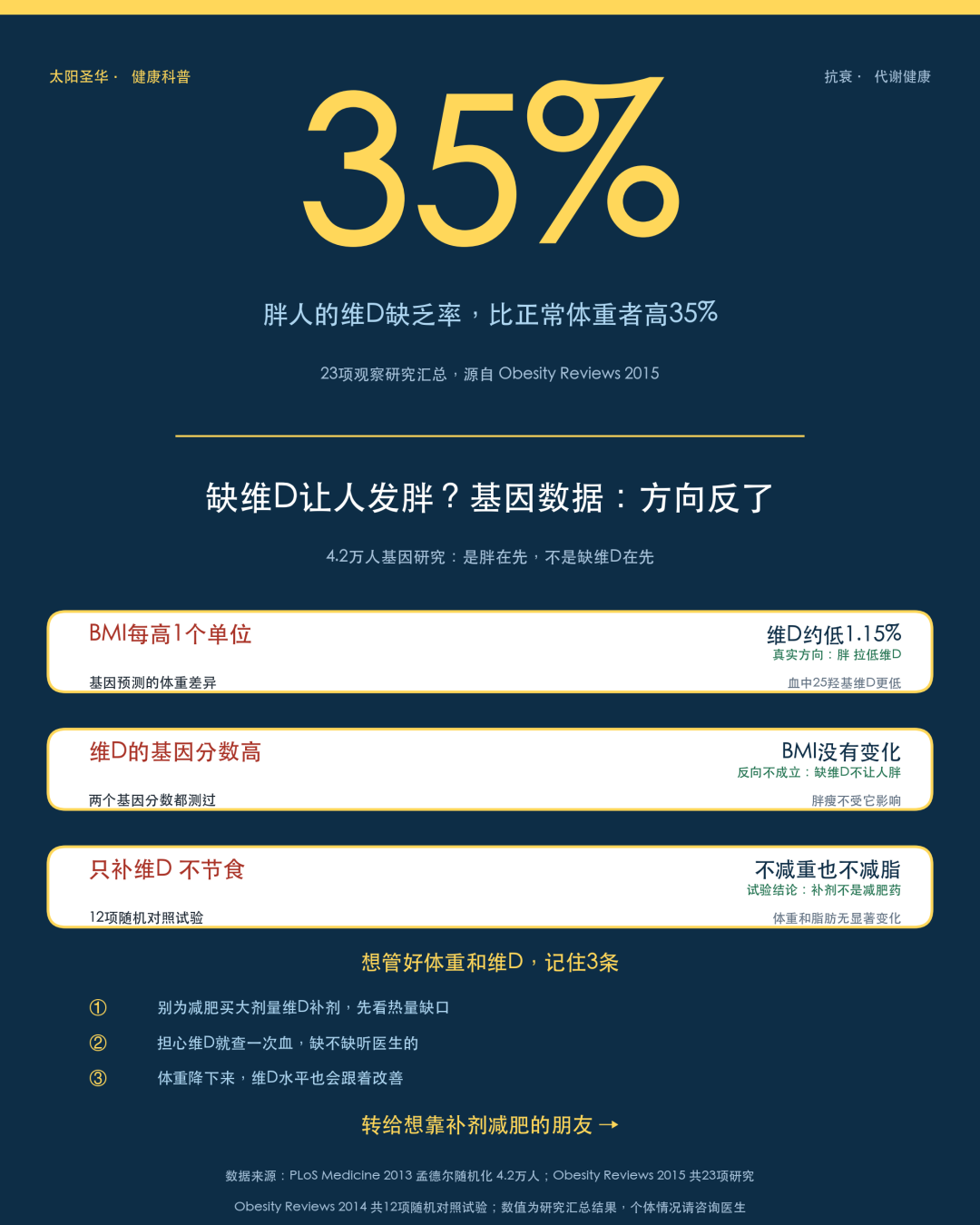
Let's start with the most solid conclusion: people with obesity are indeed more likely to be deficient in vitamin D. A meta-analysis pooling 23 observational studies found that the detection rate of vitamin D deficiency among people with obesity was about 35% higher than among those of normal weight (prevalence ratio 1.35, 95% CI 1.21-1.50), and this gap exists consistently across different ages and regions [2].
In plain terms: it's true that people with obesity are more likely to be deficient in vitamin D; but "vitamin D deficiency causes obesity" is a different matter.
Genetic evidence says: "fat" comes first, not vitamin D deficiency
Why does being fat lower vitamin D? It is currently thought to be related to adipose tissue "storing away" vitamin D, as well as people with obesity spending relatively less time outdoors. But observational studies cannot tell which comes first, so researchers used a cleverer approach—Mendelian randomization: using genes as a tool for "random grouping," because genes are set at birth and cannot be reverse-influenced by lifestyle habits.
This study, published in 2013 in PLoS Medicine, pooled 21 cohorts and up to 42,000 adults: for every 1-unit higher genetically predicted BMI, blood 25-hydroxyvitamin D was about 1.15% lower, an extremely strong association; conversely, the two genetic scores associated with vitamin D levels were both unrelated to BMI [1].
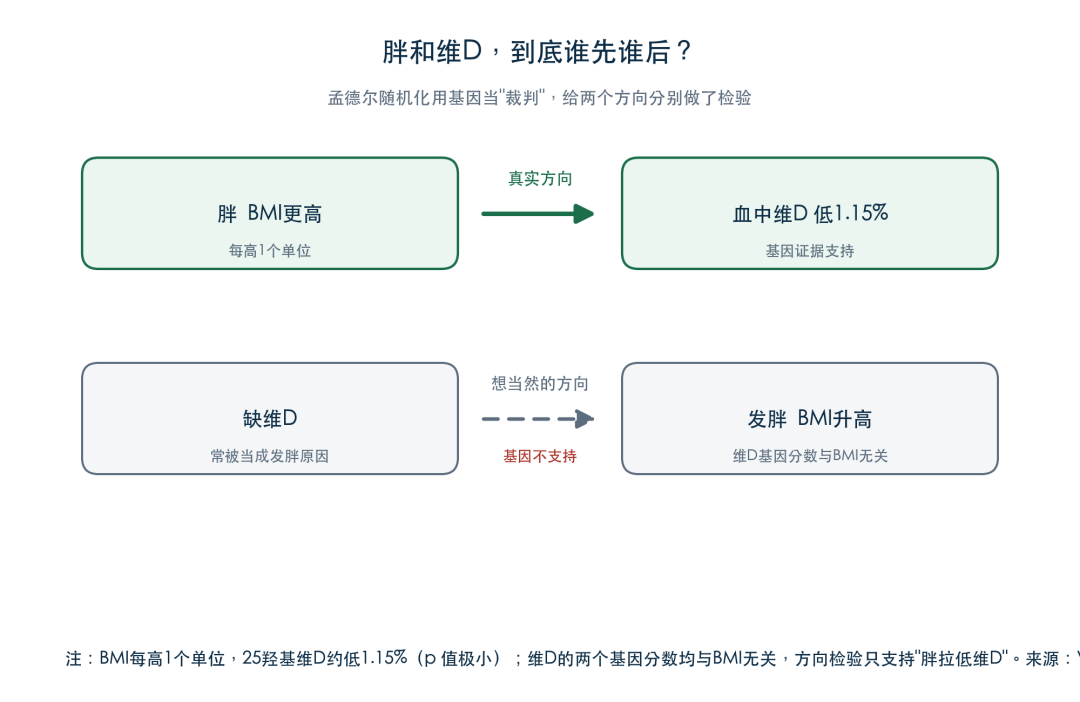
(Figure above: genetic evidence supports only one direction—"fat lowers vitamin D")
In plain terms: fat comes first, vitamin D deficiency follows. The commonly assumed idea that "vitamin D deficiency makes people fat" is not supported by genetic evidence.
So can vitamin D supplementation help with weight loss? Trials say: no
If vitamin D deficiency really did make people fat, then supplementing vitamin D should help with weight loss—and the answer from randomized controlled trials is clear-cut: no. A meta-analysis pooling 12 high-quality randomized controlled trials found that, without dietary restriction, vitamin D supplementation alone had no significant effect on body weight, fat mass, or lean mass [3].
So if you want to lose weight, don't count on supplements—a calorie deficit, eating right, and getting moving are the real path. But don't go to the other extreme either: vitamin D deficiency itself is very common across all age groups [4]. If your lab tests do show a deficiency, supplement as your doctor advises—just don't treat it as a weight-loss drug.
Three-sentence action advice
① Don't buy supplements for weight loss: first look at your daily calorie deficit and activity level—these two are the real key to weight loss.
② If you're really worried, get a blood test once: add a 25-hydroxyvitamin D test to your health check; whether you're deficient should be based on the lab results and your doctor's judgment [4].
③ To kill two birds with one stone, manage your weight first: the conclusion of this genetic study is that once weight comes down, the incidence of vitamin D deficiency will decline along with it [1].
Share this graphic with a friend who is taking vitamin D to lose weight: Only when the direction is right will your efforts not be wasted.
If this has been helpful to you, give it a like or a "Wow," and feel free to leave a comment telling us what topics you'd like to see.
✦ ✦ ✦
Disclaimer: The content of this article is compiled based on publicly available academic literature and is intended for health education reference only; it does not constitute medical advice. For individual circumstances, please consult a professional doctor.
Declaration of interests: The author has no conflicts of interest with the studies mentioned in this article.
© 2026 Sun Shenghua (Beijing) Medical Technology Co., Ltd.
References
- Causal relationship between obesity and vitamin D status: bi-directional Mendelian randomization analysis of multiple cohorts. PLoS Med. 2013;10(2):e1001383. PMID:23393431
- Obesity and vitamin D deficiency: a systematic review and meta-analysis. Obes Rev. 2015;16(4):341-349. PMID:25688659
- Vitamin D supplementation and body weight status: a systematic review and meta-analysis of randomized controlled trials. Obes Rev. 2014;15(6):528-537. PMID:24528624
- Evaluation, treatment, and prevention of vitamin D deficiency: an Endocrine Society clinical practice guideline. J Clin Endocrinol Metab. 2011;96(7):1911-1930. PMID:21646368