Is Being Thin in Old Age Really Linked to Longer Life? After 80, Thinner People Have a 20% Higher Risk of Death
This article is for health education purposes only and is intended as general information; it does not constitute medical advice. If you have health concerns, please consult a professional doctor.
The saying "money can't buy thinness in old age" may lead many older adults to deliberately eat less meat and chase weight loss. But after age 80, the body's accounting doesn't work that way.

First, look at data from Chinese people themselves
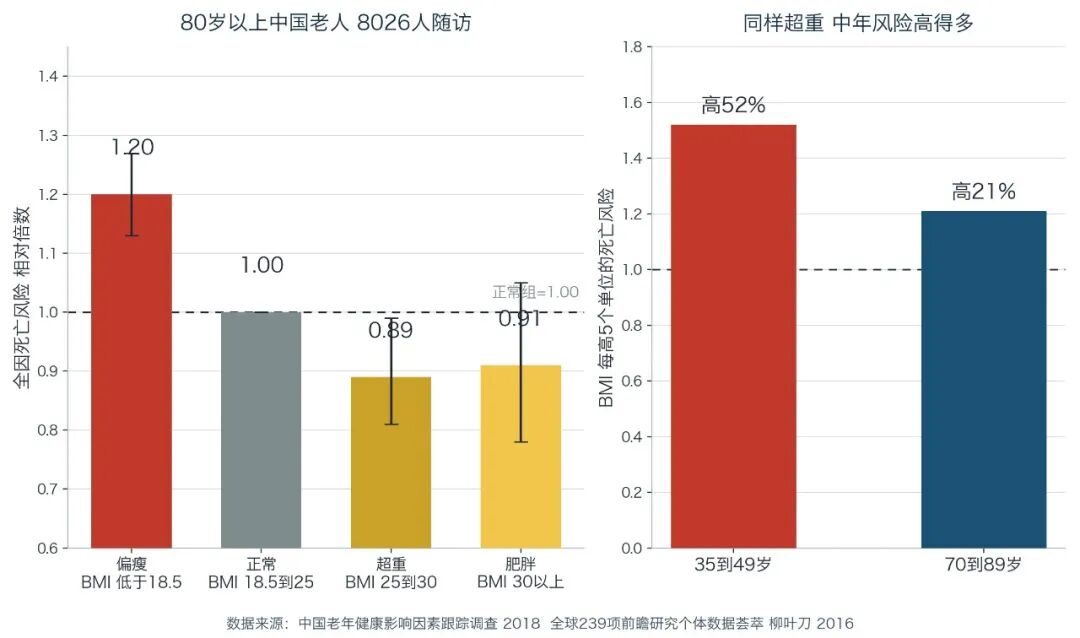
The Chinese Longitudinal Healthy Longevity Survey included 8,026 adults aged 80 and older, with an average follow-up of many years, recording 5,962 deaths. The results are straightforward[1]:
-
Older adults who were underweight (BMI below 18.5) had a 20% higher risk of all-cause mortality than those with normal weight;
-
Those who were overweight (BMI 25 to 30) actually had an 11% lower risk of death;
-
The average BMI of these older adults was only 19.8, and more than 30% were underweight—malnutrition was the more common problem.
This is not meant to vindicate obesity. A global pooled analysis of individual data covering 10.62 million people makes it clear: for young and middle-aged adults aged 35 to 49, every 5-unit increase in BMI raises the risk of death by 52%; that figure shrinks to 21% among those aged 70 to 89[2]. Middle-age weight gain still needs to be managed—it's just that at advanced ages, the relationship between weight and lifespan clearly flattens and becomes gentler.
Why you "can't afford to be thin" as you age
First, what comes off the scale isn't all fat. A 2013 systematic review published in JAMA found that, across all adult populations, those who were overweight (BMI 25 to 30) had an all-cause mortality risk about 6% lower than those of normal weight, but those with moderate to severe obesity had a significantly higher risk[3]. Researchers repeatedly warn: weight loss in older adults is often accompanied by muscle loss.
Second, muscle is the "reserve fund" for longevity. A 2023 meta-analysis of 49 prospective studies covering nearly 880,000 people showed that people with low muscle mass had a 36% higher risk of all-cause mortality[4]. With less muscle, the risks of falls, fractures, disability, and failure to recover from a bout of pneumonia all rise.
Third, walking speed is a report card for the body's reserves. A pooled analysis by JAMA of 9 cohort studies and 34,485 older adults found that for every 0.1 meter per second increase in walking speed, survival risk improved by about 12%; at age 75, the expected 10-year survival rate between the faster and slower walking groups ranged from 19% to 87% in men[5]. Muscle and cardiorespiratory reserves are all written in how fast you walk.
Middle age and old age: opposite strategies
The same word "thin" calls for almost opposite strategies at different ages:
-
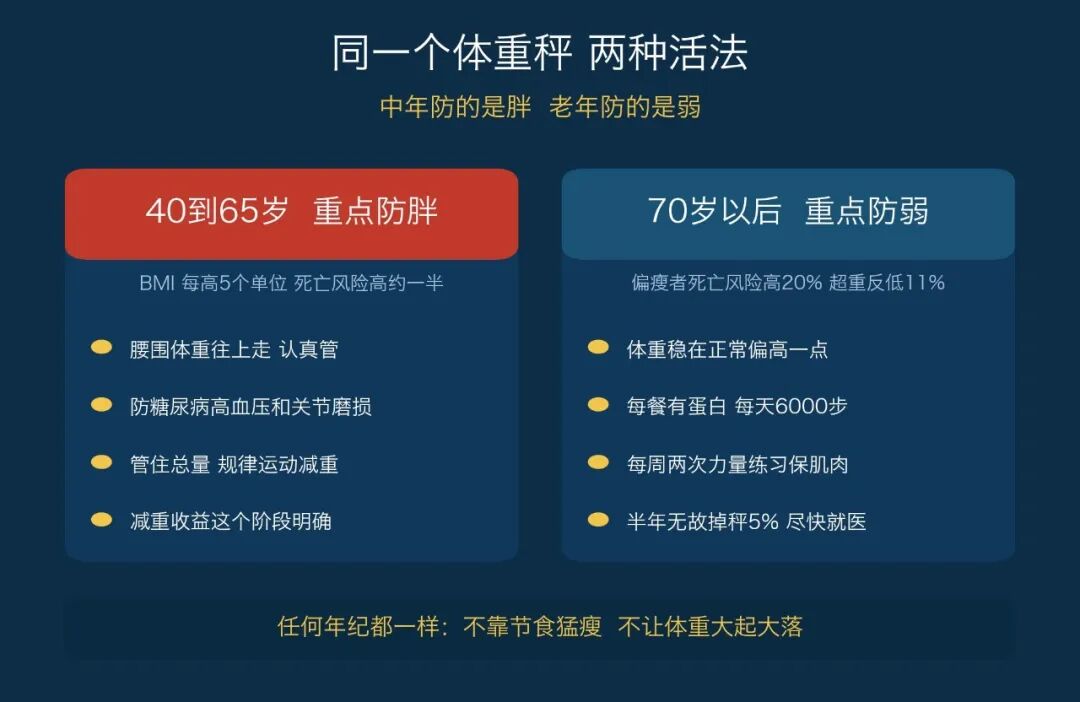
Ages 40 to 65: Rising waist circumference and weight should be taken seriously. At this stage, being overweight directly raises the risk of diabetes, high blood pressure, and joint burden—the benefits of weight loss are clear;
-
After 70: The focus shifts from "losing weight" to "preserving muscle." A weight stable at slightly above normal, with strong hands and legs and a walking pace that isn't slow, is safer than low body weight;
-
At any age: Losing weight rapidly through dieting and having weight swing back and forth both harm the body. Weight loss takes muscle first, but what comes back is mostly fat.
In other words, middle age guards against "fat," while old age guards against "frailty." If an 80-year-old family member has a poorer appetite, a looser waistband, and struggles to twist open a bottle cap, that deserves more attention than two or three extra pounds on the scale.
Two indicators more accurate than weight
Look at trends, not single readings. A 2026 national cohort of 617,000 Korean adults aged 75 and older showed that weight fluctuating up and down carries higher risk: the group with the highest fluctuation had a 62% higher all-cause mortality risk than the lowest group, and this held regardless of whether the overall trend was weight gain or loss[6]. Eating too little and then losing and regaining weight is more harmful than being stably slightly overweight.
Look at activity level and protein intake. Walking 6,000 to 8,000 steps a day is the range where the risk curve flattens for people over 60—in a meta-analysis of 15 international cohorts, the group walking about 6,000 steps a day had only 60% of the mortality risk of the 3,500-step group[7]. On protein, the international PROT-AGE consensus recommends that older adults eat 1.0 to 1.2 grams of protein per kilogram of body weight per day—for a 60 kg person, that's 60 to 72 grams, roughly equal to two eggs, a carton of milk, plus about 150 grams of fish or lean meat[8].
Three practical words of advice for parents
-
After 70, don't chase "thinness in old age is priceless." A BMI between 20 and 26 with a waistline that isn't ballooning matters more than a smaller number on the scale.
-
If there's no deliberate weight loss but body weight drops more than 5% within half a year, proactively see a doctor to investigate the cause—rather than being happy about it.
-
Walk at least 6,000 steps a day, include protein in every meal, and add leg raises or resistance-band exercises twice a week—preserving muscle is the real anti-aging.
Weight is not an indicator that should be pushed lower and lower with age—muscle, walking speed, and a stable lifestyle are. Consider sharing this with an older family member who is deliberately eating vegetarian and losing weight, and feel free to leave a comment about your own family elder's weight story.
If this was helpful to you, give it a like or a "reading" click, and feel free to leave a comment telling us what topics you'd like to see.
✦ ✦ ✦
References:
[1] Wang J, et al. J Nutr Health Aging. 2018;22(2):262-268. PMID: 29380854
[2] Global BMI Mortality Collaboration. Lancet. 2016;388(10046):776-786. PMID: 27423262
[3] Flegal KM, et al. JAMA. 2013;309(1):71-82. PMID: 23280227
[4] Zhou HH, et al. J Cachexia Sarcopenia Muscle. 2023;14(4):1596-1612. PMID: 37209044
[5] Studenski S, et al. JAMA. 2011;305(1):50-58. PMID: 21205966
[6] Seo JY, et al. Sci Rep. 2026;16(1):24388. PMID: 42209728
[7] Paluch AE, et al. Lancet Public Health. 2022;7(3):e219-e228. PMID: 35247352
[8] Bauer J, et al. J Am Med Dir Assoc. 2013;14(8):542-559. PMID: 23867520
✦ ✦ ✦
Disclaimer: This article is for health education purposes only and is intended as general information; it does not constitute medical advice. If you have health concerns, please consult a professional doctor. Older adults adjusting their diet or exercise plans—especially those with chronic conditions—are advised to consult a doctor or dietitian first.
Conflict of interest statement: The content of this article is based on publicly published medical literature, and the author has no relevant conflicts of interest.
© 2026 Sunsheng Hua (Beijing) Medical Technology Co., Ltd.