Should Lung Nodules Be Removed Surgically? First, Look at These 5 Words on the Report
This article is for health education and informational purposes only and does not constitute medical advice; if you have health concerns, please consult a professional doctor.
✦ ✦ ✦
When a line reading "lung nodule" appears on a health checkup report, many people panic on the spot.
Over the next few days, their search history runs from "are lung nodules cancer" all the way to "do I need surgery right away."
First, here is a number that can help you sit back down.
In a single-center study published in 2023, among 5,486 people who underwent low-dose CT at a tertiary hospital in Hunan, 84.3% were reported to have lung nodules; the researchers' own words were that these nodules basically require no clinical intervention [1].
In other words, nodules are extremely common on screening CTs; first and foremost, a nodule is an imaging description, not a diagnosis.
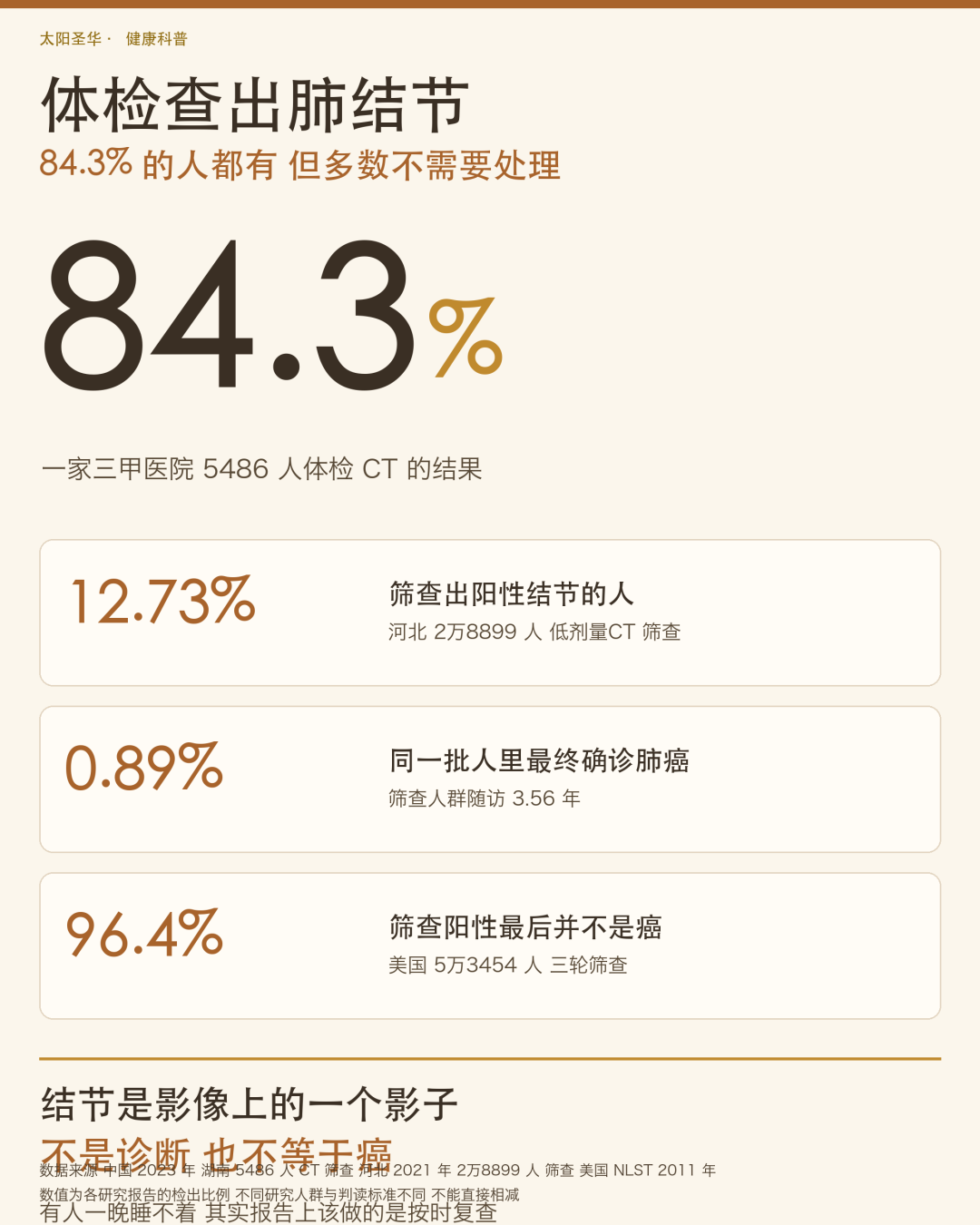
Caption: Among 5,486 people who underwent low-dose CT, 84.3% were reported to have lung nodules; while in a screening of 28,899 people in Hebei, 12.73% had positive nodules and only 0.89% were ultimately diagnosed with lung cancer; in the US NLST, 96.4% of positive results turned out not to be cancer.
1. 84% Is a Detection Rate, Not a Prevalence Rate
Different studies use very different standards. From 2013 to 2019, Hebei conducted low-dose CT screening for 28,899 high-risk individuals: 12.73% had positive nodules, 1.46% were suspected of lung cancer, and 0.89% of the same group were ultimately diagnosed with lung cancer [3].
The differences come down to three things: the age and smoking history of the population, the resolution and interpretation standards of the CT, and each study's cutoff for "positive nodules." So don't directly compare percentages across two studies, and don't interpret 84% as "eight out of ten Chinese people have something in their lungs."
2. These 5 Words on the Report Are Worth Asking Your Doctor About
Combining two Canadian screening datasets of 1,871 and 1,090 people—a total of 12,029 nodules—researchers found after modeling that features associated with malignancy probability included: older age, family history of lung cancer, larger nodule size, location in the upper lobe, part-solid composition, spiculated margins, and fewer nodules [2].
And among people with nodules, the proportion ultimately diagnosed with cancer in the two datasets was 5.5% and 3.7%, respectively [2].
In plain terms: of 100 people who receive a "has nodules" report, ninety-something will ultimately not have cancer.
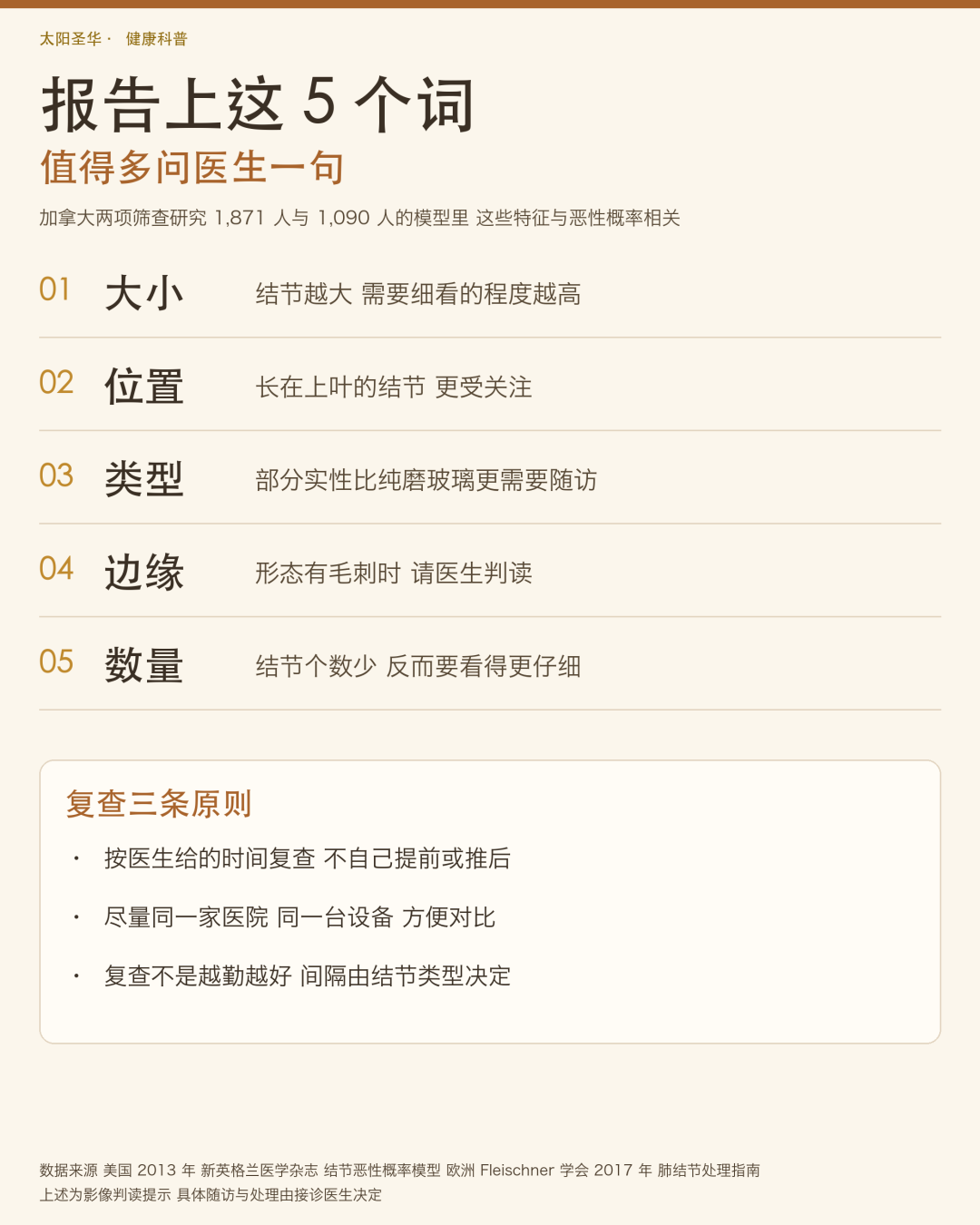
Caption: The first things to look at on a report are the five items—size, location, type, margins, and number—along with the three principles for follow-up: follow the timing your doctor gives, try to use the same equipment, and shorter intervals are not always better.
3. Most Cases Are Observed, Not Operated On the Moment They're Found
When the Fleischner Society revised its guidelines for managing pulmonary nodules in 2017, it raised the minimum threshold for routine follow-up, and changed the recommended follow-up intervals from fixed time points to ranges, so that radiologists, clinicians, and patients could adjust based on individual risk and preferences [4].
In clinical practice, the routine approach is to set the next follow-up time based on nodule size and type. Observation is itself a form of management, not procrastination.
One reminder: this applies to nodules found incidentally during checkups. People who already have hemoptysis, persistent cough, or significant weight loss are not covered by this process and should seek medical attention promptly.
4. Is Low-Dose CT Screening Actually Useful?
Yes, and it carries the weight of randomized trials.
The US NLST enrolled 53,454 high-risk smokers, randomly assigned to a low-dose CT group and a chest X-ray group, with three rounds of screening and follow-up through the end of 2009: lung cancer mortality fell by 20.0% (95% confidence interval 6.8 to 26.7), and all-cause mortality fell by 6.7% [5].
The European NELSON trial enrolled 13,195 men (aged 50 to 74, current or former smokers), with ten-year follow-up: lung cancer mortality fell by a relative 24% (rate ratio 0.76, 95% confidence interval 0.61 to 0.94); the referral rate for suspicious nodules requiring additional workup was only 2.1% [6].
The costs should also be made clear: in NLST, 96.4% of positive results ultimately were not cancer, and false positives bring extra CT scans and a period of anxiety. That is why screening should be targeted at selected people, not done annually by everyone.
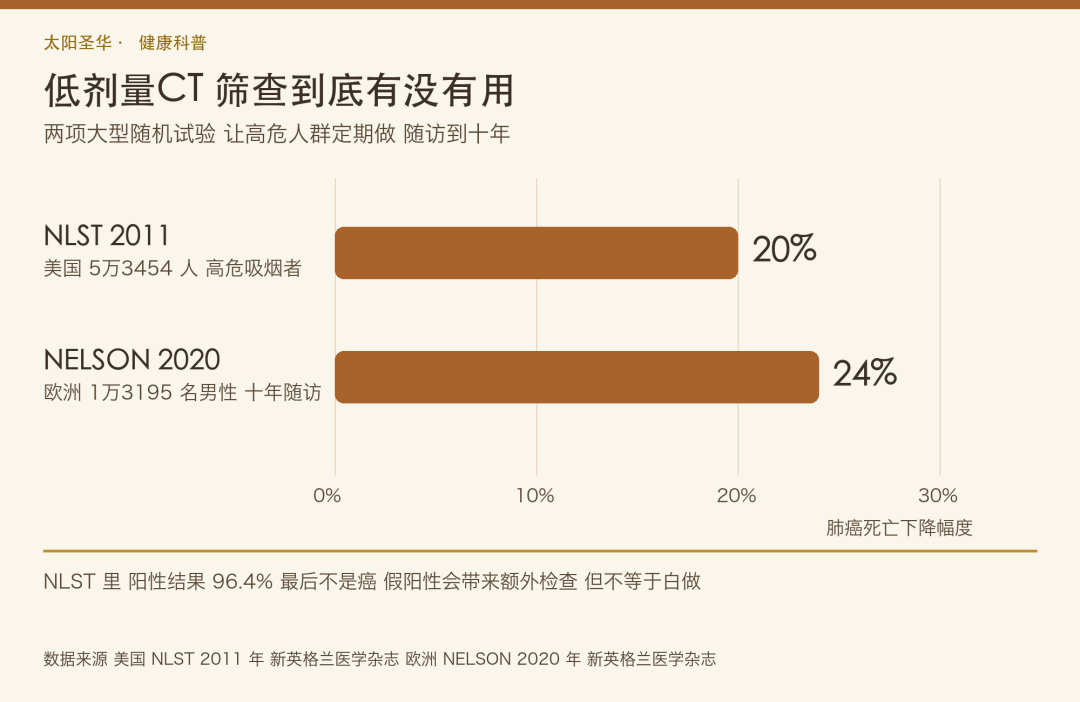
Caption: In two large randomized trials, low-dose CT screening reduced lung cancer mortality in high-risk populations by 20% and 24%, respectively; in the same trials, more than ninety percent of positive results ultimately were not cancer.
Three Things You Can Do Today
-
Keep this report safe, and note down the nodule's size, type, and location, and bring it to your next follow-up.
-
Follow up at the interval your doctor gives. Don't move it earlier on your own, and don't skip it because "you don't feel anything."
-
If you are a long-term smoker, have long-term secondhand smoke or occupational dust exposure, or have a family history of lung cancer, discuss with your doctor whether to undergo low-dose CT screening.
A nodule is a shadow on a scan, not a verdict. What truly determines the outcome is following up on time and quitting smoking when it's time to quit.
Share this with the family member who just got their report and is searching "lung nodule" right now.
If this has been helpful to you, give it a like or a "Wow," and feel free to leave a comment telling us what topics you'd like to see.
✦ ✦ ✦
Disclaimer: This article is for health education and does not constitute medical advice; please follow your doctor's instructions for specific examinations and management.
Conflict of interest statement: This article does not involve any product promotion and has no financial relationship with the research institutions mentioned in the text.
© 2026 Sun Sheng Hua (Beijing) Medical Technology Co., Ltd.
References
[1] Zhang Z, Gao Y, Liu S, et al. Initial low-dose computed tomography screening results and summary of participant characteristics: based on the latest Chinese guideline. Front Oncol. 2023;13:1085434. PMID: 37293585
[2] McWilliams A, Tammemagi MC, Mayo JR, et al. Probability of cancer in pulmonary nodules detected on first screening CT. N Engl J Med. 2013;369(10):910-919. PMID: 24004118
[3] Liang D, Shi J, Li D, et al. Participation and Yield of a Lung Cancer Screening Program in Hebei, China. Front Oncol. 2021;11:795528. PMID: 35083151
[4] MacMahon H, Naidich DP, Goo JM, et al. Guidelines for Management of Incidental Pulmonary Nodules Detected on CT Images: From the Fleischner Society 2017. Radiology. 2017;284(1):228-243. PMID: 28240562
[5] National Lung Screening Trial Research Team, Aberle DR, Adams AM, Berg CD, et al. Reduced lung-cancer mortality with low-dose computed tomographic screening. N Engl J Med. 2011;365(5):395-409. PMID: 21714641
[6] de Koning HJ, van der Aalst CM, de Jong PA, et al. Reduced Lung-Cancer Mortality with Volume CT Screening in a Randomized Trial. N Engl J Med. 2020;382(6):503-513. PMID: 31995683