This article is for health education purposes only and is intended for informational reference. It does not constitute medical advice; please consult a professional doctor if you have any health concerns.
A Skipped Beat Isn't Just Fatigue: Atrial Fibrillation Nearly Quintuples Stroke Risk
Rushing for the subway in the morning, your chest suddenly goes "thunk"—like a beat skipped; you sit down and rest a while, and it passes.
Most people chalk this up to late nights, coffee, or being too tired. But there is a type of heart rhythm problem that comes and goes in episodes like this, and then one night sends a blood clot into the brain's blood vessels.
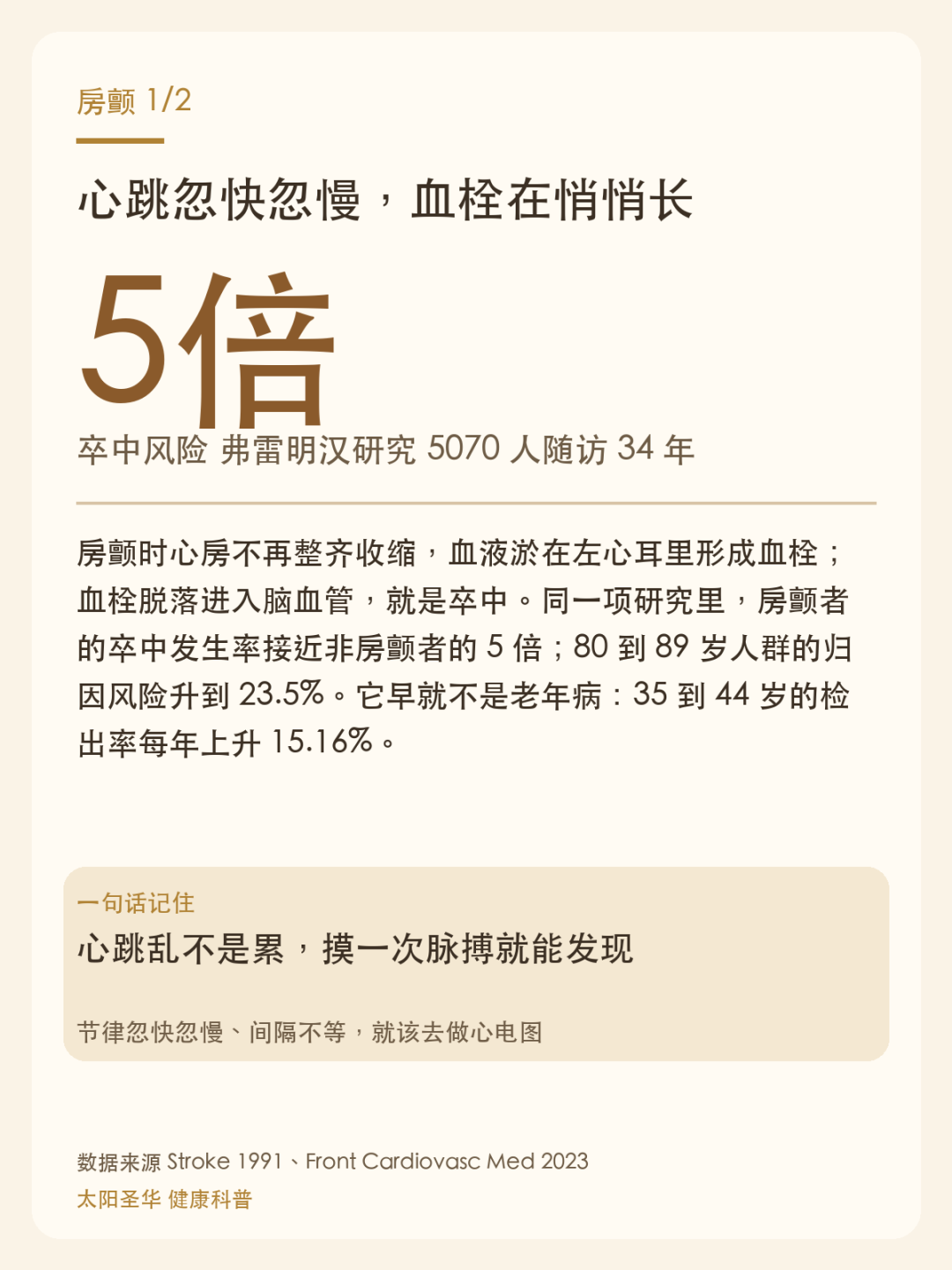
Image caption: In atrial fibrillation, the atria no longer contract in an organized way, and blood pools in the left atrial appendage to form clots; when a clot breaks loose and enters the brain's blood vessels, it causes a stroke. The Framingham Study showed that people with atrial fibrillation have a stroke rate nearly 5 times higher.
First, That Number: Nearly 5 Times
The Framingham Study followed 5,070 people over 34 years: compared with people without atrial fibrillation, those with atrial fibrillation had a stroke rate nearly 5 times higher [1].
What's more interesting is the age breakdown. Among people aged 50 to 59, atrial fibrillation accounted for only 1.5% of strokes; by ages 80 to 89, that proportion rose to 23.5%. Among the several cardiovascular conditions the researchers analyzed, atrial fibrillation was the one whose weight continued to rise with age.
It's Long Since Stopped Being an "Old Person's Disease"
A 2023 national analysis covering 3.04 million health check-up participants aged 35 and older: the standardized prevalence held steady at 0.4% to 0.45%, but the detection rate in the 35-to-44 age group rose 15.16% per year between 2012 and 2017 [4].
The same study had another line worth remembering: as age increases, the weight of overweight and obesity for atrial fibrillation gradually surpasses that of diabetes and hypertension. In other words, body weight ranks very high on this list.
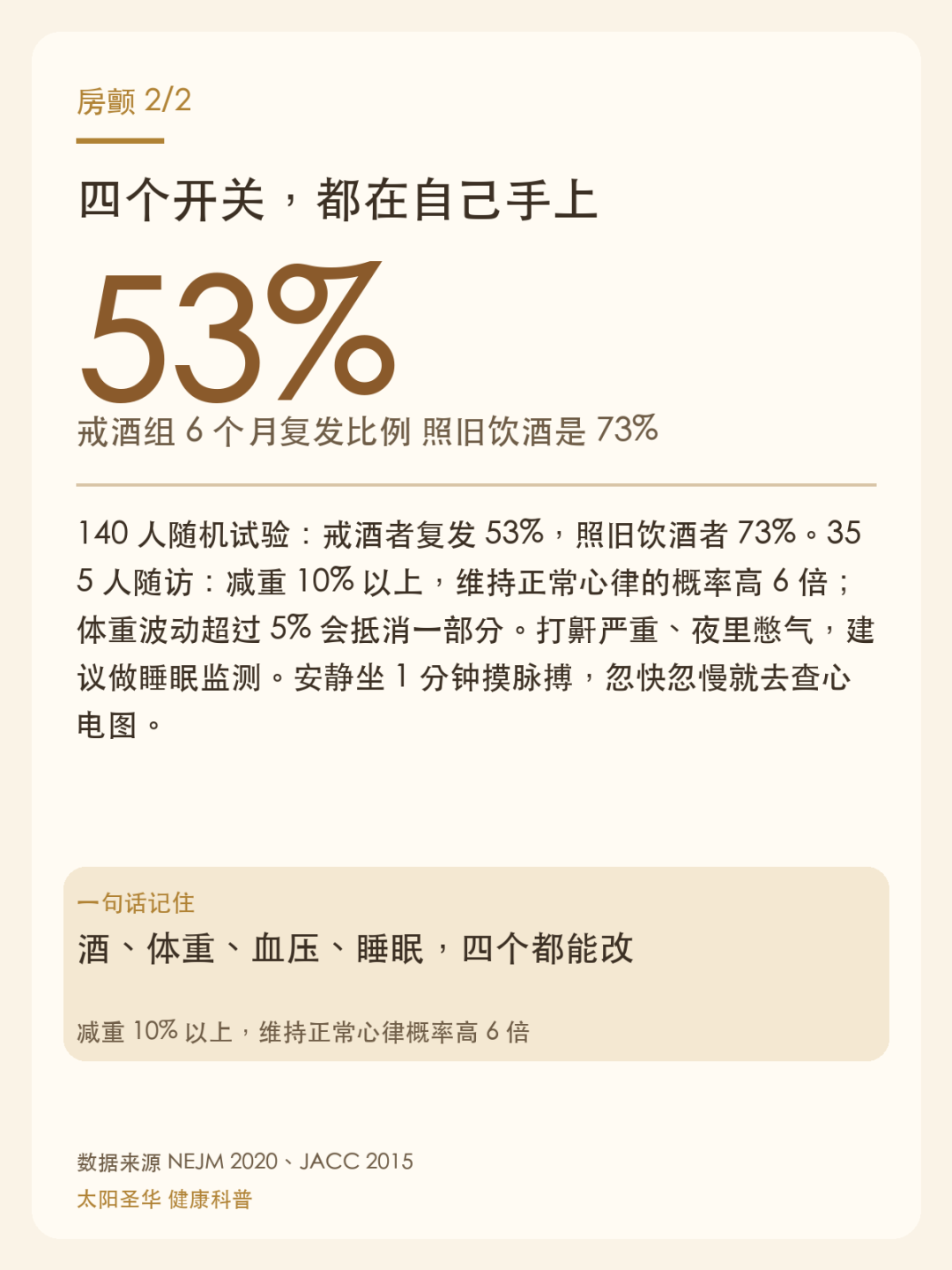
Image caption: Alcohol, body weight, blood pressure and metabolism, and a one-minute pulse check are four switches you can flip yourself; the card gives the research numbers for each.
Three Switches You Can Flip Yourself
Alcohol. 140 atrial fibrillation patients who drank regularly were randomly assigned to two groups: one abstained from alcohol, the other continued as before. After 6 months, the abstinence group had a 53% recurrence rate versus 73% in the group that continued, with a risk ratio of 0.55 [2]. This was a randomized trial, not an observational study.
Body weight. 355 overweight atrial fibrillation patients were followed long-term: those who lost more than 10% of their body weight were 6 times more likely to maintain normal heart rhythm; while weight fluctuating back and forth by more than 5% offset part of that benefit [3].
Blood pressure and metabolism. Keeping blood pressure, blood sugar, and body weight within reasonable ranges is a routine part of atrial fibrillation management. People who snore heavily or gasp for breath at night are advised to have a sleep study done.
Plus One That Costs Nothing: Check Your Pulse
Sit quietly for 1 minute, press your index and middle fingers on the thumb side of your wrist, and feel whether the rhythm is sometimes fast and sometimes slow, and whether the intervals between beats are unequal. The typical pulse in atrial fibrillation is "irregular," not simply fast.
A clearly irregular pulse that doesn't resolve within a few minutes; palpitations accompanied by chest tightness, shortness of breath, sweating, or darkening of vision; having high blood pressure, diabetes, obesity, or a long history of heavy drinking—if any of these apply, getting an ECG is standard practice. When a regular ECG can't catch it, doctors will recommend a 24-hour Holter monitor.
After diagnosis, the doctor will assess whether anticoagulation therapy is needed to reduce stroke risk. It's not advisable to decide on your own to add or stop medications.
A Quick Word About the Brain
A 2024 meta-analysis: atrial fibrillation was associated with a 23% higher risk of Alzheimer's disease and an 80% higher risk of vascular dementia [5]. This is not yet a causal conclusion, but it serves as a reminder—an irregular heart rhythm affects more than just the heart.
Three Things You Can Do Today
-
Check your pulse once, and note the rate and whether it's regular.
-
Calculate your weight: if your BMI is above 27, set a small goal of losing 10% first.
-
Write down how much you drank this week, and cut it in half first.
An irregular heart rhythm itself isn't scary; what's scary is that it comes quietly, and then one day shows up as a stroke.
If this article was useful to you, consider sharing it with that family member who always says "my heart goes thunk."
If it helped you, give it a like or a "reading" mark, and feel free to leave a comment telling us what topics you'd like to see.
✦
Disclaimer: This article is for health education purposes only and is intended for informational reference. It does not constitute medical advice; please consult a professional doctor if you have any health concerns.
Conflict of interest statement: This article does not involve any drug or product recommendations and has no financial relationship with the research institutions mentioned in the text.
© 2026 Sunsaint Hua (Beijing) Medical Technology Co., Ltd.
References
[1] Wolf PA, Abbott RD, Kannel WB. Atrial fibrillation as an independent risk factor for stroke: the Framingham Study. Stroke. 1991;22(8):983-988. PMID: 1866765
[2] Voskoboinik A, Kalman JM, De Silva A, et al. Alcohol Abstinence in Drinkers with Atrial Fibrillation. N Engl J Med. 2020;382(1):20-28. PMID: 31893513
[3] Pathak RK, Middeldorp ME, Meredith M, et al. Long-Term Effect of Goal-Directed Weight Management in an Atrial Fibrillation Cohort: A Long-Term Follow-Up Study (LEGACY). J Am Coll Cardiol. 2015;65(20):2159-2169. PMID: 25792361
[4] Sun T, Ye M, Lei F, et al. Prevalence and trend of atrial fibrillation and its associated risk factors among the population from nationwide health check-up centers in China, 2012-2017. Front Cardiovasc Med. 2023;10:1151575. PMID: 37324618
[5] Zheng Y, Li G. Association between Atrial Fibrillation and Risk of Alzheimer's Disease and Vascular Dementia: A Systematic Review and Meta-analysis. Ann Indian Acad Neurol. 2024;27(6):619-628. PMID: 39652360