This article is for health education purposes only and is intended for informational reference. It does not constitute medical advice. If you have health concerns, please consult a professional doctor.
When your back hurts, the first thing people around you usually say is, "Lie down and rest." But at the hospital, doctors often say something quite different: "Don't stay in bed all the time—walk if you can."
Two completely opposite pieces of advice—whose should you follow? Over the past decade or so, this question has been repeatedly tested in randomized trials. The answer is not ambiguous.
600 Million People Worldwide Have Low Back Pain—Lying Down Is Not the Cure
In 2020, 619 million people worldwide were affected by low back pain, and that number is projected to reach 843 million by 2050 [1]. Low back pain is already the leading cause of disability globally, and between 1990 and 2015, years of healthy life lost due to low back pain increased by 54% [2].
What needs to be made clearer is this: the vast majority of low back pain has no identifiable structural cause. No disc herniation, no fracture, no inflammation—yet the pain is real [2]. In other words, imaging often can't capture the "cause," and "lying flat" won't make the problem disappear.
First Set of Data: Bed Rest vs. Staying Active
A 2010 Cochrane systematic review included 10 randomized controlled trials comparing two types of medical advice: "recommend bed rest" versus "recommend staying active" [3].
Among patients with acute low back pain, two trials involving 401 people found that those advised to stay active had slightly better pain scores than the bed rest group (standardized mean difference 0.22, 95% confidence interval 0.02 to 0.41), and slightly better daily function as well (0.29, 0.09 to 0.49) [3].
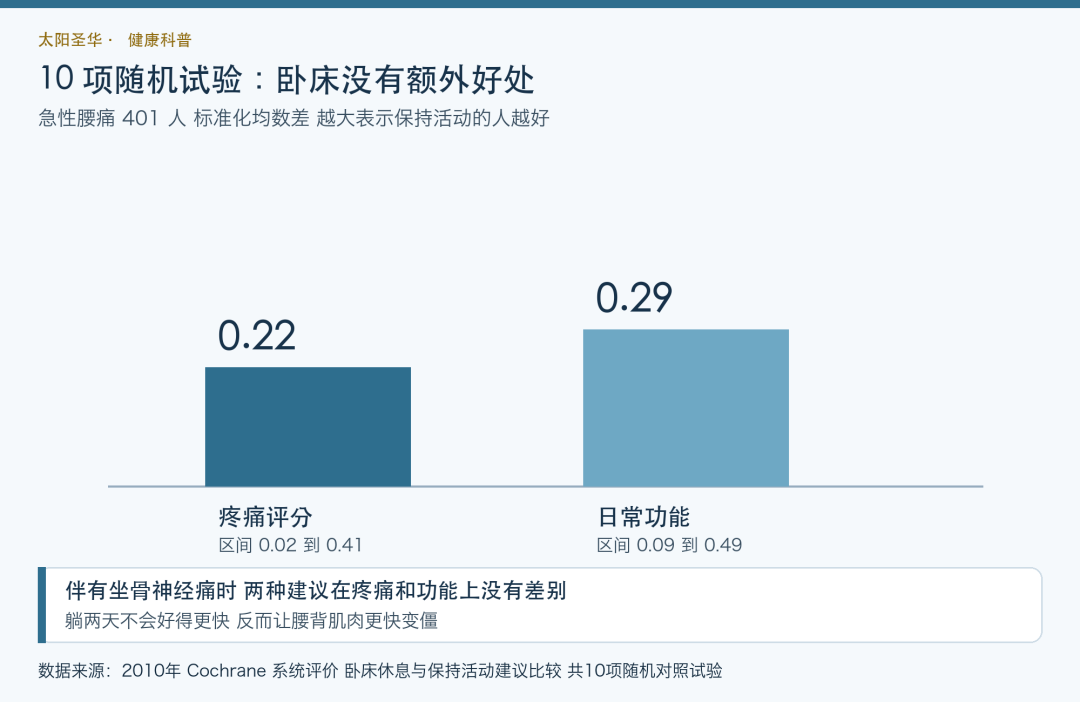
The difference is small, but the direction is consistent—bed rest offers no additional benefit. For people with sciatica, the two types of advice showed no difference in pain or function [3].
In other words: lying down for two days won't help you recover faster—it will actually make your back muscles stiffen more quickly and make getting up more painful.
Second Set of Data: Moving vs. Not Moving
If "don't lie down" is just the passing grade, then "how to move" is where the extra points come from.
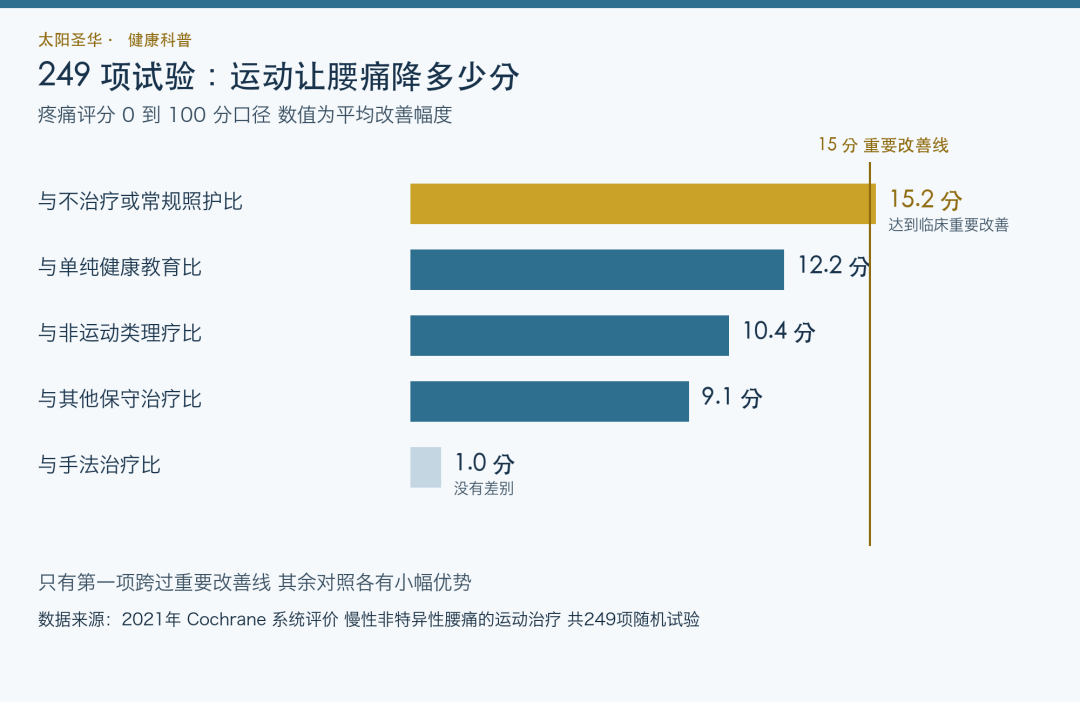
A 2021 updated Cochrane systematic review pooled 249 exercise therapy trials. Compared with no treatment, usual care, or placebo, exercise reduced pain scores in patients with chronic low back pain by an average of 15.2 points (out of 100)—already reaching a clinically meaningful level of improvement; functional limitation improved by 6.8 points [4].
Compared with other conservative treatments, exercise also reduced pain by an additional 9.1 points. Breaking it down further: compared with education alone, exercise reduced pain by an additional 12.2 points; compared with non-exercise physical therapies, by an additional 10.4 points; but compared with manual therapy, there was no difference [4].
In terms of safety, 33% of the exercise group reported adverse events, compared with 29% in the control group—the vast majority being mild reactions such as muscle soreness [4].
Guidelines Changed Long Ago
The American College of Physicians' 2017 guideline is very clear: for acute or subacute low back pain, non-pharmacologic treatments are first-line—such as superficial heat, massage, acupuncture, or spinal manipulation; for chronic low back pain, first-line options include exercise, multidisciplinary rehabilitation, acupuncture, and mindfulness-based stress reduction, followed by tai chi, yoga, and progressive relaxation [5]. Opioids should only be considered when the aforementioned approaches have been tried and the benefits outweigh the risks [5].
The 2018 Lancet low back pain series directly pointed out the problem: guidelines in various countries all recommend "education + return to normal activities + exercise," but in reality, imaging, bed rest, opioids, injections, and surgery are overused, while the first-line treatments that should be done are underused [6].
When Not to Tough It Out on Your Own
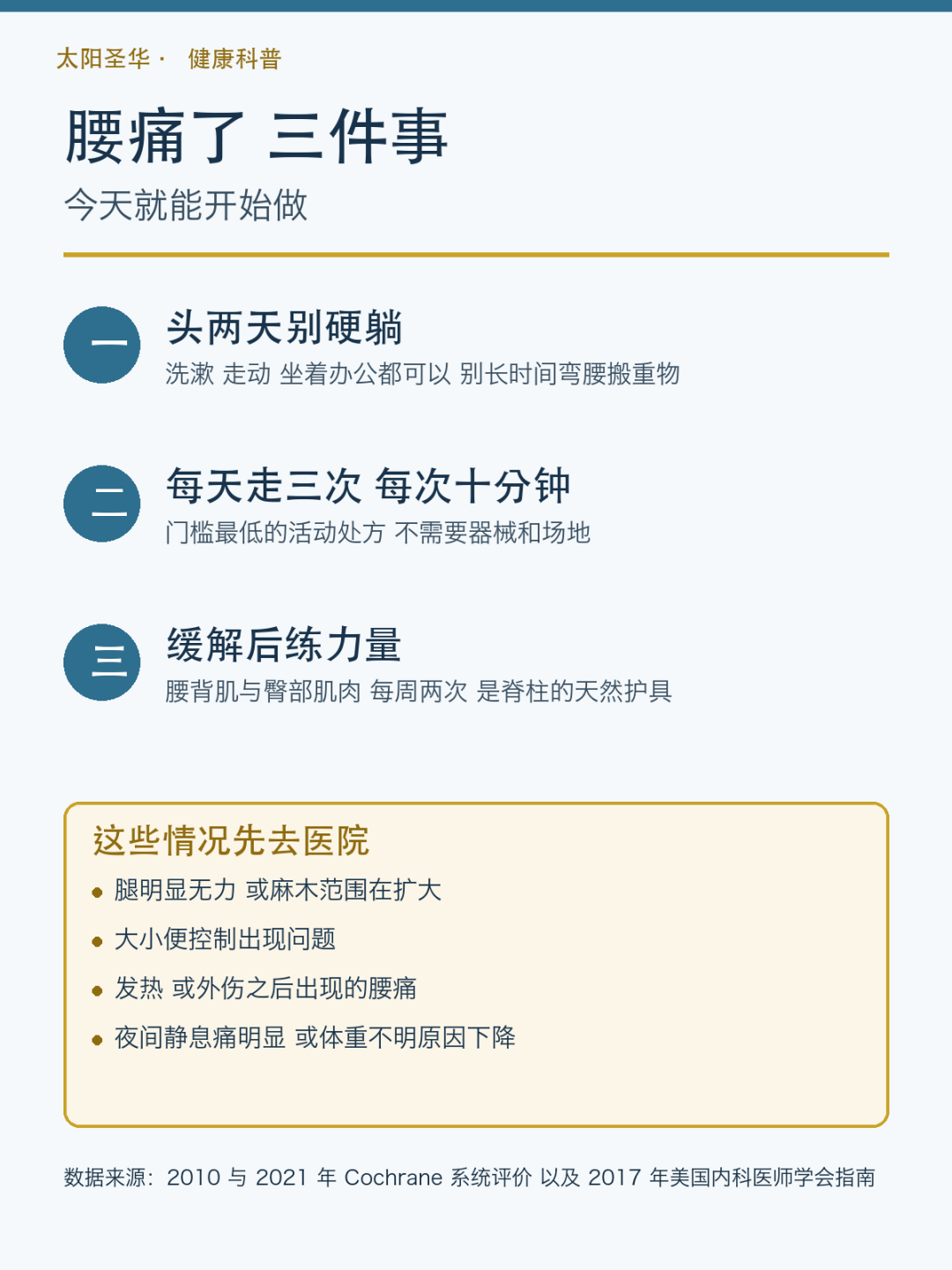
Not all low back pain can be solved by staying active. If any of the following occur, go to the hospital first:
-
Obvious leg weakness, or numbness that is spreading
-
Problems with bowel or bladder control
-
Low back pain accompanied by fever or following trauma
-
Significant resting pain at night, or accompanied by unexplained weight loss
-
A history of cancer
These are "red flag signs" that require investigation—they are not the same as ordinary muscular low back pain.
Three Things You Can Do Today
First, in the first two days of a low back pain episode, don't force yourself to lie down. Do daily activities within a tolerable range: washing up, walking short distances, sitting at a desk—just avoid prolonged bending and heavy lifting.
Second, walk for 10 minutes, two to three times a day. Walking has the lowest barrier to entry—no equipment, no special venue needed—and it's easy to stick with once the pain subsides.
Third, once the pain eases, add strength and core training back in—just twice a week is enough. The back and gluteal muscles are the spine's natural protective gear; strengthening them is more effective than lying down at preventing the next episode.
Your back isn't healed by lying down—it's healed by moving. Share this article with that older family member who heads straight to bed at the first sign of back pain.
If you found this helpful, give it a like or a "reading" click, and feel free to leave a comment telling us what topics you'd like to see.
✦
Disclaimer: This article is for health education purposes only and is intended for informational reference. It does not constitute medical advice. If you have health concerns, please consult a professional doctor.
Conflict of Interest Statement: This article does not involve any drug or product recommendations and has no financial relationship with the research institutions mentioned in the text.
© 2026 Sun Sheng Hua (Beijing) Medical Technology Co., Ltd.
References
[1] GBD 2021 Low Back Pain Collaborators. Global, regional, and national burden of low back pain, 1990-2020, its attributable risk factors, and projections to 2050: a systematic analysis of the Global Burden of Disease Study 2021. Lancet Rheumatol. 2023;5(6):e316-e329. PMID: 37273833
[2] Hartvigsen J, Hancock MJ, Kongsted A, et al. What low back pain is and why we need to pay attention. Lancet. 2018;391(10137):2356-2367. PMID: 29573870
[3] Dahm KT, Brurberg KG, Jamtvedt G, Hagen KB. Advice to rest in bed versus advice to stay active for acute low-back pain and sciatica. Cochrane Database Syst Rev. 2010;(6):CD007612. PMID: 20556780
[4] Hayden JA, Ellis J, Ogilvie R, Malmivaara A, van Tulder MW. Exercise therapy for chronic low back pain. Cochrane Database Syst Rev. 2021;9(9):CD009790. PMID: 34580864
[5] Qaseem A, Wilt TJ, McLean RM, Forciea MA. Noninvasive Treatments for Acute, Subacute, and Chronic Low Back Pain: A Clinical Practice Guideline From the American College of Physicians. Ann Intern Med. 2017;166(7):514-530. PMID: 28192789
[6] Foster NE, Anema JR, Cherkin D, et al. Prevention and treatment of low back pain: evidence, challenges, and promising directions. Lancet. 2018;391(10137):2368-2383. PMID: 29573872