This article is for health education purposes only and is intended for informational reference; it does not constitute medical advice. If you have any health concerns, please consult a professional doctor.
✦ ✦ ✦
A common habit among the elderly at home: wake up in the morning, sit down on the sofa, wrap the cuff around the arm, a "beep," and 135 pops up on the screen... the heart skips half a beat. The next day it's 128, a sigh of relief; two days later it's 142, and the anxiety starts again. Same blood pressure monitor, same person—why do the numbers keep going up and down?
First, some background data: the prevalence of hypertension among Chinese adults is about 27.5%, meaning roughly 1 in every 4 adults has elevated blood pressure[5]. Blood pressure monitors have become a near-standard household item, but the measurement process itself may harbor considerable error—a systematic review of 328 studies found that, from patient state to device to operating procedure, 27 of 29 potential sources of error produced significant reading deviations, with a single item differing by as much as about 33 mmHg[1].
In other words: many times it's not that blood pressure is "misbehaving"—it's that the measurement method isn't right yet.
✦ ✦ ✦
Mistake 1: Measuring as soon as you sit down, without giving the body time to "calm down"
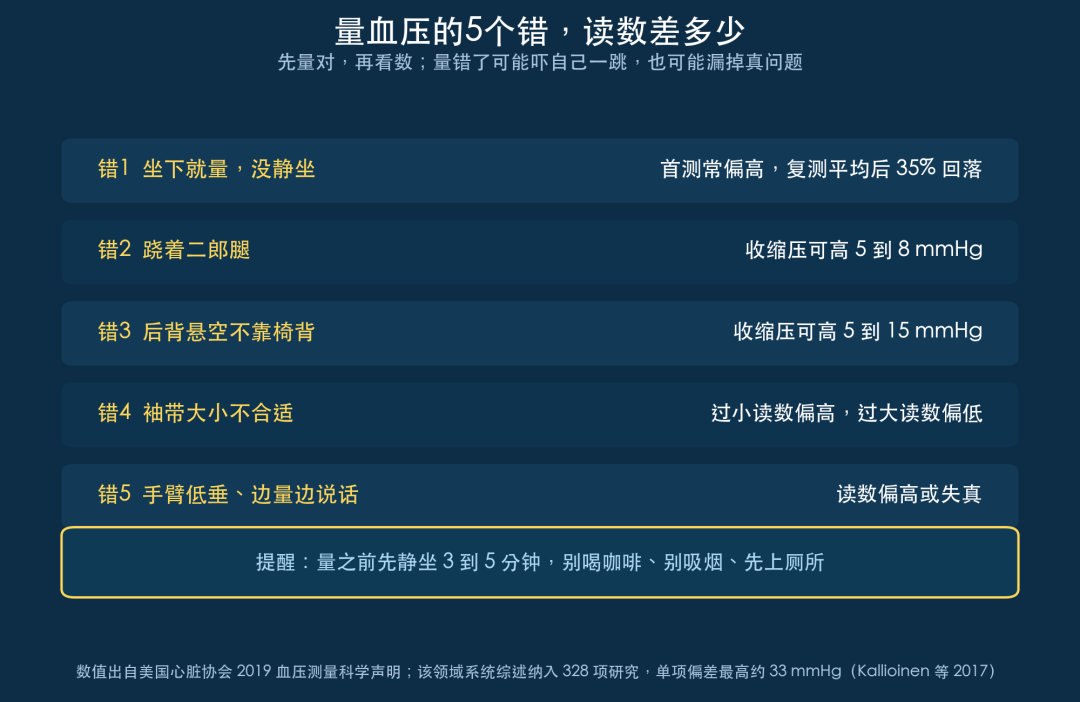
Wrapping the cuff the moment you sit down after coming home often gives a high reading. The correct approach is to sit quietly for 3 to 5 minutes—no chatting, no scrolling on your phone—before measuring[2]. Don't underestimate this step: in a hospital setting, among people whose first blood pressure reading was 140–159 mmHg, about 35% fell below 140 after taking the average of 3 measurements[2]—so if one reading is high, really don't rush to conclusions about yourself.
Mistake 2: Posture "whatever goes"—crossing your legs, leaning on the bed, arm dangling
Sitting posture directly affects readings: crossing your legs can raise systolic pressure by 5 to 8 mmHg; sitting without your back against the chair back, unsupported, can raise it by 5 to 15 mmHg[2]. The standard posture is: back against the chair back, feet flat on the floor, legs uncrossed, arm resting on the table at roughly heart height[2]. Take the time it takes to measure your blood pressure to get your posture right—only then do the numbers count.
Mistake 3: Talking while measuring, or having coffee or a cigarette beforehand
Talking distorts readings, so keep quiet during measurement[2]. Also avoid coffee, strong tea, exercise, and smoking within 30 minutes before measuring, and use the bathroom first to empty your bladder—these can all interfere with the results[2].
Mistake 4: Wrong cuff size, or wrapping it too loose or too tight
A cuff that's too small artificially raises readings; one that's too large lowers them[2]. Choosing a cuff depends on upper-arm circumference—it's not just "as long as it wraps on." Wrap it on the bare upper arm (not over thick clothing), with tightness such that you can insert 1 finger, and the lower edge about 2 to 3 cm above the elbow crease[2].
Mistake 5: One measurement decides everything—no fixed timing, no record-keeping
Blood pressure fluctuates naturally: in home self-measurement, winter readings average about 6 mmHg higher than summer readings[3]. One high reading doesn't mean hypertension, and one normal reading doesn't mean all is well. High readings at the clinic but normal at home may be the "white-coat effect"; conversely, normal at the clinic but high at home (masked hypertension) carries a higher cardiovascular risk[2]—so home self-measurement records are very important for doctors' judgment.
✦ ✦ ✦
Action suggestions (you can do them today): Measure once each at a fixed time every morning and evening; take 2 to 3 readings each time, 1 minute apart, and use the average; keep records for 7 consecutive days[4]; bring the entire 7-day record to show your doctor—don't just mention the one reading that scared you. If home self-measurements repeatedly reach 135/85 mmHg or above, or clinic measurements reach 140/90 mmHg, it's advisable to seek medical evaluation; do not add or stop medications on your own[4].
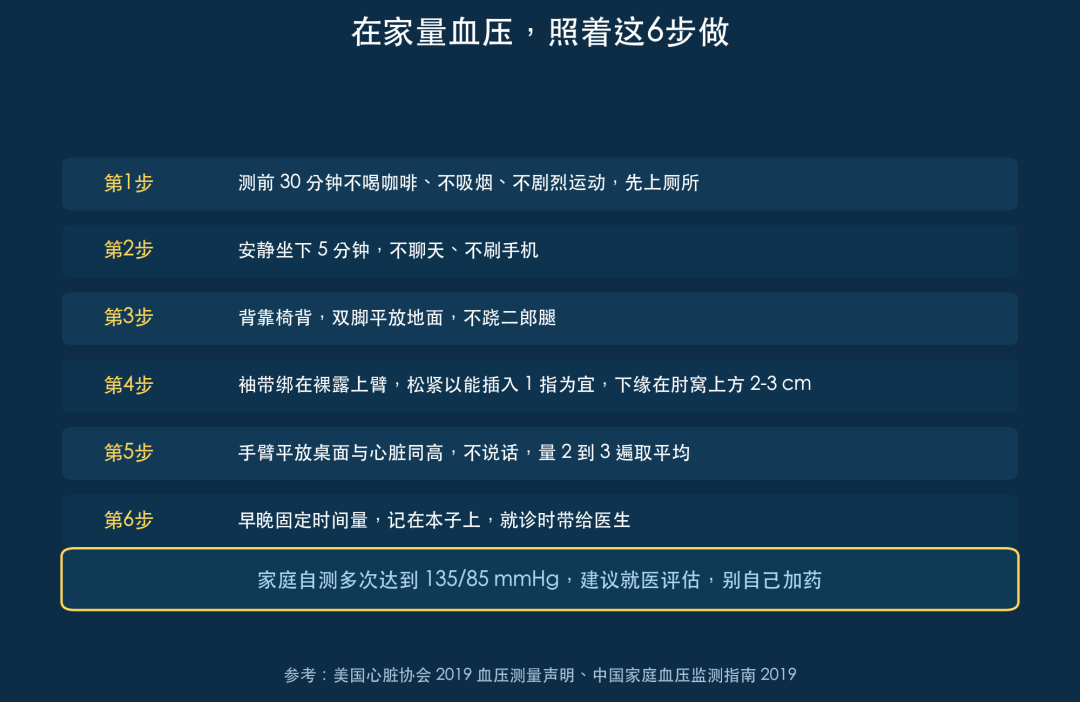
Save an image for whoever measures blood pressure at home: measure correctly first, then look at the numbers; if one reading is high, re-measure first.
If you found this helpful, give it a like or a "Wow," and feel free to leave a comment telling us what topics you'd like to see.
✦ ✦ ✦
Disclaimer: This article is for health education purposes only and is intended for informational reference; it does not constitute medical advice. If you have any health concerns, please consult a professional doctor.
Conflict of interest statement: The content of this article is based on publicly published medical literature and guidelines, and the author has no relevant conflicts of interest.
References
1. Sources of inaccuracy in the measurement of adult patients' resting blood pressure in clinical settings: a systematic review. J Hypertens. 2017;35(3):421-441. PMID:27977471
2. Measurement of Blood Pressure in Humans: A Scientific Statement From the American Heart Association. Hypertension. 2019;73(5):e35-e66. PMID:30827125
3. Seasonal blood pressure variation assessed by different measurement methods: systematic review and meta-analysis. J Hypertens. 2020;38(5):791-798. PMID:32102047
4. China Hypertension League. Chinese Guidelines for Home Blood Pressure Monitoring (2019). Chinese Circulation Journal. 2019;34(12):1135-1143.
5. Report on the Nutrition and Chronic Disease Status of Chinese Residents (2020). Issued by the National Health Commission, December 2020.
© 2026 Sun Shenghua (Beijing) Medical Technology Co., Ltd.