This article is for health education purposes only and is intended for informational reference; it does not constitute medical advice. If you have any health concerns, please consult a professional physician.
Need to Hold Your Knees to Stand Up? 4,000 People Followed for 12 Years, 42% Mortality in the Lowest-Scoring Group
Sit down cross-legged on the floor, then stand up without using your hands to push off the ground. You do this movement dozens of times a day, but you have never been scored on it.
It actually has a formal name: the sitting-rising test. The maximum score is 10 points, and the deduction rules are simple—each time you use a hand or knee for support, deduct 1 point; each time you wobble, deduct 0.5 points.
In 2026, a study with 12 years of follow-up divided 4,282 adults aged 46 to 75 into five groups based on this score, and the differences were strikingly stark[1].
In the lowest-scoring group (0 to 4 points), 42.1% of people died over the 12 years; in the full-score group of 10 points, only 3.7%. The three middle tiers were 20.4%, 11.1%, and 7.0%, respectively.
After adjusting for age, sex, body mass index, and clinical factors, the ratio of natural death risk between the lowest-scoring group and the full-score group was 3.84, and the ratio for cardiovascular death risk reached 6.05[1].
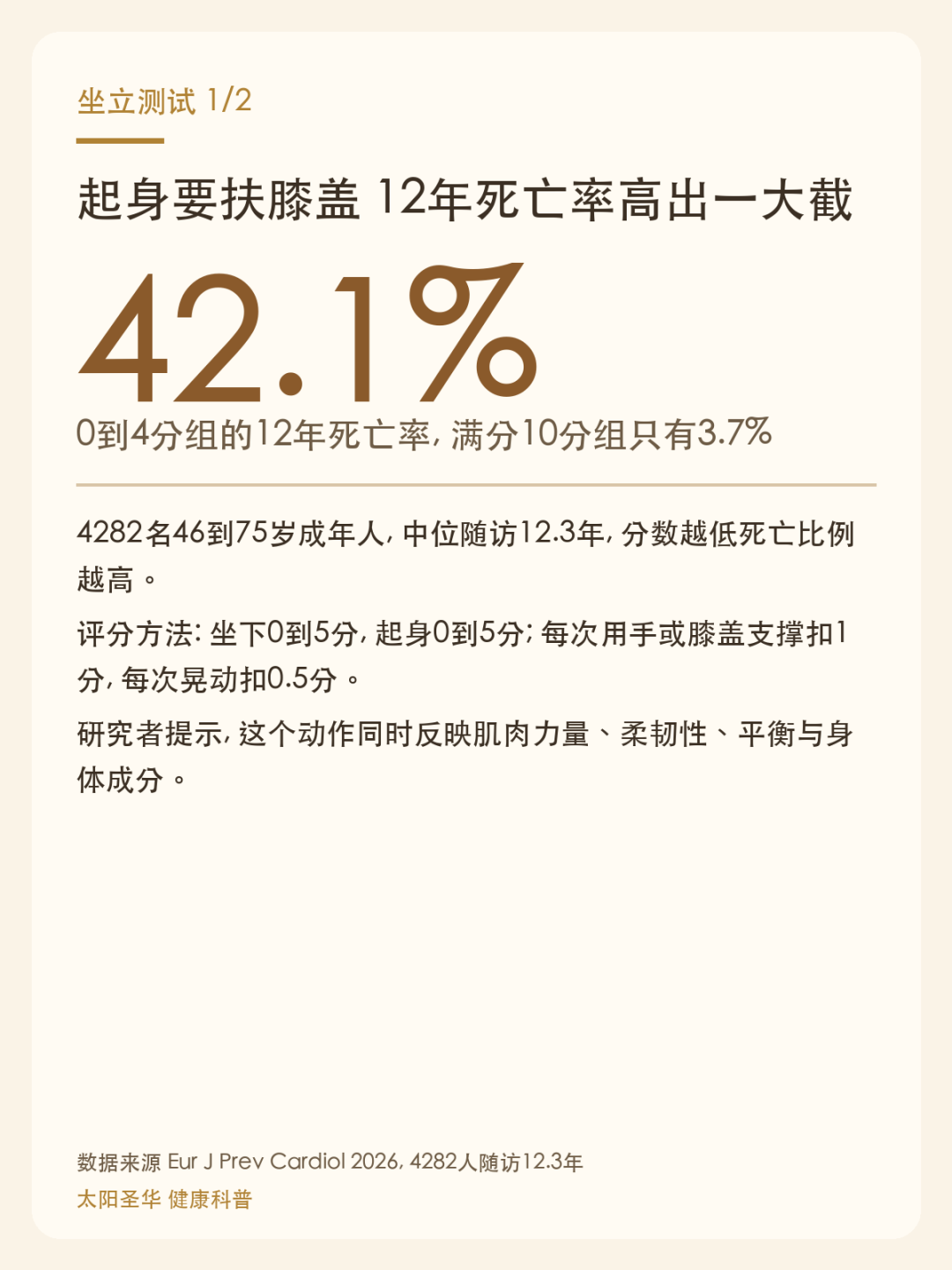
Figure caption: The lower the sitting-rising test score, the higher the mortality rate during the 12-year follow-up—42.1% in the 0 to 4 point group, 3.7% in the full-score 10 point group
1. This Score Measures More Than One Thing
The researchers emphasized that the sitting-rising test is simultaneously affected by four aspects: muscle strength and power, flexibility, balance, and body composition[1].
It is not a flexibility contest. Using a hand to push off the ground means insufficient strength; wobbling means unstable balance; being unable to get up often means the legs and glutes lack power—in a single movement, several systems are exposed at once.
2. An Older Study From 12 Years Ago Pointed in the Same Direction
A 2014 study of 2,002 people aged 51 to 80, with a median follow-up of 6.3 years, found that the lower the score, the higher the mortality rate; after adjusting for age, sex, and body mass index, the risk ratios for the four groups from low to high were 5.44, 3.44, and 1.84, respectively. For each 1-point increase in score, survival improved by about 21%[2].
The two studies are 12 years apart, with different samples and longer follow-up, yet the direction has not changed. This is more convincing than a single study.
Note: this is an observational study, which shows "correlation" and cannot directly say that "practicing this movement well will extend life."
3. A Single Indicator Is Not Enough; a Set of Indicators Is More Robust
A 2010 meta-analysis in the British Medical Journal pooled four objective measures: grip strength, walking speed, rising from a chair, and standing balance. People in the lowest quartile of grip strength had a 1.67 times higher risk of death than those in the highest quartile (14 studies, 53,476 people); those in the slowest quartile of walking speed had a 2.87 times higher risk than those in the fastest quartile (5 studies, 14,692 people)[3].
In other words, physical function is a whole, and the sitting-rising test is just one convenient window into it that requires no equipment.
4. A Low Score Is Not a Verdict; Muscle Is Use-It-or-Lose-It
A 2022 meta-analysis in a sports medicine journal (16 cohort studies) found that people who engage in muscle-strengthening activities had 10% to 17% lower risks of all-cause death, cardiovascular disease, total cancer, and diabetes; 30 to 60 minutes per week was associated with about a 10% to 20% reduction in risk, showing a J-shaped pattern[4].
On the other hand, the pooled prevalence of sarcopenia among community-dwelling older adults aged 60 and above in China was 12.9% in men and 11.2% in women, and in hospitalized populations it can rise to 29.7% in men and 23.0% in women[5]—functional decline is not rare, but it is not irreversible either.
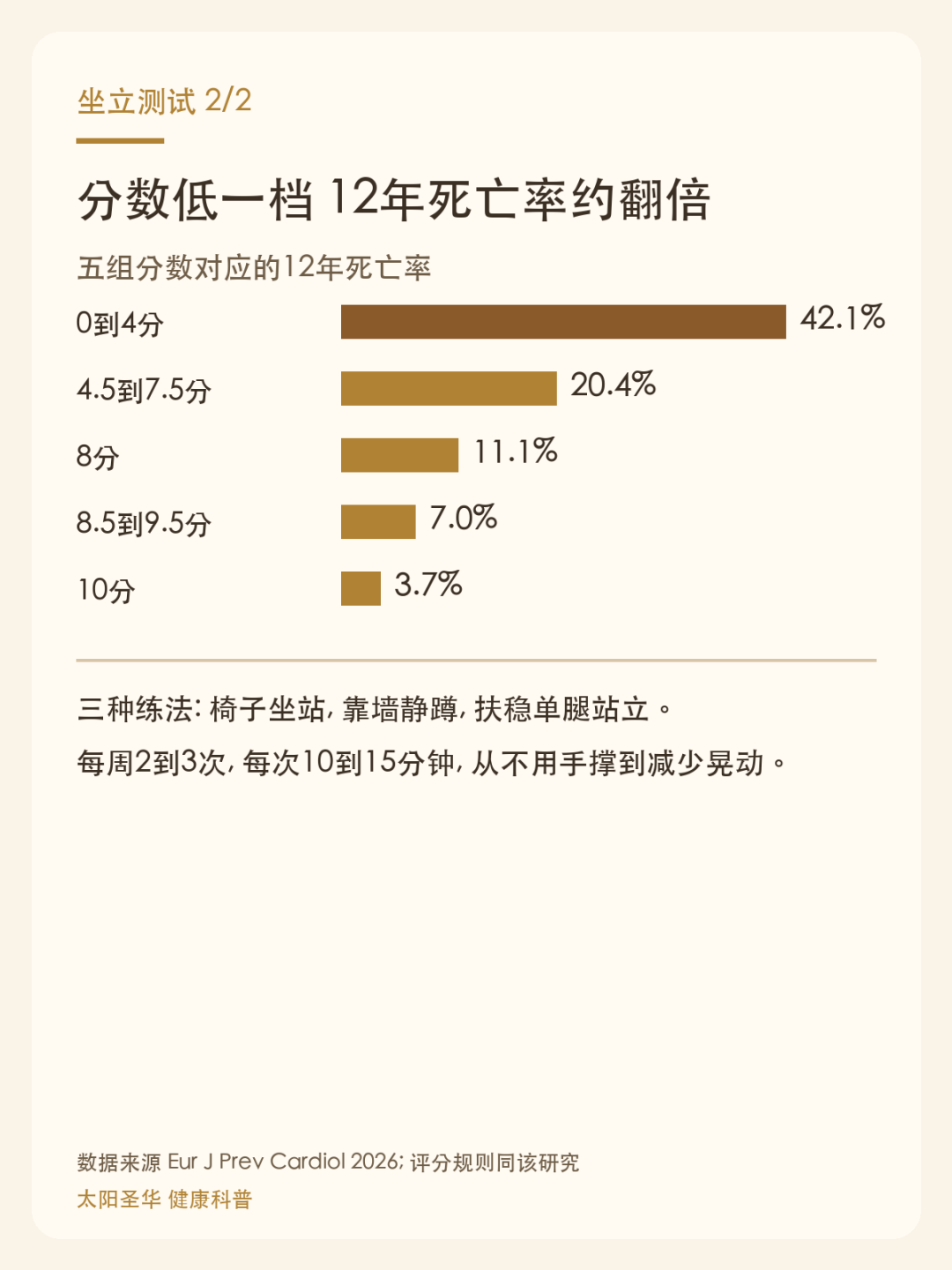
Figure caption: Scoring method for the sitting-rising test (0 to 5 points for sitting down, 0 to 5 points for rising; using a hand or knee for support deducts 1 point each, wobbling deducts 0.5 points) and three everyday practice methods
Four Things You Can Do Today
-
Try it once on the spot: barefoot, with a wall or chair nearby for safety, sit down cross-legged and stand up, and score yourself according to the rules.
-
Lower-body strength two to three times per week: chair sit-to-stand, wall sit, and single-leg standing with support; 10 to 15 minutes each time is enough[4].
-
Add a little difficulty: first practice until you no longer need hand support, then practice reducing wobbling; progress means you are on the right track.
-
Get checked if you need to: if you must hold on to get up, have knee or hip pain, recent marked weakness, or repeated falls, consider an assessment of muscle mass and fall risk[5].
⚠️ People with knee pain, balance disorders, or cardiovascular disease should not try eyes-closed or rapid rising alone at home; ask a doctor before practicing.
The score of a single movement cannot measure lifespan, but it can measure how much reserve your body still has right now. Consider saving this article and testing again in six months to compare with today's self.
If this has been helpful to you, give it a like or a "Wow," and feel free to leave a comment telling us what topics you would like to see.
✦
Disclaimer: This article is for health education purposes only and is intended for informational reference; it does not constitute medical advice. If you have any health concerns, please consult a professional physician. Conflict of interest statement: This article does not involve any drug or product recommendations and has no conflict of interest with the research institutions mentioned in the text. © 2026 Sunshenghua (Beijing) Medical Technology Co., Ltd.
References
-
Araújo CGS, de Souza E Silva CG, Myers J, et al. Sitting-rising test scores predict natural and cardiovascular causes of deaths in middle-aged and older men and women. Eur J Prev Cardiol. 2026;33(12):2170-2178. PMID: 40569873
-
Brito LB, Ricardo DR, Araújo DS, et al. Ability to sit and rise from the floor as a predictor of all-cause mortality. Eur J Prev Cardiol. 2014;21(7):892-898. PMID: 23242910
-
Cooper R, Kuh D, Hardy R; Mortality Review Group. Objectively measured physical capability levels and mortality: systematic review and meta-analysis. BMJ. 2010;341:c4467. PMID: 20829298
-
Momma H, Kawakami R, Honda T, Sawada SS. Muscle-strengthening activities are associated with lower risk and mortality in major non-communicable diseases: a systematic review and meta-analysis of cohort studies. Br J Sports Med. 2022;56(13):755-763. PMID: 35228201
-
Chen Z, Li WY, Ho M, Chau PH. The Prevalence of Sarcopenia in Chinese Older Adults: Meta-Analysis and Meta-Regression. Nutrients. 2021;13(5):1441. PMID: 33923252