This article is for health education purposes only and is intended for informational reference; it does not constitute medical advice. If you have any health concerns, please consult a professional doctor.
✦ ✦ ✦
Have you been trying to lose weight for a long time without success? Don't rush to blame your willpower. In 2024, a review summarizing 45 studies and covering approximately 9.88 million people was published in The BMJ: the more highly processed a food is, the more it is associated with an increased risk of health problems [2]. More intuitive evidence comes from a 20-person inpatient experiment—with meals matched almost identically and participants allowed to eat as much as they wanted, during the two weeks when they were switched to "ultra-processed foods," participants ate an average of 508 extra kcal per day and gained nearly 1 kg [1].
✦ ✦ ✦
1. Where did the 508 kcal come from?
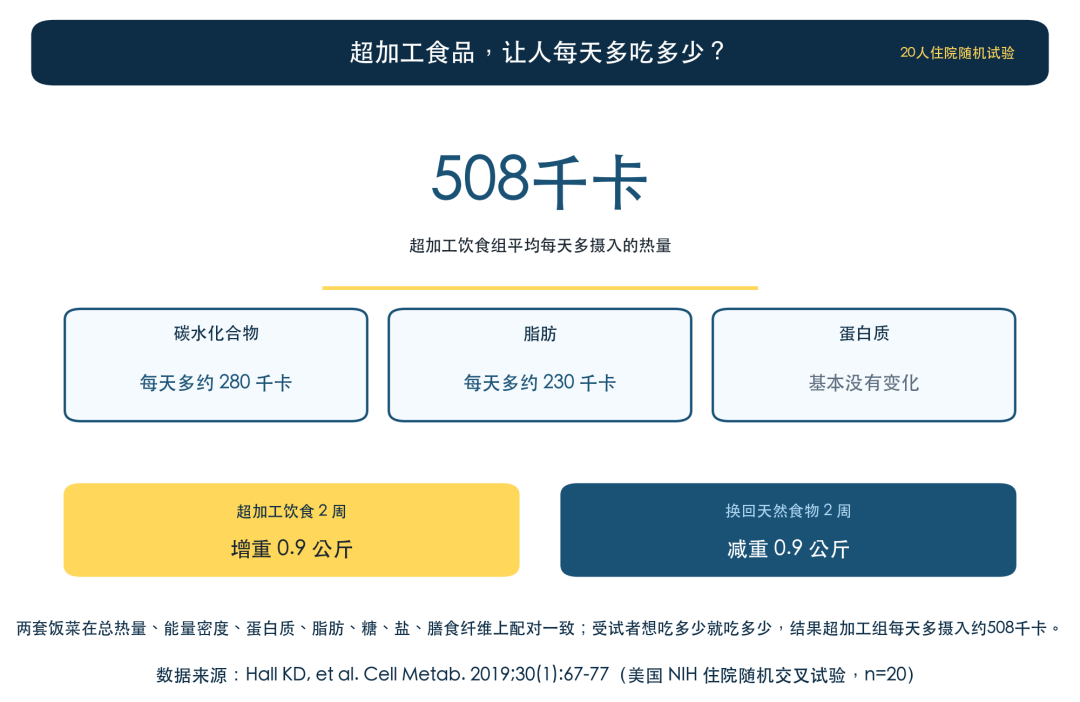
This experiment was conducted by a team from the U.S. National Institutes of Health (NIH): 20 adults with excess weight were hospitalized for 4 weeks. They first randomly ate either an ultra-processed diet or an unprocessed diet for two weeks, then crossed over to the other group [1]. The two sets of meals were matched almost identically for calories, energy density, protein, fat, sugar, salt, and dietary fiber; the main difference was the degree of processing—participants were instructed to "eat as much as they wanted."
The results were surprising: during the two weeks on ultra-processed foods, they consumed an average of 508 more kcal per day and gained an average of 0.9 kg over the two weeks; after switching back to a diet based mainly on natural foods, their daily intake decreased by about 508 kcal and their weight dropped by 0.9 kg [1].
Where did the extra calories come from? Breaking it down: about 280 more kcal per day from carbohydrates and about 230 more kcal from fat, while protein intake barely changed (a difference of only about 2 kcal per day) [1]. In other words, what ultra-processed foods make people eat more of is mainly sugar and oil—they are energy-dense and slow to make you feel full, so you eat more and more without realizing it.
Why does this happen? The researchers observed that ultra-processed foods tend to be softer in texture and easier to swallow quickly, and eating speed is noticeably faster; in addition, the combination of high sugar and high oil brings greater "palatability," so the brain's reward signals can easily override satiety signals. With these two factors combined, the body has not yet registered "full" before the calories are already in [1].
2. First, clarify: what counts as "ultra-processed food"?
In nutrition, the NOVA classification is commonly used to divide foods into four levels according to degree of processing:
- Unprocessed or minimally processed: vegetables, fruits, meat, eggs, milk, rice, flour, legumes—only washed, cut, frozen, or simply cooked.
- Processed culinary ingredients: salt, sugar, oil, honey, etc.
- Processed foods: made from these ingredients, such as canned fish, cheese, and artisan bread; the ingredient list is generally all recognizable.
- Ultra-processed foods: industrially formulated products, usually made from sugar, oil, and salt plus various additives, ready to eat straight from the package.
Milk tea, carbonated drinks, potato chips, biscuits, instant noodles, ham sausages, luncheon meat, ice cream, and candy basically all belong to ultra-processed foods. In daily life, there is a simple way to judge: if the ingredient list has more than five lines, or contains ingredients you would not use in your own kitchen—margarine, shortening, various gums, emulsifiers, colorants, sweeteners—be more cautious.
To be clear first: ultra-processed does not mean "toxic," and eating it occasionally is fine; the problem is that when it makes up the bulk of your three meals a day, the costs gradually show up.
3. What does long-term consumption cost the body?
First, look at the pooled data: the 2024 BMJ review summarized 45 meta-analyses and found that higher intake of ultra-processed foods was directly associated with an increased risk of 32 types of health problems [2]. Among those with stronger evidence grading were: a 50% higher risk of cardiovascular death (hazard ratio 1.50, 95% CI 1.37-1.63) and type 2 diabetes (dose-response hazard ratio 1.12, 95% CI 1.11-1.13); highly suggestive associations included all-cause mortality (hazard ratio 1.21, 95% CI 1.15-1.27), obesity (odds ratio 1.55, 95% CI 1.36-1.77), and depression (hazard ratio 1.22), among others [2].
The direction of individual large cohorts is also consistent: a French cohort of 105,000 people followed for about 5 years found that for every 10-percentage-point increase in the proportion of ultra-processed foods in the diet, cardiovascular disease risk was about 12% higher [3]; a Spanish cohort of nearly 20,000 people found that those who ate more than 4 servings of ultra-processed foods per day had a 62% higher risk of all-cause mortality than those who ate the least, and each additional serving was associated with about an 18% increase in risk [4].
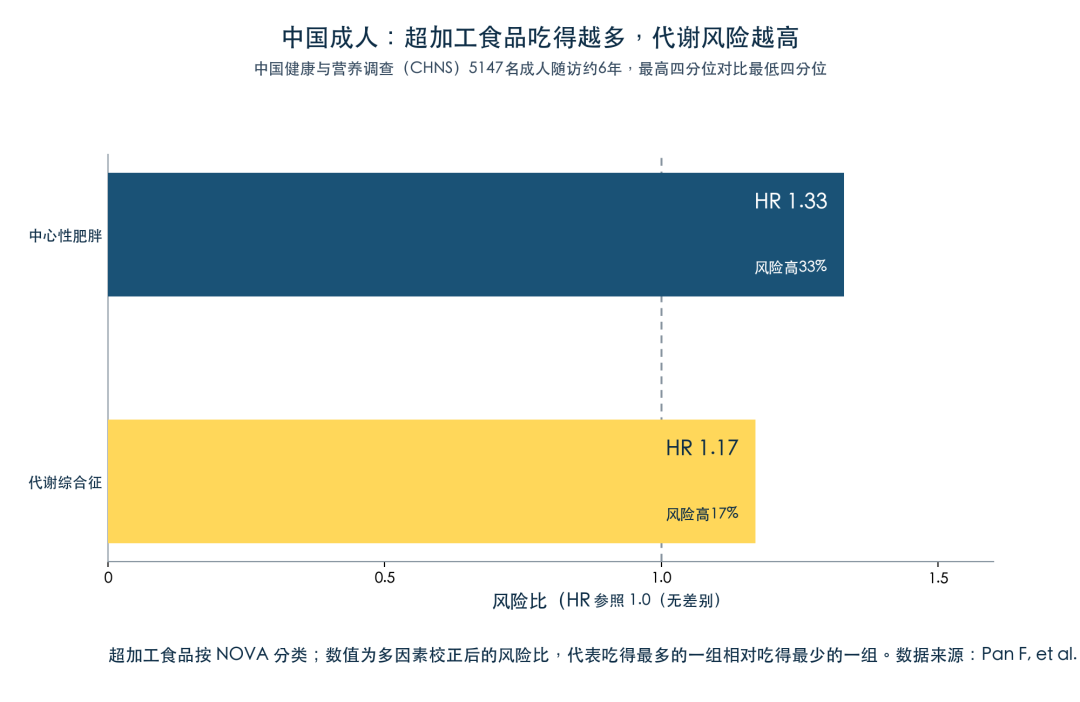
China's own data are consistent as well: a follow-up of 5,147 adults in the China Health and Nutrition Survey for about 6 years showed that those who ate the most ultra-processed foods had a 17% higher risk of metabolic syndrome (hazard ratio 1.17) and a 33% higher risk of central obesity (hazard ratio 1.33) [5]; another survey covering more than 38,000 Chinese adults found that the more ultra-processed foods consumed, the higher the risk of overweight and obesity, especially among women and residents of small and medium-sized cities, while sugar-sweetened beverages are a common source of ultra-processed foods among Chinese adults [6].
To be fair: most of the above are observational studies, and "association" does not equal "inevitable causation," and the quality of evidence is mostly moderate to low; however, the direction is highly consistent across different countries and populations, and the inpatient experiment has already shown that an ultra-processed diet directly leads to eating more [1]—there is ample reason to put it on the list for weight loss and chronic disease prevention and control.
4. Want to eat less? Start with 1 serving a day
You don't have to quit everything all at once—start by swapping out the "big offenders":
- Replace sugary drinks and milk tea with water or weak tea—beverages are the category of ultra-processed foods most likely to be consumed "every day"[6];
- Replace potato chips and cookies with plain nuts and fruit;
- Replace ham sausages and luncheon meat with eggs, chicken breast, or home-braised beef;
- Replace instant noodles with oatmeal plus an egg, or whole-wheat steamed buns with milk;
- Replace cake and ice cream with unsweetened yogurt and fruit. The Chinese Dietary Guidelines also recommend no more than 50 grams of added sugar per day, and keeping it under 25 grams is even better[7].
How to do it specifically: First, spend three days recording how many servings of ultra-processed foods you eat each day, then cut out 1 serving per week, starting with the easiest to replace, such as sugary drinks. Here, "1 serving" doesn't need a precise definition—it's roughly one packaged unit such as a bag of potato chips, a bottle of a beverage, or one ham sausage. Don't aim for perfection in one step; the goal is to gradually bring natural foods back to the table.
One-sentence action tip
Next time you shop at the supermarket, turn the package over and count the ingredients list—if it has more than five lines, put it back on the shelf first. Share this swap list with family and friends who rely on milk tea and snacks to "keep going" every day, and save it to make the swaps gradually.
If this has been helpful to you, give it a like or a "Wow," and feel free to leave a comment telling us what topics you'd like to see.
✦ ✦ ✦
Disclaimer: This article is compiled based on publicly available academic literature and is intended only as health science popularization reference; it does not constitute medical advice. For individual circumstances, please consult a professional doctor.
Conflict of interest statement: The author has no conflicts of interest with the studies mentioned in this article.
© 2026 Sun Shenghua (Beijing) Medical Technology Co., Ltd.
References
- Hall KD, et al. Ultra-Processed Diets Cause Excess Calorie Intake and Weight Gain: An Inpatient Randomized Controlled Trial of Ad Libitum Food Intake. Cell Metab. 2019;30(1):67-77.e3. PMID:31105044
- Lane MM, et al. Ultra-processed food exposure and adverse health outcomes: umbrella review of epidemiological meta-analyses. BMJ. 2024;384:e077310. PMID:38418082
- Srour B, et al. Ultra-processed food intake and risk of cardiovascular disease: prospective cohort study (NutriNet-Santé). BMJ. 2019;365:l1451. PMID:31142457
- Rico-Campà A, et al. Association between consumption of ultra-processed foods and all cause mortality: SUN prospective cohort study. BMJ. 2019;365:l1949. PMID:31142450
- Pan F, et al. Association between Ultra-Processed Food Consumption and Metabolic Syndrome among Adults in China—Results from the China Health and Nutrition Survey. Nutrients. 2023;15(3):752. PMID:36771458
- Pan F, et al. Ultra-Processed Food Consumption and Risk of Overweight or Obesity in Chinese Adults: Chinese Food Consumption Survey 2017-2020. Nutrients. 2023;15(18):4005. PMID:37764788
- Chinese Dietary Guidelines (2022). Chinese Nutrition Society. Beijing: People's Medical Publishing House; 2022.