This article is for general health education and informational purposes only. It does not constitute medical advice; please consult a professional doctor if you have any health concerns.
Why is it that some people lose weight easily while others gain more the harder they try? The problem usually isn't willpower—it's method. These 5 "weight-loss truisms" that almost everyone believes may be the very reason you keep rebounding[[1-5]].
✦ ✦ ✦
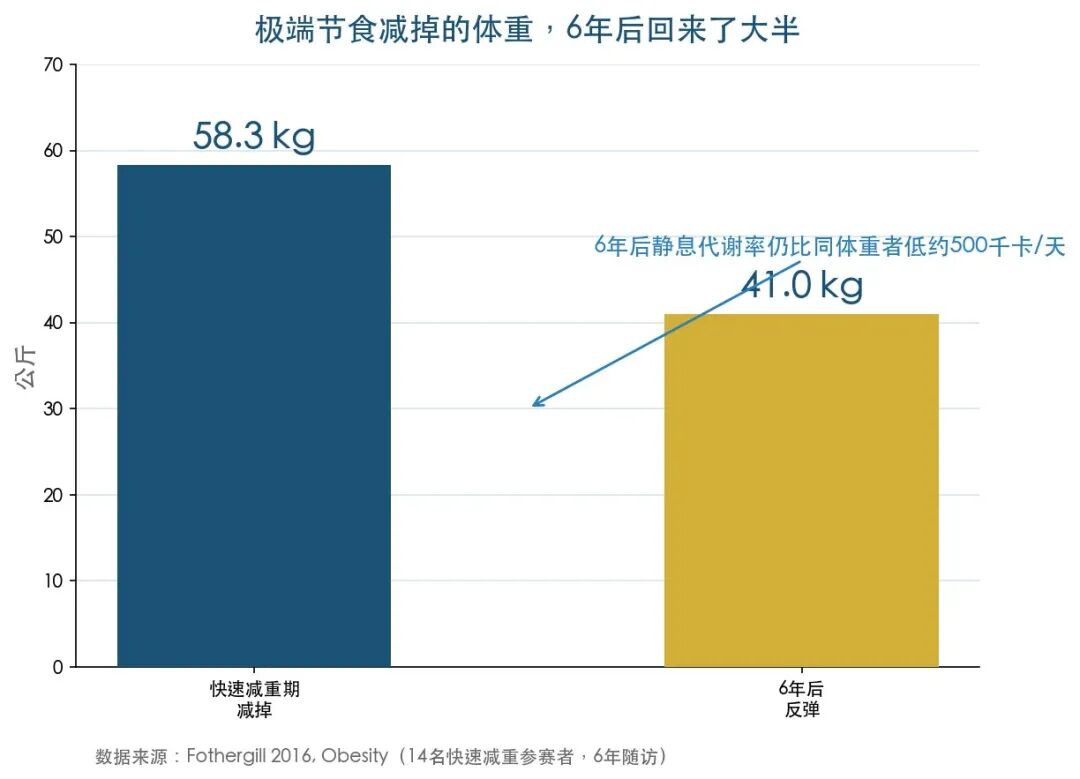
First, some sobering data: 14 contestants on a US weight-loss reality show lost an average of 58.3 kg through extreme calorie restriction and high-intensity training. Six years later, they had regained an average of 41 kg, and their resting metabolic rate was still about 500 kcal/day lower than that of people at the same body weight—once the body has been "scared hungry," it stays in power-saving mode for the long haul[[1]].
❌ Myth 1: The less you eat, the faster you lose weight
Extreme calorie restriction does make the scale drop quickly, but what you lose is often water and muscle, while the body kicks off "metabolic adaptation": leptin drops, ghrelin rises, and resting metabolic rate falls[[1]]. Once you return to normal eating, rebound is almost inevitable.
✅ What to do instead: Create a daily calorie deficit of 300-500 kcal (roughly equal to eating one-third less at each meal), but don't go below your basal metabolic rate. At the same time, make sure you get enough protein and do strength training to preserve muscle—muscle is a major calorie burner.
❌ Myth 2: The more you sweat, the more fat you burn
Sweat is mostly water. How much you sweat depends on temperature, humidity, and individual constitution—it has no direct relationship to how many calories you've burned. You sweat just sitting still in summer, but that doesn't mean you're burning fat.
✅ What to do instead: Measure exercise by "time multiplied by intensity," not by how much you sweat. Aim for 150 minutes of moderate-intensity aerobic activity per week (at an intensity where you can talk but can't sing) plus 2 strength-training sessions. Reviews show that exercise alone typically produces only 2-3 kg of weight loss; its real value lies in preventing rebound and benefiting cardiovascular health[[2]].
❌ Myth 3: 100 sit-ups a day will slim your belly
"Spot reduction"—losing fat only where you train—is one of the biggest myths in the weight-loss world. Fat mobilization is systemic; working a certain area doesn't mean you'll lose fat there. In a randomized controlled trial, 24 women did abdominal exercises 5 days a week for 6 weeks, and their abdominal fat did not decrease significantly[[3]].
✅ What to do instead: Belly fat must be reduced through full-body exercise (brisk walking, jogging, swimming) combined with a calorie deficit. Sit-ups can build abdominal muscle definition, but only after your body fat percentage comes down first.
❌ Myth 4: You must give up staple foods to lose weight
Carbs are not the enemy—cutting them out is. A 12-month randomized controlled trial of 609 people published in JAMA found that the low-carb group lost an average of 6.0 kg and the low-fat group lost 5.3 kg, a difference that was not statistically significant[[4]]. What determines success isn't "what you cut out" but total calories and whether you can stick with it long-term.
✅ What to do instead: You don't need to give up staple foods—just switch to "half whole grains" (oats, brown rice, mixed beans), one fist-sized portion per meal. This keeps you full and stabilizes blood sugar.
❌ Myth 5: If the scale doesn't move, your weight loss has failed
It's normal for weight to fluctuate 1-2 kg within a single day: water, sodium, and glycogen all make the number jump around, and fat loss can be "masked" by water retention. A systematic review showed that people who weigh themselves regularly (at least once a week) actually do better at losing weight and preventing rebound[[5]].
✅ What to do instead: Weigh yourself at a fixed time (such as in the morning on an empty stomach) and look at the weekly average trend. Don't let a single day's number hold you hostage.
✦ ✦ ✦
Losing weight isn't about being hard on yourself—it's about finding a lifestyle you can stick with for life. Flip those 5 myths around, and you have 5 shortcuts.
Consider sharing this with family and friends who are trying to lose weight, and save this "myth self-check list."
If you found this helpful, feel free to hit "Like" or "Wow," and leave a comment telling us what topics you'd like to see.
✦ ✦ ✦
References
-
Fothergill E, et al. Persistent metabolic adaptation 6 years after "The Biggest Loser" competition. Obesity (Silver Spring). 2016;24(8):1612-1619. PMID: 27136388.
-
Swift DL, et al. The effects of exercise and physical activity on weight loss and maintenance. Prog Cardiovasc Dis. 2018;61(2):206-213. PMID: 30003901.
-
Vispute SS, et al. The effect of abdominal exercise on abdominal fat. J Strength Cond Res. 2011;25(9):2559-2564. PMID: 21804427.
-
Gardner CD, et al. Effect of low-fat vs low-carbohydrate diet on 12-month weight loss in overweight adults and the association with genotype pattern or insulin secretion: the DIETFITS randomized clinical trial. JAMA. 2018;319(7):667-679. PMID: 29466592.
-
Zheng Y, et al. Self-weighing in weight management: a systematic literature review. Obesity (Silver Spring). 2015;23(2):256-265. PMID: 25521523.
Disclaimer: This article is based on publicly published scientific research and is for reference only. It does not constitute any medical advice or product recommendation. Individual circumstances vary; please consult a professional doctor if you have any health concerns.
Conflict of Interest Statement: The author has no financial relationship with any of the studies or institutions mentioned in this article.
© 2026 Sun Saint Hua (Beijing) Medical Technology Co., Ltd.