This article is for health education purposes only and is intended for informational reference. It does not constitute medical advice; if you have health concerns, please consult a professional physician.
Running vs. Lifting Weights: Which Extends Life More? The Answer Isn't Either/Or
Gyms have had two camps for years. The running camp says cardio is the main event for fat loss; the lifting camp says muscle is the metabolic engine.
After all these years of debate, the data actually gave us an answer long ago—it's just that this answer isn't on the bathroom scale.
First, a set of rather uncomfortable numbers. The Cleveland Clinic tracked 122,007 adults who underwent treadmill testing, with an average follow-up of 8.4 years. Those in the lowest quartile of fitness had a mortality risk 5.04 times that of the top fitness group (top 2.3%); while smoking was 1.41 times, diabetes 1.40 times, and coronary heart disease 1.29 times[3]. In other words, poor fitness is a heavier burden than many of the risk factors we dread most.
So here's the question: what raises fitness—running, or lifting weights?
1. On the Scale Alone: Cardio Wins the First Round
A 2013 network meta-analysis of 15 randomized controlled trials involving 741 overweight or obese individuals compared three training approaches: aerobic only, strength only, and combined[6].
The result: after 8+ weeks of training, aerobic exercise reduced 1.15 kg more body weight, 1.15 kg more fat mass, and 1.10 cm more waist circumference than strength training[6].
So the claim that "running drops weight faster" holds up on the scale. For those who like watching the numbers go down, choosing cardio is no injustice.
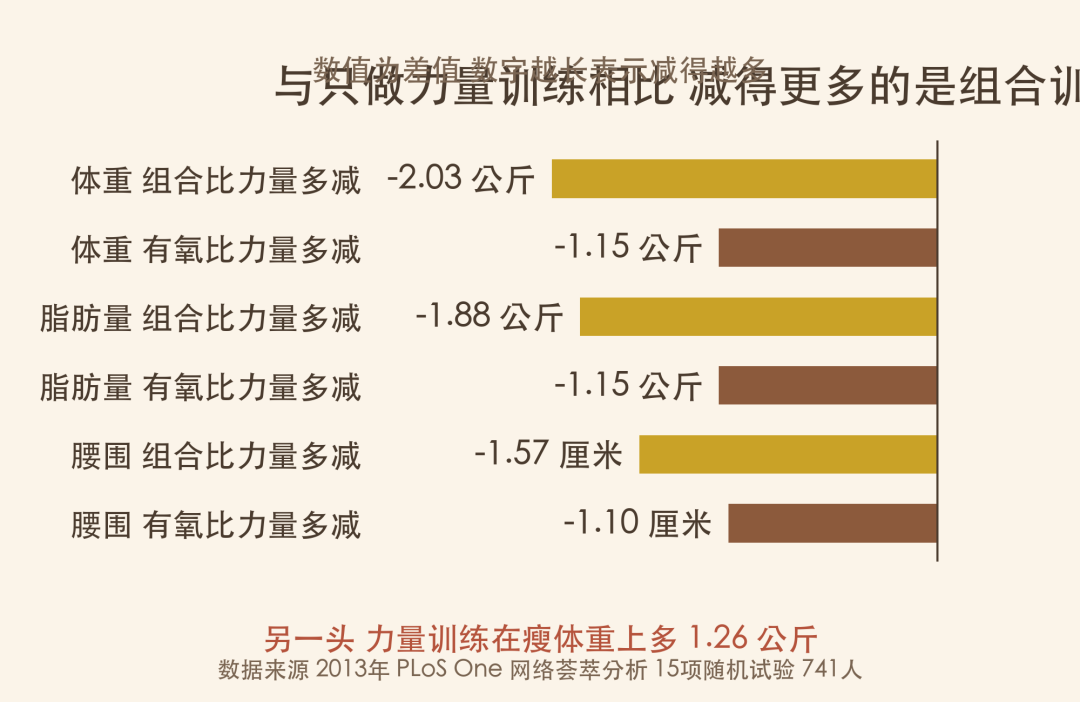
Figure 1: Differences among the three training approaches across 15 randomized trials—combined training reduced more body weight, fat mass, and waist circumference, while strength training won on lean body mass
2. But Weight Isn't Everything: Strength Wins on the Other End
In the same study, strength training beat aerobic exercise on lean body mass (muscle and other fat-free mass) by 1.26 kg[6].
1.26 kg doesn't sound like much, but it determines something else: whether you'll still be able to stand up from a chair on your own when you're old.
US NHANES data included 4,449 adults aged 50 and older. After follow-up, researchers found: people with low muscle strength had significantly higher mortality risk—even when their muscle mass was completely normal, the odds ratio (OR) was still 2.66; for those with both low muscle mass and low strength, the OR was 2.03 to 2.53[5].
In other words, muscle that "looks like enough" doesn't mean "is enough"—and strength is something cardio can't build.
3. Cardiorespiratory Fitness Is the Bigger Leg
Back to that 5.04-fold number. It compares "cardiorespiratory fitness"—the oxygen uptake capacity measured by treadmill testing, primarily improved through aerobic exercise[3].
The study's conclusion: cardiorespiratory fitness is inversely associated with long-term mortality risk, and no ceiling of benefit was observed—the fitter you are, the lower the risk, even among people over 70 with hypertension[3].
Don't be scared off by "running ruins your knees": what actually harms knees is excess body weight combined with sudden increases in volume, not running itself.
4. The Dose of Strength Training Is Lower Than You Think
Many people don't lift because they think it requires living at the gym. A 2022 British Journal of Sports Medicine review pooled 16 prospective cohort studies: muscle-strengthening activities were associated with a 10% to 17% lower risk of all-cause mortality, cardiovascular disease, total cancer, and diabetes[1].
More importantly, the dose-response curve: risk reductions for all-cause mortality, cardiovascular disease, and total cancer followed a J-shape—with the greatest reduction at roughly 30 to 60 minutes per week, about 10% to 20%, and doing more did not continue to add benefit[1].
30 to 60 minutes per week, split into two sessions of 15 to 30 minutes each. This threshold is far lower than most people imagine.
5. For Blood Sugar, the Three Approaches Barely Differ
If you're exercising to control blood sugar, this debate becomes even more unnecessary. A 2006 Diabetes Care meta-analysis pooled 27 controlled trials with 1,003 type 2 diabetes patients: aerobic, strength, and combined training showed negligible differences in improving glycated hemoglobin; with 12+ weeks of adherence, the overall average reduction was about 0.8 percentage points[4].
The study also noted that for other risk factors such as blood lipids, combined training was generally superior to either alone[4].
6. Together—That's the Real Answer
Back to that meta-analysis of 15 trials: combined training reduced 2.03 kg more body weight, 1.88 kg more fat mass, and 1.57 cm more waist circumference than strength training alone[6]. This was the group with the greatest reductions among the three approaches.
The same holds for mortality risk. A pooled analysis of over 80,000 UK adults showed: those who met only the strength training guideline (2 times/week) had an all-cause mortality hazard ratio of 0.79; those who met only the aerobic guideline (150 minutes/week of moderate intensity) had 0.84; those who met both had a hazard ratio of 0.71[2].
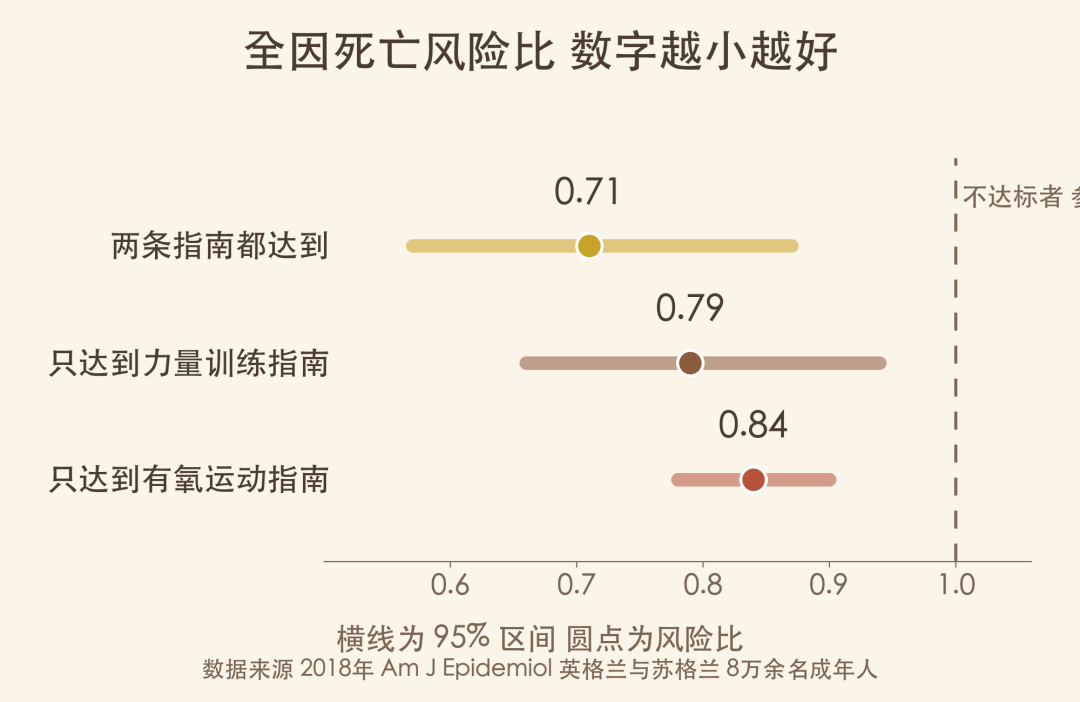
Figure 2: The gap in all-cause mortality hazard ratios between doing one type vs. both—the group meeting both guidelines had the lowest risk
Doing just one gets you 70% to 80% of the benefit; doing both gets you close to a 30% risk reduction. That's the full meaning of "not either/or."
A Plan You Can Start Today
-
Aerobic: 150 minutes/week: Brisk walking, jogging, cycling, swimming all count. The intensity standard is "can talk, can't sing." Splitting into 20 to 30 minutes per day is easier to sustain.
-
Strength: 2 times/week, 15 to 30 minutes each: Bodyweight squats, wall sits, push-ups, resistance band rows, glute bridges—cover legs, back, chest, and core at least once each. You can start without equipment.
-
Cardio first, then strength: When doing both in the same session, put strength first to avoid poor form from fatigue.
-
Increase only one notch per week: Whether it's mileage or weight, only add a little more than last week. Increase too fast, and your knees and lower back will protest first.
-
Get assessed first if you have old injuries: If you have known issues with knees, lumbar spine, or heart, see a doctor or rehabilitation specialist first to establish your exercise boundaries—don't force yourself through someone else's plan.
Remember in one sentence: fat loss takes the cardio road, anti-aging takes the strength road, and longevity needs people walking on both.
Consider sharing this with that friend who "only runs" or "only lifts," and bookmark it too—refer back to it next time you plan your training.
If this was helpful, give it a like or a "reading" mark, and feel free to leave a comment telling us what topics you'd like to see.
✦ ✦ ✦
Disclaimer: This article is for health education purposes only and is intended for informational reference. It does not constitute medical advice; the data cited come from publicly published research. For individual exercise plans, please follow the advice of a professional physician or rehabilitation specialist.
Conflict of interest statement: This article does not involve any drug, device, or course recommendations, and has no financial relationship with the research institutions mentioned.
© 2026 Sunshenghua (Beijing) Medical Technology Co., Ltd.
References
[1] Momma H, Kawakami R, Honda T, Sawada SS. Muscle-strengthening activities are associated with lower risk and mortality in major non-communicable diseases: a systematic review and meta-analysis of cohort studies. Br J Sports Med. 2022;56(13):755-763. PMID: 35228201
[2] Stamatakis E, Lee IM, Bennie J, et al. Does Strength-Promoting Exercise Confer Unique Health Benefits? A Pooled Analysis of Data on 11 Population Cohorts With All-Cause, Cancer, and Cardiovascular Mortality Endpoints. Am J Epidemiol. 2018;187(5):1102-1112. PMID: 29099919
[3] Mandsager K, Harb S, Cremer P, et al. Association of Cardiorespiratory Fitness With Long-term Mortality Among Adults Undergoing Exercise Treadmill Testing. JAMA Netw Open. 2018;1(6):e183605. PMID: 30646252
[4] Snowling NJ, Hopkins WG. Effects of different modes of exercise training on glucose control and risk factors for complications in type 2 diabetic patients: a meta-analysis. Diabetes Care. 2006;29(11):2518-2527. PMID: 17065697
[5] Li R, Xia J, Zhang XI, et al. Associations of Muscle Mass and Strength with All-Cause Mortality among US Older Adults. Med Sci Sports Exerc. 2018;50(3):458-467. PMID: 28991040
[6] Schwingshackl L, Dias S, Strasser B, Hoffmann G. Impact of different training modalities on anthropometric and metabolic characteristics in overweight/obese subjects: a systematic review and network meta-analysis. PLoS One. 2013;8(12):e82853. PMID: 24358230