Intermittent Fasting vs. Small Frequent Meals: 139 People Over 12 Months, Only 1.8 kg Difference in Weight
This article is for health education purposes only and is intended for informational reference. It does not constitute medical advice; if you have health concerns, please consult a professional physician.
With the same calorie deficit, one approach packs three meals into an 8-hour window, while the other splits calories into five or six smaller meals eaten slowly.
Supporters of each camp have their own theories: one side says extending fasting time can trigger cellular autophagy, while the other says small frequent meals support metabolism and make it less likely you'll lose control from hunger.
A randomized controlled trial that ran for 12 months with 139 participants put these two approaches head-to-head under the same calorie deficit.
After 12 Months, the Two Groups Differed by 1.8 kg — But It Doesn't Count
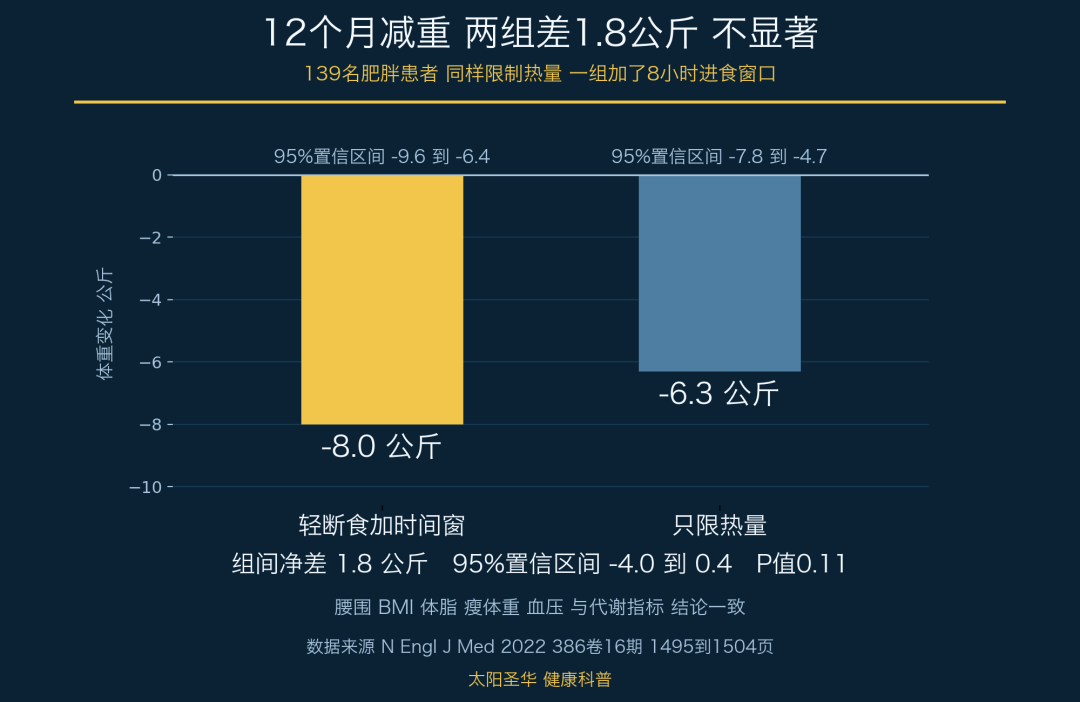
This 2022 study in the New England Journal of Medicine came from a team at Southern Medical University. 139 patients with obesity were randomly divided into two groups: one group ate only between 8 AM and 4 PM each day while restricting calories; the other group restricted calories only, with no time limit. Both groups followed the same dietary standards — 1500 to 1800 kcal per day for men and 1200 to 1500 kcal per day for women.
After 12 months, the time-window group lost an average of 8.0 kg, while the calorie-restriction-only group lost 6.3 kg. The net difference between groups was 1.8 kg, with a 95% confidence interval of -4.0 to 0.4 and a P value of 0.11.
Statistically, this difference is not significant — meaning that adding that 8-hour window did not bring any extra benefit. Conclusions were consistent across waist circumference, BMI, body fat, lean mass, blood pressure, and various metabolic indicators [1].
Adding a Time Window Doesn't Make Weight Loss Any Faster
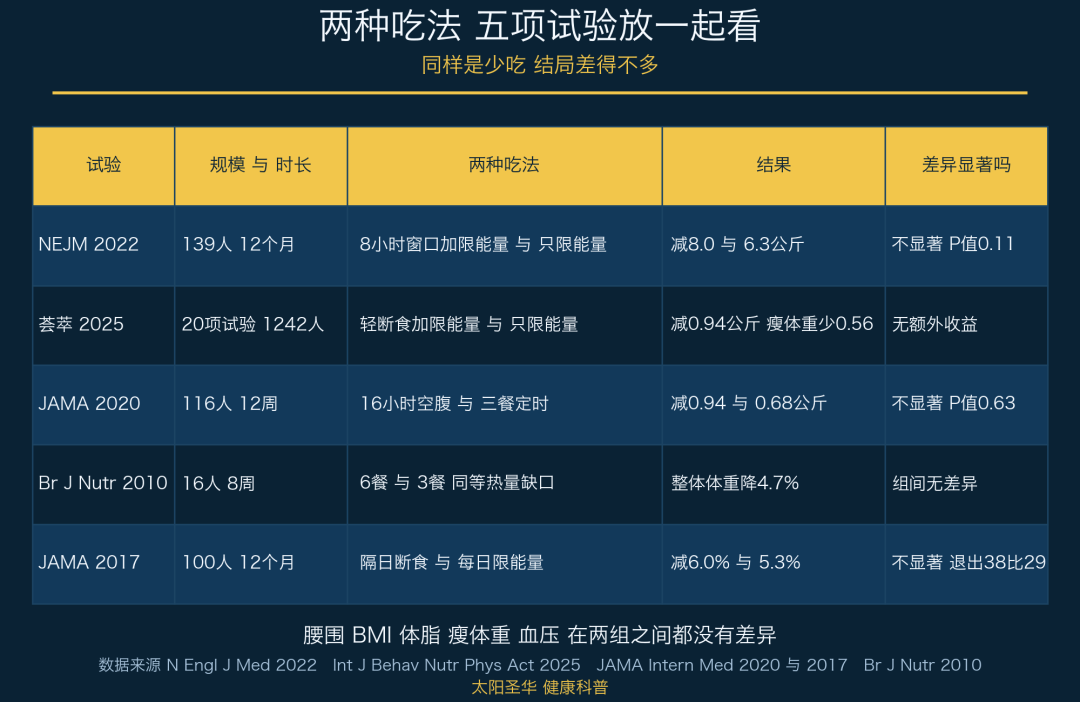
A 2025 meta-analysis of 20 randomized controlled trials with 1242 participants put it even more plainly: intermittent fasting used alone produced an average weight loss of 1.59 kg; when combined with calorie restriction, weight loss was 0.94 kg, with lean mass also decreasing by 0.56 kg. The authors concluded that intermittent fasting combined with calorie restriction offers no additional weight-loss benefit [2].
In other words, the pathway through which intermittent fasting works is not burning more fat, but compressing the eating window so that some people naturally eat less.
On the Small Frequent Meals Side, the Metabolic Bonus Also Doesn't Hold Up
The widely circulated claim about small frequent meals is that eating more often boosts metabolism and makes it harder to store fat. A 2015 meta-analysis in Nutrition Reviews examined 15 studies. Initial data suggested that higher eating frequency was associated with greater fat loss, but sensitivity analysis found that this positive result was carried by a single study and did not hold up once it was removed. The authors' conclusion was cautious: evidence is insufficient as to whether increasing meal frequency truly benefits body composition [3].
Another randomized controlled trial came from the University of Ottawa. Sixteen adults with obesity, under the same daily calorie deficit of about 700 kcal, were assigned to either three meals a day or three meals plus three snacks, for 8 weeks. Overall body weight decreased by 4.7%, and fat mass decreased by about 3.1 kg, with no differences between the two groups in fat indicators, hunger, or the gut hormones PYY and ghrelin [4].
The Real Difference Between the Two Approaches Is Whether You Can Stick With It
The 12-week, 116-participant TREAT trial offered another perspective: the intermittent fasting group lost 0.94 kg, the three-structured-meals group lost 0.68 kg, with a between-group difference of 0.26 kg and a P value of 0.63 — still not significant; recorded energy intake also did not differ between the two groups. However, the intermittent fasting group showed a more pronounced decrease in appendicular lean mass index, with a between-group difference of 0.16 kg per square meter and a P value of 0.005. This suggests that when the time window is too tight and protein intake is insufficient, what you lose isn't just fat [5].
What better illustrates how important adherence is, is a long-term alternate-day fasting trial. 100 adults with obesity were followed for 12 months. The alternate-day fasting group lost 6.0% at month 12, while the daily calorie restriction group lost 5.3% — the difference was not significant. But the dropout rate in the alternate-day fasting group reached 38%, compared with 29% in the daily calorie restriction group and 26% in the control group. Moreover, the alternate-day fasting group's LDL cholesterol was 11.5 mg per dL higher than that of the daily calorie restriction group [6].
How to Choose: Look at When You Lose Control
-
Prone to overeating at night: Move your eating window earlier, have dinner earlier, and stop eating 3 hours before bed — this is usually more effective than white-knuckling it.
-
Shaky, palpitations, and scattered attention when hungry: Keep three meals, and swap snacks for protein — for example, a cup of unsweetened yogurt or an egg.
-
High exercise volume and want to preserve muscle: Spread protein across 3 to 4 eating occasions, 25 to 30 grams per meal — don't cram all your protein into one meal.
-
Currently taking glucose-lowering drugs or insulin, pregnant or breastfeeding, history of eating disorders, stomach conditions: Do not attempt prolonged fasting on your own; ask your doctor first.

One Thing You Can Do Today
Don't pick a camp yet. For 3 consecutive days, record: what you ate, what time you ate, and how full you felt. After estimating your total daily calories, set your deficit at 300 to 500 kcal, then decide whether to achieve that deficit by skipping a meal or by eating a little less at each meal.
When weighing yourself, look only at the trend: weigh once a week on a fixed day, in the morning on an empty stomach, in the same clothing, and watch the change over 4 consecutive weeks. Single-day numbers are affected by water and salt and have limited reference value.
Weight loss is rarely won by picking the right camp — it's about taking the one you can stick with and doing it for a full 12 months. Feel free to share this with a friend who's torn between intermittent fasting and small frequent meals.
If this article was helpful to you, give it a like or a "reading" — and feel free to leave a comment telling us what topics you'd like to see.
Disclaimer: This article is for health education purposes only and is intended for informational reference. It does not constitute medical advice; if you have health concerns, please consult a professional physician.
Conflict of interest statement: This article does not involve any drug or product recommendations and has no conflicts of interest with the research institutions mentioned in the text.
© 2026 Sunsheng Hua (Beijing) Medical Technology Co., Ltd.
References
[1] Liu D, Huang Y, Huang C, et al. Calorie Restriction with or without Time-Restricted Eating in Weight Loss. N Engl J Med. 2022;386(16):1495-1504. PMID: 35443107
[2] Sun Y, Liu Y, Ye W, et al. Efficiency of time-restricted eating and energy restriction on anthropometrics and body composition in adults: a systematic review and meta-analysis of randomized controlled trials. Int J Behav Nutr Phys Act. 2025;22(1):121. PMID: 41034862
[3] Schoenfeld BJ, Aragon AA, Krieger JW. Effects of meal frequency on weight loss and body composition: a meta-analysis. Nutr Rev. 2015;73(2):69-82. PMID: 26024494
[4] Cameron JD, Cyr MJ, Doucet E. Increased meal frequency does not promote greater weight loss in subjects who were prescribed an 8-week equi-energetic energy-restricted diet. Br J Nutr. 2010;103(8):1098-1101. PMID: 19943985
[5] Lowe DA, Wu N, Rohdin-Bibby L, et al. Effects of Time-Restricted Eating on Weight Loss and Other Metabolic Parameters in Women and Men With Overweight and Obesity: The TREAT Randomized Clinical Trial. JAMA Intern Med. 2020;180(11):1491-1499. PMID: 32986097
[6] Trepanowski JF, Kroeger CM, Barnosky A, et al. Effect of Alternate-Day Fasting on Weight Loss, Weight Maintenance, and Cardioprotection Among Metabolically Healthy Obese Adults: A Randomized Clinical Trial. JAMA Intern Med. 2017;177(7):930-938. PMID: 28459931