This article is for health education purposes only and is intended for informational reference; it does not constitute medical advice. If you have health concerns, please consult a professional doctor.
"Can skipping dinner help you lose weight?" "Is eating five meals a day more likely to help you lose weight than three?" Every few months, the weight-loss world argues another round about "how to eat."
The truth is: what determines whether you lose weight is first and foremost total calories; but your eating window and frequency affect whether you can stick with it, and whether you lose fat or muscle.
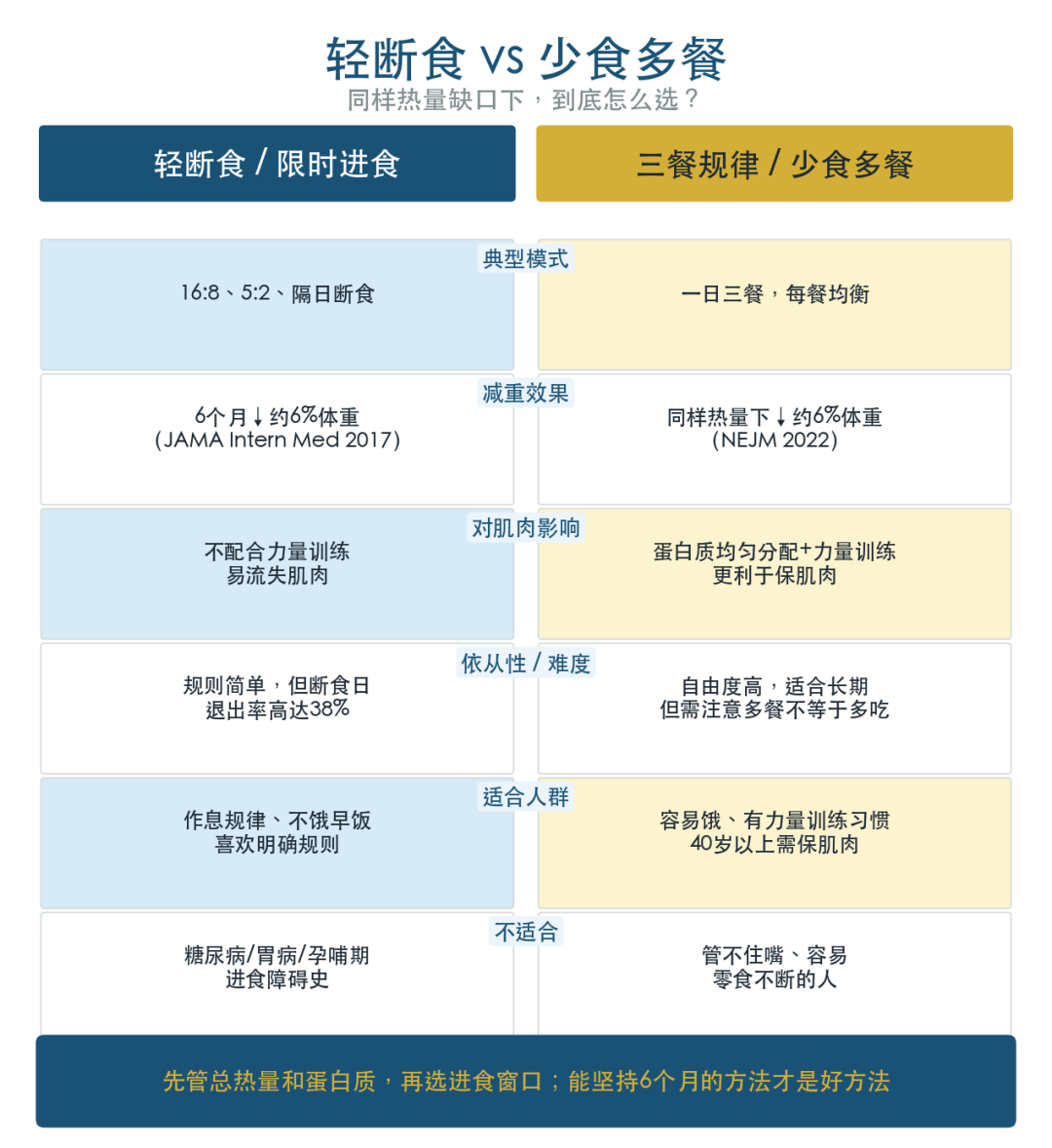
A 2017 randomized trial published in JAMA Internal Medicine divided 100 obese adults into two groups: one group followed alternate-day fasting (eating only 25% of calories one day, then eating freely the next), while the other group followed continuous daily calorie restriction. After 6 months, the two groups had similar weight loss (about 6%), but the dropout rate in the alternate-day fasting group was as high as 38%, significantly higher than in the daily restriction group[[1]].
In 2022, the New England Journal of Medicine published a 12-month randomized trial of 139 people: the calorie restriction alone group lost 6.3 kg, while the calorie restriction plus 8-hour time-restricted eating group lost 8.0 kg—the difference did not reach statistical significance[[2]]. In other words, the extra weight-loss effect from "when you eat" is far less important than "how much you eat."
✦ ✦ ✦
✦ ✦ ✦
1. Intermittent fasting: who is it for? Where are the pitfalls?
Common patterns include 16:8 (finish eating within 8 hours each day) and 5:2 (two very-low-calorie days per week). Its advantage is that the rules are simple and you do not have to calculate every meal, making it friendly to people who "do not have time to micromanage their eating."
But the TREAT trial published in JAMA Internal Medicine found that 16:8 time-restricted eating, without deliberate calorie control, did not bring significant additional weight loss, and even showed a trend toward mild muscle loss[[3]]. A 2025 BMJ network meta-analysis also pointed out that various intermittent fasting patterns differ little in weight-loss effects, and adherence is the key variable[[4]].
Who it suits: people with a regular routine, who can accept a fixed eating window, and who do not enjoy breakfast.
Caution: on fasting days, people easily overeat revenge-style during the "open eating" period; people with diabetes, those who are pregnant or breastfeeding, and those with a history of eating disorders are not advised to try it on their own.
✦ ✦ ✦
2. Eating small frequent meals / regular three meals: who is it for? Where are the pitfalls?
The theory behind "eating small frequent meals" is to stabilize blood sugar and avoid excessive hunger. But the research evidence is inconsistent: for ordinary dieters, as long as total calories are the same, whether you eat 3 meals or 6 meals a day makes very little difference to body weight.
Its real advantage is preserving muscle. A 2026 systematic review in Nutrition Reviews pointed out that distributing protein evenly across three meals (25-30 grams of high-quality protein per meal), combined with strength training, is more beneficial for maintaining lean body mass than "eating all your protein for the day in one meal"[[5]]. For people over 40 whose muscle mass is already declining, this point is important.
Who it suits: people who get hungry easily, have large blood sugar fluctuations, have a strength training habit, and middle-aged and older adults who need to preserve muscle.
Caution: "small meals" is the premise—many people turn "more meals" into "more food," with snacks, nuts, and fruit one bite after another, and if total calories exceed the limit, they will still gain weight.
✦ ✦ ✦
3. How to choose? Look at these three points
-
See whether you can stick with it for more than 6 months. In all successful weight-loss trials, the method with the highest adherence is the best method. If you hate going to bed hungry at night, do not force yourself through 16:8; if you do not like counting calories, simple time rules may actually be more useful.
-
See whether you are doing strength training. People who do strength training 2-3 times a week should prioritize regular three meals plus maximizing protein at each meal to reduce muscle loss; people who only do aerobic exercise or do not exercise can use either approach, but should first ensure a total calorie deficit.
-
See your health status. With diabetes, hypoglycemia, stomach disease, or pregnancy/breastfeeding, do not fast on your own; consult a doctor or dietitian first.
✦ ✦ ✦
One-sentence action advice
Do a small test this week: choose 3 days and record everything you eat and the approximate calories. You will find that the impact of "when you eat" is far smaller than that of "what you eat and how much you eat." First manage total calories and protein well, then talk about the eating window.
Weight loss is not about finding the most painful method and sticking with it, but about finding the method that is least painful for you and doing it long term.
If this content has been helpful to you, feel free to hit "Like" or "Wow," and also feel free to leave a comment telling us which approach you have tried.
✦ ✦ ✦
References
-
Trepanowski JF, Kroeger CM, Barnosky A, et al. Effect of alternate-day fasting on weight loss, weight maintenance, and cardioprotection among metabolically healthy obese adults: a randomized clinical trial. JAMA Intern Med. 2017;177(7):930-938. PMID: 28459931.
-
Liu D, Huang Y, Huang C, et al. Calorie restriction with or without time-restricted eating in weight loss. N Engl J Med. 2022;386(16):1495-1504. PMID: 35443107.
-
Lowe DA, Wu N, Rohdin-Bibby L, et al. Effects of time-restricted eating on weight loss and other metabolic parameters in women and men with overweight and obesity: the TREAT randomized clinical trial. JAMA Intern Med. 2020;180(11):1491-1499. PMID: 32986097.
-
Patikorn C, Hadfield G, Huawei X, et al. Intermittent fasting strategies and their effects on body weight and other cardiometabolic risk factors: systematic review and network meta-analysis. BMJ. 2025;389:e080814. PMID: 40533200.
-
Comparison of different intermittent fasting patterns or different extents of calorie restriction for weight loss and metabolic improvement. Nutr Rev. 2026;84(3):477-493. PMID: 40367516.
© 2026 Sun Saint Hua (Beijing) Medical Technology Co., Ltd.