Frost's Descent Nourishment: Bone Broth Can't Restore Collagen, and Vitamin C Can't Stop Colds
This article is for health education purposes only and is intended as general information; it does not constitute medical advice. If you have health concerns, please consult a professional doctor.
Around Frost's Descent, once the weather turns cold, social media feeds change overnight: clay pots of bone broth, queue numbers outside hot pot restaurants, vitamin C on pharmacy counters.
"Autumn and winter nourishment" is a ritual woven into daily life. But what to nourish with and how—many people's answers come from their elders' experience, not from data.
We dug up several widely circulated nourishment practices to see what the evidence actually says.
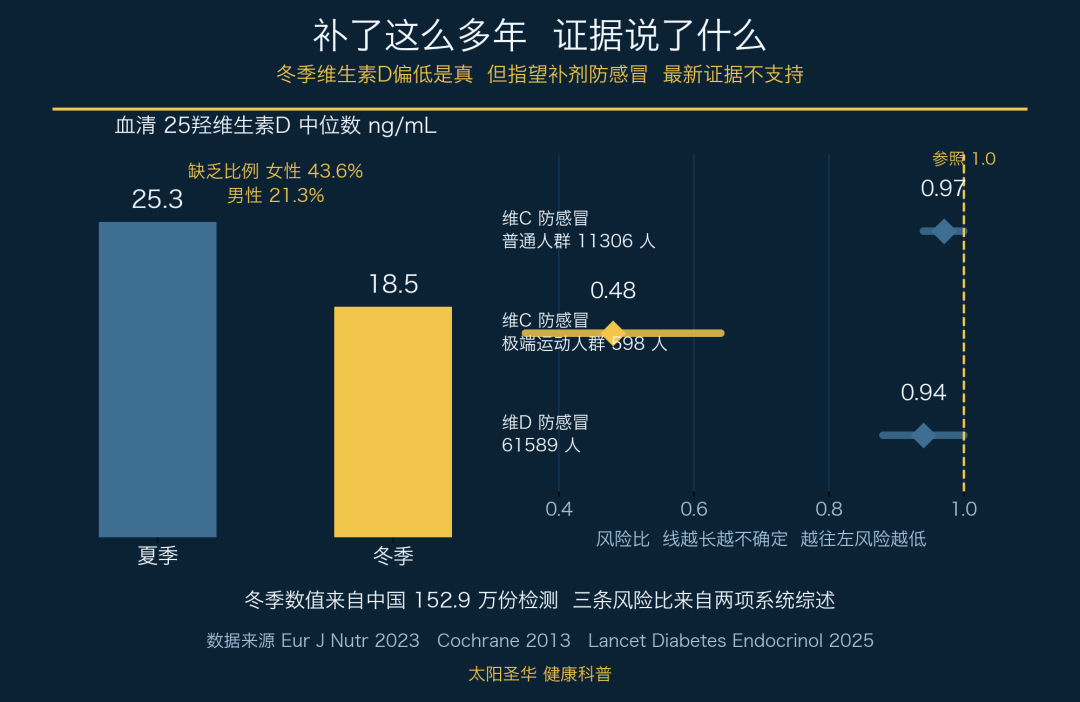
A 2025 update in The Lancet Diabetes & Endocrinology published a meta-analysis on vitamin D and respiratory infections: pooling 40 randomized controlled trials with 61,589 participants. The conclusion was that, compared with placebo, vitamin D supplementation had an infection risk ratio of 0.94, 95% confidence interval 0.88 to 1.00, p value 0.057—not statistically significant[1].
In other words, the long-circulated advice to "take some vitamin D in winter to prevent colds" doesn't hold up well against larger, newer evidence. The four sections below break down common nourishment practices one by one.
1. Bone Broth for Collagen: Good Soup, Not Enough of It
Simmer for four or five hours until the broth turns milky white—many believe this means "the collagen has been stewed out."
A 2019 study in the International Journal of Sport Nutrition and Exercise Metabolism quantified this: researchers made bone broth according to a standardized recipe, and also collected commercial products and samples simmered fresh at coffee shops, measuring 6 amino acids related to collagen synthesis. The result: bone broth made with the standard recipe had significantly lower levels of these amino acids than the 20-gram collagen supplement used as a reference in the study; and there was wide variation between different recipes[3].
The soup is fine to drink—warming and tasty—but if the goal is collagen, it's hard to get enough from a bowl of soup.
2. Vitamin C for Cold Prevention: May Shorten Duration Slightly, but Prevention Is a Stretch
Vitamin C is a staple on the nourishment list. A Cochrane systematic review pooled 29 trial comparisons with 11,306 participants: routine vitamin C supplementation in the general population yielded a cold risk ratio of 0.97, 95% confidence interval 0.94 to 1.00—essentially no difference[2].
What did make a difference was a small group of special people: 598 marathon runners, skiers, and polar-training soldiers—under extreme physical exertion, the risk ratio dropped to 0.48[2].
So is vitamin C completely useless? Not exactly. In the same review, long-term supplementation shortened cold duration by 8% in adults and 14% in children; in children taking 1 to 2 grams daily, duration was shortened by 18%[2].
So don't pop effervescent tablets every day for prevention; if you catch a cold and want to try shortening its course, the cost is low and the risk is small.
3. Vitamin D Is Worth Taking—but Not for Cold Prevention
Winter really is the low season for vitamin D.
A study covering 30 provinces in China, spanning 3 consecutive years and 1.529 million serum 25-hydroxyvitamin D tests, showed: median concentration was 25.3 ng/mL in summer but only 18.5 ng/mL in winter; using the cutoff adopted in that study, deficiency rates were 21.3% in men and 43.6% in women[4].
So there are good reasons to supplement vitamin D in winter—bone and muscle function both need it. Just don't tie "taking vitamin D" to "preventing colds"—the latest evidence doesn't support that expectation[1].
4. Drinking Rich Broth Like Water: Umami Is Real, So Are Purines
Why is umami broth so savory? Researchers quantified 18 purine compounds in three types of stock—chicken, clear soup, and bonito—and the most abundant was inosine monophosphate[5].
In cell experiments, adding chicken broth raised both intracellular and extracellular uric acid and guanosine levels[5].
For healthy people this isn't a problem; but for those with elevated uric acid or a history of gout, drinking rich broth like water is not a good idea: soup is soup, water is water.
5. The Real Cost of Nourishment: That Half-Jin of Meat Follows You Into Next Year
The data is blunt. 195 adults were weighed throughout the year: average weight gain during the 6-to-8-week holiday period was 0.37 kg; by February–March of the following year, net gain compared with September–October of the prior year was 0.48 kg; by the following autumn, that 0.48 kg had essentially not come off[6].
That extra half-jin in autumn and winter is very likely not "nourishment" but fat—and it has no plans to leave on its own.
Three Things You Can Do Today
-
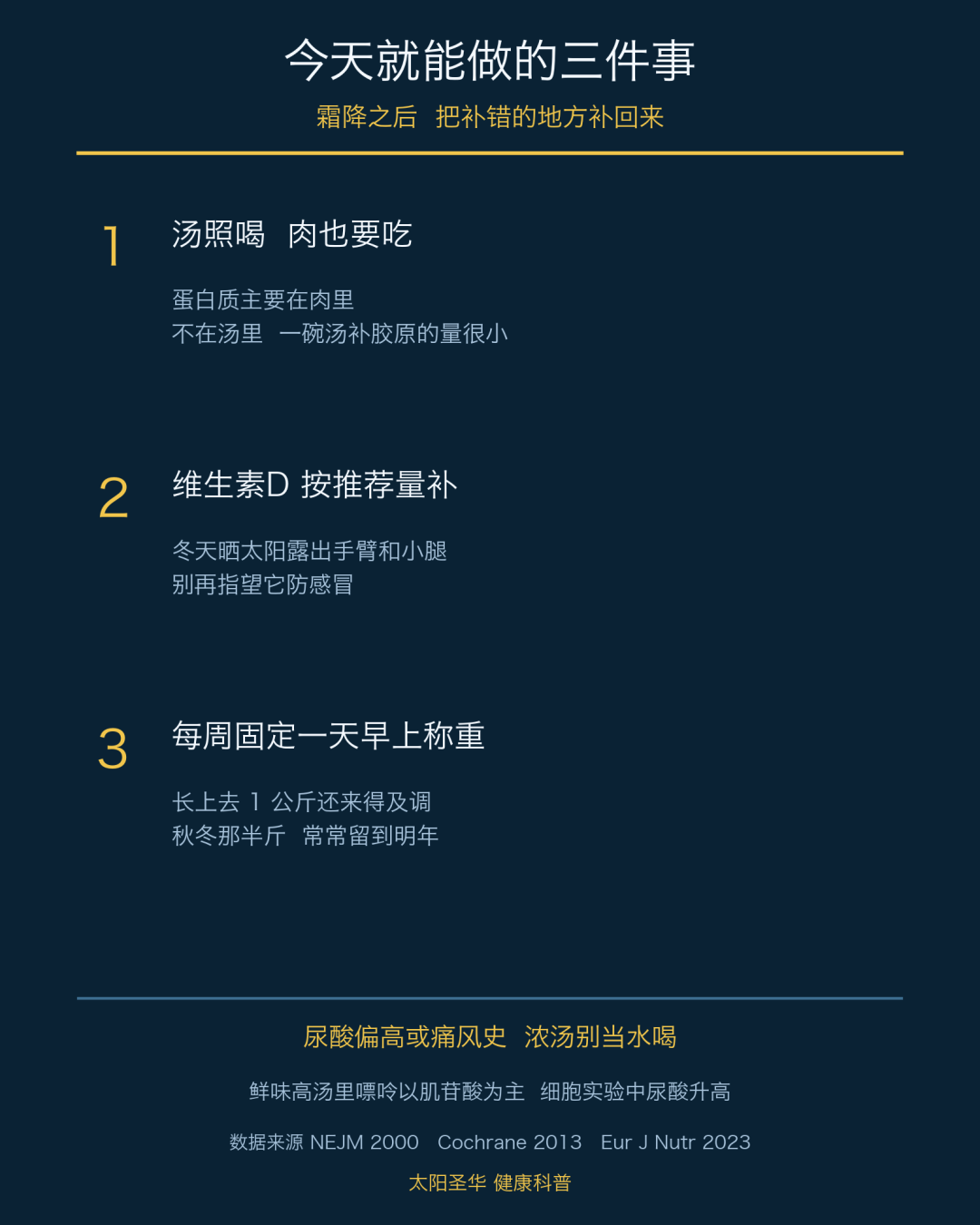
Keep drinking the soup, but eat the meat too. Protein is mainly in the meat, not the broth[3].
-
Take vitamin D at the recommended dose; sunlight on exposed arms and lower legs is a better deal. But stop expecting it to prevent colds[1][4].
-
Weigh yourself every week on a fixed morning. Numbers are more reliable than feelings—if you've gained 1 kg, there's still time to adjust[6].
Nourishment isn't about eating more calories—it's about replenishing the few things you're lacking.
Share this with whoever at home is simmering soup: the recipe doesn't have to change, but the mindset is worth revisiting.
If you found this helpful, give it a like or a "reading" click, and feel free to leave a comment telling us what topics you'd like to see.
Disclaimer: This article is for health education purposes only and is intended as general information; it does not constitute medical advice. If you have health concerns, please consult a professional doctor.
Conflict of interest statement: This article does not involve any drug or supplement recommendations and has no financial relationship with the research institutions mentioned.
© 2026 Sunshenghua (Beijing) Medical Technology Co., Ltd.
References
[1] Jolliffe DA, Camargo CA Jr, Sluyter JD, et al. Vitamin D supplementation to prevent acute respiratory infections: systematic review and meta-analysis of stratified aggregate data. Lancet Diabetes Endocrinol. 2025;13(4):307-320. PMID: 39993397
[2] Hemilä H, Chalker E. Vitamin C for preventing and treating the common cold. Cochrane Database Syst Rev. 2013;2013(1):CD000980. PMID: 23440782
[3] Alcock RD, Shaw GC, Burke LM. Bone Broth Unlikely to Provide Reliable Concentrations of Collagen Precursors Compared With Supplemental Sources of Collagen Used in Collagen Research. Int J Sport Nutr Exerc Metab. 2019;29(3):265-272. PMID: 29893587
[4] Bai K, Dong H, Liu L, et al. Serum 25-hydroxyvitamin D status of a large Chinese population from 30 provinces by LC-MS/MS measurement for consecutive 3 years: differences by age, sex, season and province. Eur J Nutr. 2023;62(3):1503-1516. PMID: 36692589
[5] Fukuuchi T, Iyama N, Yamaoka N, Kaneko K. Simultaneous quantification by HPLC of purines in umami soup stock and evaluation of their effects on extracellular and intracellular purine metabolism. Nucleosides Nucleotides Nucleic Acids. 2018;37(5):273-279. PMID: 29652211
[6] Yanovski JA, Yanovski SZ, Sovik KN, Nguyen TT, O'Neil PM, Sebring NG. A prospective study of holiday weight gain. N Engl J Med. 2000;342(12):861-867. PMID: 10727591