Drinking 500ml of Water Before Meals: Lose 1.3 kg More in 12 Weeks?
This article is for general health education and informational purposes only. It does not constitute medical advice. If you have health concerns, please consult a healthcare professional.
"Can drinking water help you lose weight?" It sounds like pseudoscience, but a randomized controlled trial has actually tested it. Today, we'll answer 5 common questions to clarify the "drink water before meals" approach.
✦ ✦ ✦
Q1: Does drinking water before meals really help people lose more weight?
Yes, and there's RCT evidence.
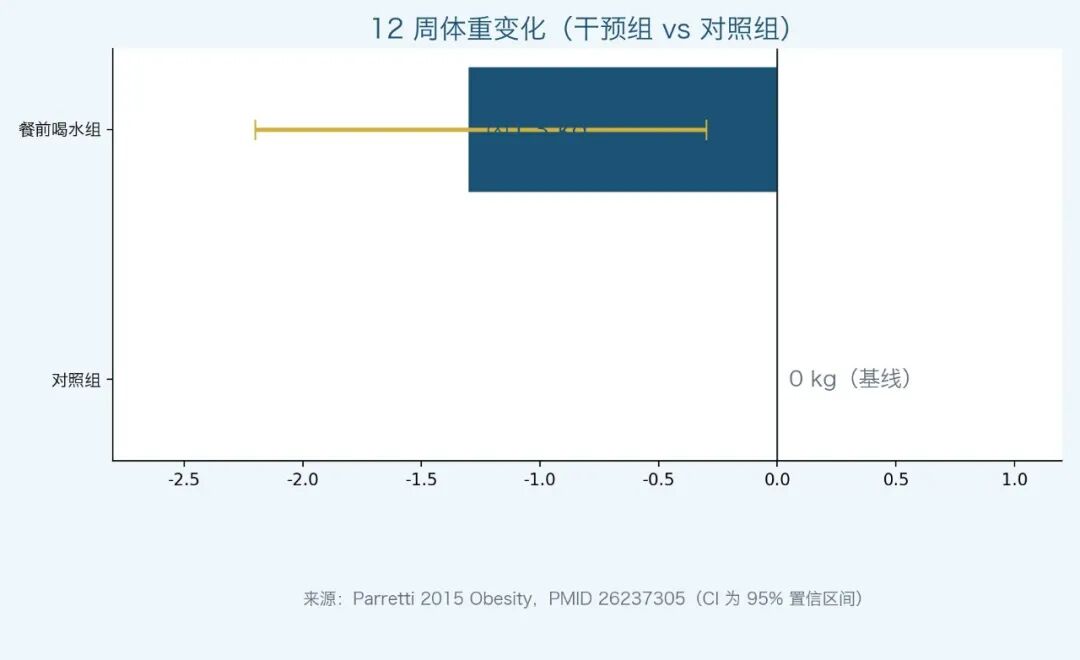
A randomized controlled trial at the University of Birmingham in the UK found: 84 obese adults were randomly divided into two groups. The intervention group drank 500ml of water 30 minutes before every main meal, while the control group did an attention-training exercise imagining their stomachs were full. After 12 weeks, the water-drinking group lost 1.3 kg more than the control group (95% CI -2.4 to -0.1, P=0.028) [[1]].
1.3 kg doesn't sound like much? Keep in mind this is the "difference between the two groups," and it's the pure effect of drinking water alone—with no added dieting or exercise. As a free bonus tool, that's a pretty good return.
Q2: Why does it work? Is water just "filling up space" in the stomach?
The mechanism is more than just "filling up space." Multiple studies suggest that drinking 500ml of water before meals can:
-
Acutely reduce hunger, decreasing energy intake during the meal [[2]];
-
Be especially pronounced in middle-aged and older adults—fullness signals arrive earlier, so they naturally eat less [[2]];
-
Replacing sugary drinks or snacks with a zero-calorie liquid is itself a net calorie reduction.
Simply put: water isn't a "weight-loss drug"—it's a physical and physiological dual-purpose tool that helps you eat a few bites less.
Q3: How much? When?
The protocol used in the research is very specific:
-
30 minutes before every main meal, drink 500ml (about two cups);
-
3 times a day (breakfast, lunch, and dinner), totaling about 1.5L;
-
Davy's team's 2025 systematic review also supports this: 500ml before meals, 3 times daily, can increase weight loss over 12 weeks [[2]].
Start with 200ml to adapt—don't gulp it all at once. Stomach capacity is limited, so gradual progression is more comfortable.
Q4: Can you lose weight by just drinking water?
No. Water is a "helper," not a "replacement."
-
It helps you eat less, but a total calorie deficit is the core of weight loss;
-
Meal composition (protein, vegetables, staple food ratios), exercise, and sleep—none can be skipped;
-
Think of water as a "weight-loss plan accelerator," not a "lazy person's magic pill."
Q5: Is it suitable for everyone?
No. The following groups should be cautious about drinking water and consult a doctor first:
-
Patients with heart failure, kidney insufficiency, or other conditions requiring fluid restriction;
-
Those taking certain diuretics or special medications;
-
People with gastric motility issues or prone to reflux—drinking large amounts of water before meals may worsen discomfort.
For generally healthy people, a cup of warm water before meals (not cold, not rushed) is basically no burden.
✦ ✦ ✦
One-Sentence Action Tip
Starting today: 30 minutes before meals, slowly drink a cup of warm water (200-500ml)—drink first, then eat. Stick with it for 12 weeks and see what the scale says.
If you found this helpful, feel free to hit "Like" or "Wow," and leave a comment telling us what topics you'd like to see.
✦ ✦ ✦
References:
-
Parretti HM, et al. Efficacy of water preloading before main meals as a strategy for weight loss in primary care patients with obesity: RCT. Obesity (Silver Spring). 2015;23(9):1785-1791. PMID: 26237305.
-
Davy BM, et al. Water intake, hydration, and weight management: the glass is half-full! Physiol Behav. 2025;297:114953. PMID: 40374025.
-
Chinese Nutrition Society. Dietary Guidelines for Chinese Residents (2022). Beijing: People's Medical Publishing House, 2022. (Adults should drink 1500-1700ml of water daily, in small amounts multiple times)
Disclaimer: This article is for general health education and informational purposes only. It does not constitute medical advice. If you have health concerns, please consult a healthcare professional.
Conflict of interest statement: The author has no financial relationship with any products or organizations mentioned in this article.
© 2026 Sun Saint Hua (Beijing) Medical Technology Co., Ltd.