Can a 10-Minute Walk After Meals Lower Blood Sugar? 5 Questions Answered
This article is for health education purposes only and is intended for informational reference; it does not constitute medical advice. If you have health concerns, please consult a professional physician.
After finishing a meal, the common reaction is to plop down on the sofa, or simply lie down and scroll through your phone.
Many people have heard the saying "take a hundred steps after a meal," and have also heard the opposite claim that exercising after eating is bad for the stomach.
Who should you listen to? Is it worth standing up and taking a walk during those ten-odd minutes after a meal? Below, we clarify the five most commonly asked questions all at once.
Question 1: Can walking after a meal really lower blood sugar?
Yes, and the effect is not insignificant.
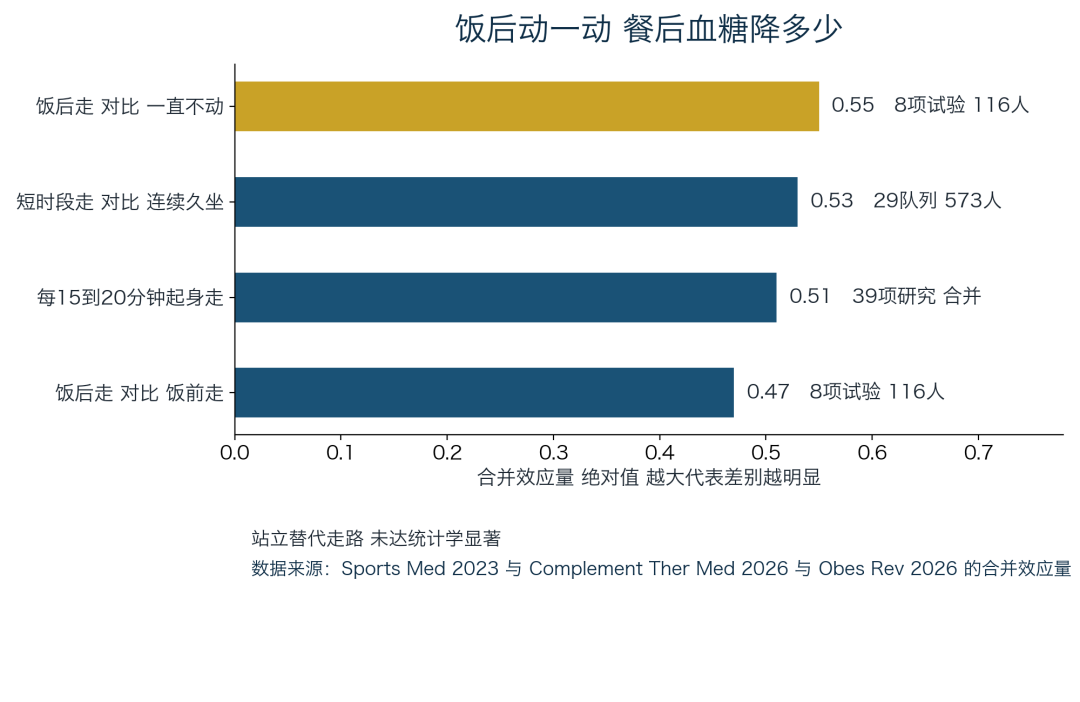
A meta-analysis pooling 8 randomized crossover trials with 116 participants (47 of whom had been diagnosed with type 2 diabetes) found that when exercise was performed after a meal, compared with a completely inactive control condition, the pooled effect size for postprandial glycemic variability was 0.55, 95% confidence interval 0.34 to 0.75 [1].
Another 2026 analysis was even closer to daily life: comparing short walking bouts of no more than 10 minutes each with uninterrupted sedentary behavior, pooling 29 cohorts and 573 adults, the pooled effect size for postprandial glucose area under the curve was -0.53, confidence interval -0.71 to -0.34, and for insulin -0.58 [2].
In plain terms: for the same meal, if you stand up and take a walk afterward, the rise in blood sugar will be gentler, and your body will need less insulin.
Question 2: Walking before or after a meal—which works better?
Walking after a meal has a clearer effect.
In the same analysis above: post-meal exercise reduced postprandial blood sugar more than pre-meal exercise, with a pooled effect size of 0.47 for the comparison between the two; while pre-meal exercise versus complete inactivity showed no statistically significant difference, with the confidence interval crossing zero [1].
The study also found a pattern: the longer the interval between eating and exercising, the weaker the blood-sugar-lowering effect, with a p value of 0.001 for this trend [1]. If you want to improve postprandial hyperglycemia, moving soon after eating is better than delaying and moving later, or exercising before the meal instead.
So that old saying can be revised: it's not "take a hundred steps after a meal," but "walk right after a meal."
Question 3: How long should you walk—do you have to walk a full half hour at once?
Not necessarily—breaking it up is actually more worthwhile.
A 2026 meta-analysis pooling 39 studies found that breaking up sedentary time with activity produced a pooled effect size of -0.30 for postprandial glucose; among these, walking showed a more pronounced reduction, while simply standing to replace sitting did not reach statistical significance [2][3].
More critical is frequency. People who got up and moved every 15 to 20 minutes showed a prominent improvement in postprandial glucose, with a pooled effect size of -0.51; for obese populations it reached -0.52 [3]. Another analysis of obese adults pooling 17 trials and 261 participants likewise found that short activity bouts of no more than 3 minutes each, interrupting sitting at intervals of no more than 30 minutes, were more effective [4].
So "10 minutes" is not a hard target. Walking 10 minutes after a meal is great; walking 3 minutes is still better than not moving; what really hurts is sitting continuously for two or three hours without getting up.
Question 4: Does slow walking count—how fast do you need to go?
It counts. For this, getting up and walking matters more than how hard you walk.
In the exploratory subgroup of the above analysis, walking as a form of activity itself had a significant effect; while replacing sitting with standing without walking was not significant [2]. The researchers also ran a regression on exercise intensity (measured in daily metabolic equivalents) and observed no notable difference from intensity [4].
In other words, you don't need to put on athletic shoes and sprint after a meal. Shuffling around the neighborhood in slippers, pacing a few steps at home, or walking a couple of laps to take out the trash—all count. For middle-aged and older adults with bad knees, or people with a larger body weight, this low-intensity, short-duration, high-frequency approach to walking is easier to sustain long-term than forcing yourself to walk briskly.
Question 5: Who benefits more, and what should you watch out for?
Based on the available data, people who are overweight benefit more from "breaking up sedentary time" [3].
But two groups should be extra cautious.
First, people taking glucose-lowering medication (especially insulin or insulin secretagogues): post-meal exercise itself further lowers blood sugar, and combined with the medication's effects there is a risk of hypoglycemia. These individuals should check their blood sugar before post-meal exercise, carry some sugar with them, and it's safer to discuss exercise timing and intensity with their doctor.
Second, people who are prone to acid reflux or bloating after eating: brisk walking right after a meal may be uncomfortable, so they can start with a slow 5-minute walk and stop if something doesn't feel right.
One honest note: it's not a cure-all
A 2024 randomized controlled trial on gestational diabetes divided 40 pregnant women into two groups: one walked continuously for 30 minutes as usual, and the other walked 10 minutes after each of three meals, for about 7 weeks. The results showed no significant difference in postprandial glucose between the two groups—split walking was not better than continuous walking [5].
This is a reminder of two things: first, the benefits of post-meal walking are mainly seen in the acute indicator of single-meal postprandial glucose; second, total volume and sedentary duration matter equally—those 10 minutes after a meal alone cannot offset the cost of being glued to a chair all day.
Three things you can do today
First, change "sit down immediately after eating" to "walk 10 minutes after eating." Washing dishes, going downstairs, or circling the neighborhood all work—don't chase speed.
Second, if you really can't get away during the day, set an alarm to get up and move for 3 minutes every 45 to 60 minutes of sitting—go get water, walk a couple of laps, or climb one flight of stairs.
Third, take the stretch when you're most sedentary (usually watching TV after dinner) and walk while listening to something, making it effortless.

Blood sugar is rarely managed by one intense effort; it's built up more by those inconspicuous ten-minute stretches throughout the day.
If someone in your family lies on the sofa right after eating, you can forward this article to them; and consider saving it to use after tomorrow's meal.
If this was helpful to you, give it a like or a "reading" click, and feel free to leave a comment telling us what topics you'd like to see.
✦ ✦ ✦
Disclaimer: This article is for health education purposes only and is intended for informational reference; it does not constitute medical advice. If you have health concerns, please consult a professional physician. Those currently using glucose-lowering medication should consult their attending physician before adjusting their exercise regimen.
Conflict of interest statement: The content of this article is based on publicly published medical literature; the author has no conflict of interest with any institution mentioned in the text, and no drug or product recommendations are involved.
© 2026 Sun Saint Hua (Beijing) Medical Technology Co., Ltd.
References
-
Engeroff T, Groneberg DA, Wilke J. After Dinner Rest a While, After Supper Walk a Mile? A Systematic Review with Meta-analysis on the Acute Postprandial Glycemic Response to Exercise Before and After Meal Ingestion. Sports Med. 2023 Apr;53(4):849-869. PMID: 36715875
-
Gong J, Tan L, Wang Y, Yan J, Li Y. Effects of short-bout accumulated exercise on postprandial metabolism in adults: A systematic review and meta-analysis. Complement Ther Med. 2026 Oct;101:103416. PMID: 42586449
-
Gale JT, Martin H, Haszard JJ, Peddie MC. The Acute Effects of Interrupting Prolonged Sitting With Regular Activity Breaks on Postprandial Glucose and Insulin in Adults: A Systematic Review and Meta-Analysis. Obes Rev. 2026 Nov;27(11):e70152. PMID: 42070794
-
Chang Y, Wang H, Zhang X, Liu H. Acute effects of exercise snacks on postprandial glucose and insulin metabolism in adults with obesity: a systematic review and meta-analysis. Front Nutr. 2025 Nov 20;12:1708301. PMID: 41356824
-
Christie HE, Winter M, Meyer BJ, Francois ME. Diagnosis to Delivery: A Randomized Clinical Trial of Postmeal Walking in Women with Gestational Diabetes. Med Sci Sports Exerc. 2024 May 1;56(5):860-867. PMID: 38233988