Cycling to Work Cuts Mortality Risk by 41%—Why Does Walking Fall Short?
This article is for health education purposes only and is intended as general information; it does not constitute medical advice. If you have health concerns, please consult a qualified healthcare professional.
Most people spend both legs of their daily commute sitting down.
Driving, taking the subway, hailing a ride—an hour or more of sitting each way, every day.
But some people rack up their exercise quota right there on the road—simply by switching how they get to work.
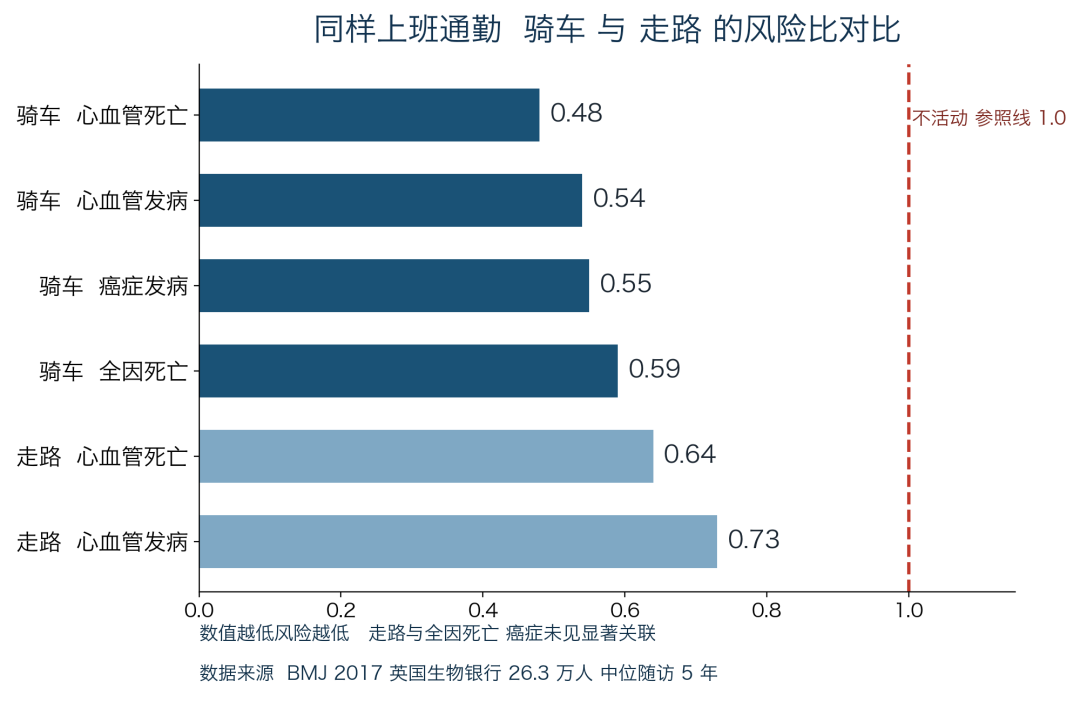
A study based on 263,000 commuters from UK Biobank, with a median follow-up of 5 years, grouped commuting modes into three categories: inactive (car or public transport), walking, and cycling[1].
Cyclists: 41% lower risk of all-cause mortality (hazard ratio 0.59), 52% lower cardiovascular mortality (0.48), 46% lower cardiovascular incidence (0.54), and 45% lower cancer incidence (0.55).
Walkers: 27% lower cardiovascular incidence (0.73) and 36% lower cardiovascular mortality (0.64); however, no significant differences were observed for all-cause mortality or cancer[1].
Both groups avoided sitting in a vehicle—so why such a big gap?
1. The Cycling Data Is Backed by More Than One Study
A pooled analysis of 9 publications, 17 prospective cohorts, and 479,000 participants found that people in the highest cycling-volume group had a 23% lower risk of all-cause mortality and 24% lower cardiovascular mortality compared with those who cycled less[2].
Even more practical is the dose: for every additional 5 MET-hours (roughly equivalent to an extra half hour or so of moderate-intensity cycling per week), all-cause mortality risk drops by another 9%—and the relationship is linear, with no obvious ceiling[2].
In a pooled analysis of 23 prospective studies covering 531,000 people, active commuters had an 8% lower risk of all-cause mortality, 9% lower cardiovascular incidence, and 30% lower diabetes risk; looking at cyclists alone, all-cause mortality was 24% lower and cancer mortality 25% lower[3].
2. Walking Didn't Lose—It Lost on Intensity
First, a correction: walking is absolutely beneficial. In the data above, walking also reduced cardiovascular incidence and cardiovascular mortality.
The problem is that walking pace varies enormously.
A pooled analysis of 11 population surveys in the UK covering 50,225 walkers found that compared with slow strolling, those walking at a moderate pace had a 20% lower risk of all-cause mortality, those walking briskly had a 24% lower risk, and cardiovascular mortality was 21% lower[5].
Moreover, the benefits were concentrated in three groups: people over 50, those not meeting weekly exercise recommendations, and those who don't normally do vigorous activity—precisely the majority of office workers[5].
In plain terms: strolling leisurely to the subway station doesn't count. You need to actually get your breathing and heart rate up.
3. Switching Commute Mode Also Shows Up on the Scale
In UK Biobank, 5,861 commuters who had two measurements taken—with a median interval of 4.4 years—had their height and weight measured on-site both times.
People who initially drove and later switched to active commuting or public transport saw their BMI drop by an average of 0.30; conversely, those who switched from active commuting to driving saw their BMI rise by 0.32[4].
Looking at both directions together: change your commute mode once, and your weight trajectory changes direction. This difference isn't achieved through sheer willpower—it happens automatically every day.
4. How to Choose: Distance, Intensity, Safety
Distance check: Within 3 km, a brisk 30-minute walk gets you there; around 5 km, cycling takes about 20 minutes.
Dose check: A 15-minute one-way trip, 5 days a week round-trip, equals 150 minutes of moderate-intensity activity—right at the weekly exercise recommendation.
Mixed modes count too: In the study, people who cycled part of the route also had lower all-cause mortality risk (0.76)[1]. You don't have to go all-in at once—cycling to the subway station and then transferring works just fine.
Intensity check: Brisk walking should leave you slightly breathless—able to talk but not sing; cycling should visibly raise your heart rate—leisurely pedaling doesn't count.
Safety check: A helmet, bike lights, and reflective stickers are the bare minimum; on rainy, snowy, or icy days, or on poorly lit roads at night, switch to brisk walking or public transport—don't force the ride.

Three Things You Can Do Today
Check your one-way distance: Within 3 km, prioritize walking; within 5 km, prioritize cycling.
Try it for one trip tomorrow: You don't need to change your whole day—just change one leg of the commute.
Pick up the pace: Walk until slightly breathless; cycle until your heart rate rises.
The commute is time you're spending anyway. Change the mode, and it becomes free exercise.
If you found this helpful, give it a like or a "reading" mark, and feel free to leave a comment telling us what topics you'd like to see. We also suggest sharing it with family members who drive to work every day—they might just need this one reminder.
Disclaimer: This article is for health education purposes only and is intended as general information; it does not constitute medical advice. If you have health concerns, please consult a qualified healthcare professional.
Declaration of Interests: This article does not involve any drug or product recommendations and has no conflict of interest with the research institutions mentioned.
© 2026 Sunsheng Hua (Beijing) Medical Technology Co., Ltd.
References
[1] Celis-Morales CA, Lyall DM, Welsh P, et al. Association between active commuting and incident cardiovascular disease, cancer, and mortality: prospective cohort study. BMJ. 2017;357:j1456. PMID: 28424154
[2] Zhao Y, Hu F, Feng Y, et al. Association of Cycling with Risk of All-Cause and Cardiovascular Disease Mortality: A Systematic Review and Dose-Response Meta-analysis of Prospective Cohort Studies. Sports Med. 2021;51(7):1439-1448. PMID: 33774807
[3] Dinu M, Pagliai G, Macchi C, Sofi F. Active Commuting and Multiple Health Outcomes: A Systematic Review and Meta-Analysis. Sports Med. 2019;49(3):437-452. PMID: 30446905
[4] Flint E, Webb E, Cummins S. Change in commute mode and body-mass index: prospective, longitudinal evidence from UK Biobank. Lancet Public Health. 2016;1(2):e46-e55. PMID: 28299370
[5] Stamatakis E, Kelly P, Strain T, et al. Self-rated walking pace and all-cause, cardiovascular disease and cancer mortality: individual participant pooled analysis of 50 225 walkers from 11 population-based surveys in England and Scotland. Br J Sports Med. 2018;52(12):761-768. PMID: 29858463