Can Fish Oil Prevent Heart Attacks? 260,000 People Took It for Years, and the Answer Is a Bit Surprising
This article is for health education purposes only and is intended for informational reference; it does not constitute medical advice. If you have health concerns, please consult a professional doctor.
✦ ✦ ✦
That bottle of fish oil at home—many people started taking it the day their triglycerides came back high on a lab report.
Three to five years later, the numbers on the lipid panel have barely budged.
The problem isn't the bottle you bought—it's that the question of "what fish oil can actually deliver" has been framed backwards.
Let's start with the most substantial body of evidence. A 2020 Cochrane systematic review pooled 86 randomized controlled trials with 162,796 participants and intervention durations of 12 to 88 months: long-term supplementation with long-chain omega-3s showed an all-cause mortality risk ratio of 0.97 (95% CI 0.93 to 1.01, high-certainty evidence), cardiovascular events 0.96 (0.92 to 1.01, high certainty), stroke 1.02, and arrhythmia 0.99. Only cardiovascular death declined slightly, at 0.92 (0.86 to 0.99, moderate certainty) [1].
In other words, when you combine data from over a hundred thousand people, fish oil capsules produce almost no measurable change in "living a bit longer" or "having one fewer heart attack."
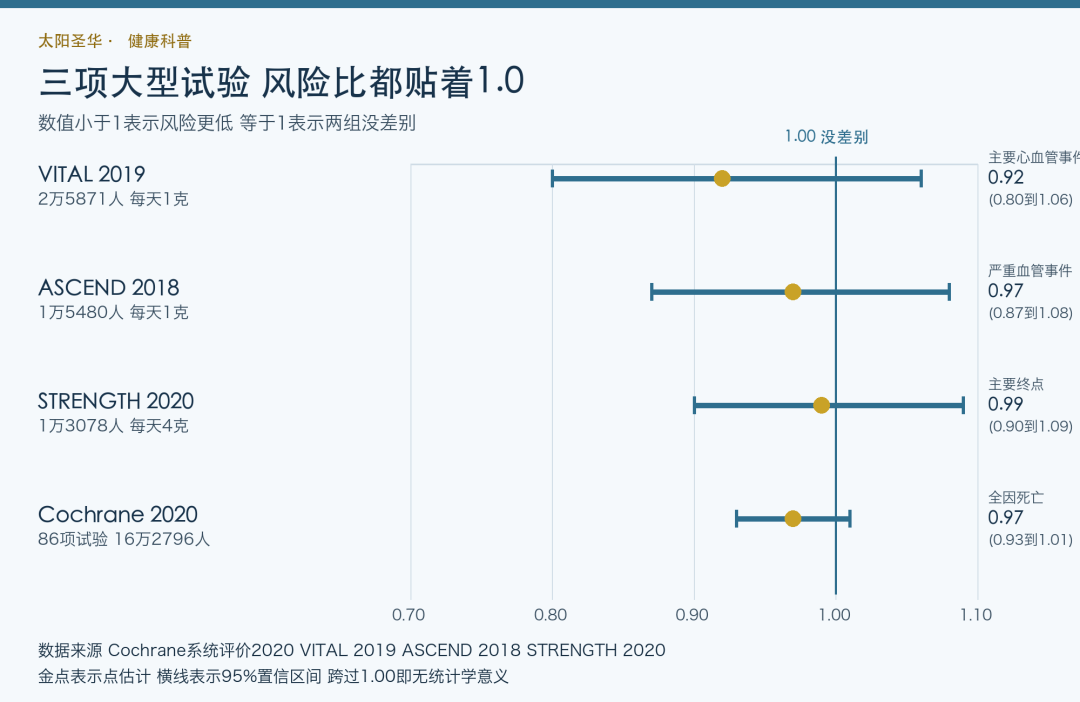
Figure caption: Across three large randomized trials and a systematic review of 86 trials, the risk ratios for the fish oil group versus the control group all hug the 1.0 line, meaning there is almost no difference between the two groups.
Question 1: Where does the claim of "lowering heart attack risk" come from?
The source is observational studies. People who eat more fish have fewer heart attacks, and this association holds across multiple cohorts. But people who eat more fish also tend to have higher incomes, smoke less, and exercise more—and these confounding factors are very hard to strip out.
Randomized controlled trials can strip them out. The 2019 VITAL trial published in the New England Journal of Medicine randomized 25,871 middle-aged and older adults with no history of cardiovascular disease to 1 gram of fish oil daily or placebo, with 5.3 years of follow-up: the risk ratio for major cardiovascular events was 0.92 (0.80 to 1.06, P=0.24), which was not statistically significant; cardiovascular death was 0.96, stroke 1.04, and all-cause death 1.02 [2].
What stands out in the figure is total myocardial infarction at 0.72 (0.59 to 0.90)—but this was a secondary endpoint with few events, where random fluctuation has a large impact, and the authors did not recommend fish oil for everyone on this basis.
Question 2: If I already have diabetes and count as high-risk, will it help?
Two trials specifically targeting high-risk populations also failed to deliver good news.
The ASCEND trial enrolled 15,480 patients with diabetes and no atherosclerotic cardiovascular disease, giving 1 gram of fish oil daily with an average follow-up of 7.4 years: serious vascular events were 8.9% versus 9.2%, rate ratio 0.97 (0.87 to 1.08); all-cause death was 9.7% versus 10.2%, rate ratio 0.95 [3].
The STRENGTH trial was even more thorough: 13,078 people who were taking statins, had elevated triglycerides, and were at high cardiovascular risk received 4 grams of high-dose omega-3 daily, with a corn oil control group. The primary endpoint was 12.0% versus 12.2%, hazard ratio 0.99 (0.90 to 1.09), and the trial was terminated early because there was no plausible chance of benefit; gastrointestinal discomfort occurred in 24.7% of the fish oil group versus 14.7% of the control group [4].
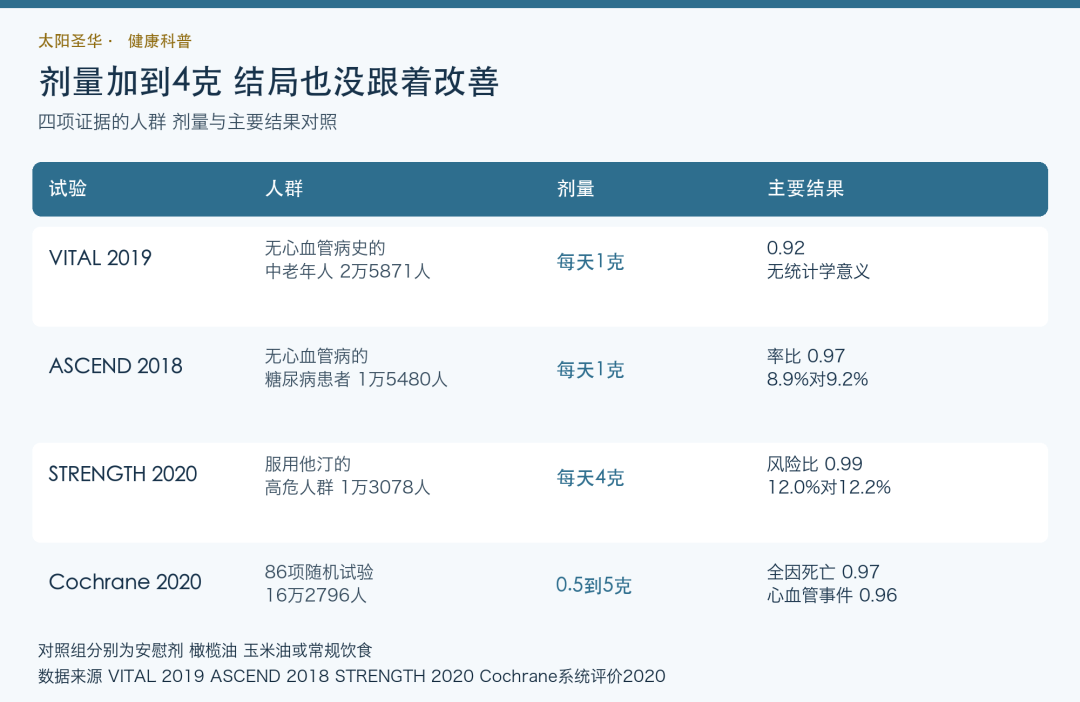
Figure caption: A comparison of doses and outcomes across three trials in high-risk or general populations—even when the dose increased from 1 gram to 4 grams, the risk ratios still hovered between 0.92 and 0.99.
Question 3: Surely it at least lowers triglycerides?
It does, but what matters is what exactly is being lowered.
High-dose omega-3 can indeed push triglycerides down—this is a relatively well-established pharmacological fact. But the STRENGTH outcomes show that even when the numbers look better, heart attacks, strokes, and cardiovascular death did not decrease accordingly. Improvement in surrogate markers does not equal improvement in outcomes—a very common gap in nutritional supplement research.
Two things need to be distinguished here: prescription-grade high-purity omega-3 formulations are a different category altogether—the eligible population, dosage, and monitoring are all determined by a doctor, and they are not the same as the health-supplement fish oil you buy off the shelf. You should not increase your dose to mimic them on your own.
Question 4: What about eating fish—does eating fish help?
Yes, and the evidence is more consistent than for capsules.
An analysis pooling 14 prospective cohorts with 911,348 people and 75,451 deaths showed that each additional 20 grams of fish per day was associated with a cardiovascular mortality risk ratio of 0.96 (0.94 to 0.98) and all-cause mortality of 0.98 (0.97 to 1.00); this association was significant only in Asian populations, while Western populations showed a U-shape, with lower risk at around 20 grams per day [5].
A 2026 meta-analysis that included only Japanese populations (16 cohorts initially screened, 9 included in the pooled analysis) showed that people who ate more fish had an all-cause mortality risk ratio of 0.94 (0.89 to 0.98) and cardiovascular mortality of 0.85 (0.80 to 0.91); the dose-response curve flattened after about 100 grams per day, with limited additional benefit beyond that; the certainty of evidence was rated as low [6].
Two points need to be made clear: these are still observational studies, and association does not equal causation; and the fish intake and cooking methods of the Japanese population differ from ours, so they cannot be directly copied.

Figure caption: Four practical ways to swap supplements for eating fish, starting with twice a week for a total of 300 to 500 grams.
Question 5: So what should I actually do?
Swapping "supplementing" for "eating" is the more practical takeaway from this article.
Eat fish twice a week for a total of 300 to 500 grams—this is the amount recommended by the Chinese Dietary Guidelines (2022). Prioritize fatty fish such as sea bass, pomfret, salmon, and sardines; steam or bake them, and avoid deep-frying.
If you are already taking statins or anticoagulants, ask your doctor before adding fish oil. High-dose omega-3 may increase the risk of bleeding, and it usually needs to be stopped before surgery.
Don't treat fish oil as a free pass to "eat whatever you want." It cannot replace a well-structured meal, nor can it replace twice-weekly strength training.
If your triglycerides are only mildly elevated, start with three months of lifestyle changes: lose 5% of your body weight, cut back on sugary drinks, and get 150 minutes of moderate-intensity exercise per week. The effects of these measures are far more solid in trials than those of capsules.
In one sentence: fish oil is not a scam—it's an overrated supplement; fish is a good thing—it's an underrated part of daily life.
Share this with that bottle of fish oil at home that's been taken for three years while the lipid panel hasn't changed.
If this was helpful to you, give it a like or a "reading" click, and feel free to leave a comment telling us what topics you'd like to see.
✦ ✦ ✦
Disclaimer: This article is for health education purposes only and is intended for informational reference; it does not constitute medical advice. If you have health concerns, please consult a professional doctor.
Conflict of interest statement: This article does not involve any product recommendations or commercial partnerships, and has no financial relationship with the research institutions mentioned in the text.
© 2026 Sun Shenghua (Beijing) Medical Technology Co., Ltd.
References
[1] Abdelhamid AS, Brown TJ, Brainard JS, et al. Omega-3 fatty acids for the primary and secondary prevention of cardiovascular disease. Cochrane Database Syst Rev. 2020;3(3):CD003177. PMID: 32114706
[2] Manson JE, Cook NR, Lee IM, et al. Marine n-3 Fatty Acids and Prevention of Cardiovascular Disease and Cancer. N Engl J Med. 2019;380(1):23-32. PMID: 30415637
[3] Bowman L, Mafham M, Wallendszus K, et al. Effects of n-3 Fatty Acid Supplements in Diabetes Mellitus. N Engl J Med. 2018;379(16):1540-1550. PMID: 30146932
[4] Nicholls SJ, Lincoff AM, Garcia M, et al. Effect of High-Dose Omega-3 Fatty Acids vs Corn Oil on Major Adverse Cardiovascular Events in Patients at High Cardiovascular Risk: The STRENGTH Randomized Clinical Trial. JAMA. 2020;324(22):2268-2280. PMID: 33190147
[5] Jayedi A, Shab-Bidar S. Fish consumption and risk of all-cause and cardiovascular mortality: a dose-response meta-analysis of prospective observational studies. Public Health Nutr. 2018;21(7):1297-1306. PMID: 29317009
[6] Yokoi K, et al. Fish intake and mortality in Japan, a high fish-consuming country: a systematic review and dose-response meta-analysis of cohort studies. Eur J Clin Nutr. 2026. PMID: 42918810